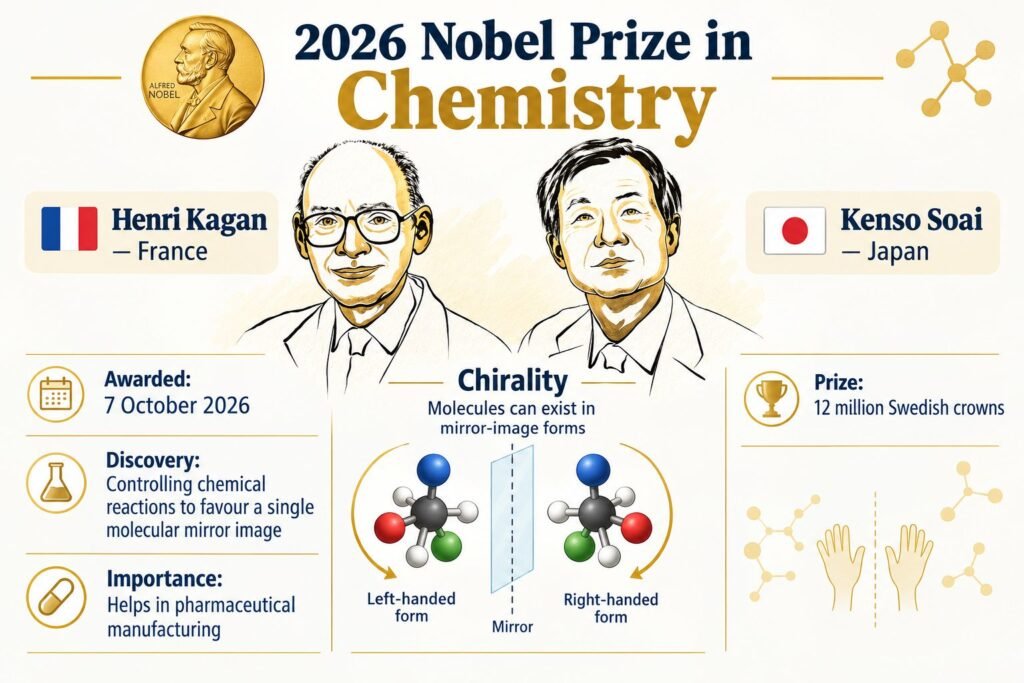
On 7 October 2026, Henri Kagan of France and Kenso Soai of Japan won the 2026 Nobel Prize in Chemistry for discoveries that showed how chemical reactions can be controlled to produce a single molecular mirror image.
- Many molecules exist in two mirror-image forms, like left and right hands. This property is called chirality.
- Living organisms generally use only one form, a phenomenon known as homochirality.
- Their work helped chemists develop reactions that favour one specific mirror-image form of a molecule.
- The discovery is especially important in pharmaceutical manufacturing, because one form of a drug may provide the desired therapeutic effect while the other can cause unwanted or harmful side effects.
- Kenso Soai is Japanese, while Henri Kagan is French.
- The laureates will receive their medals from King Carl XVI Gustaf of Sweden in Stockholm on 10 December 2026.
- They will share a prize of 12 million Swedish crowns (about $1.2 million).