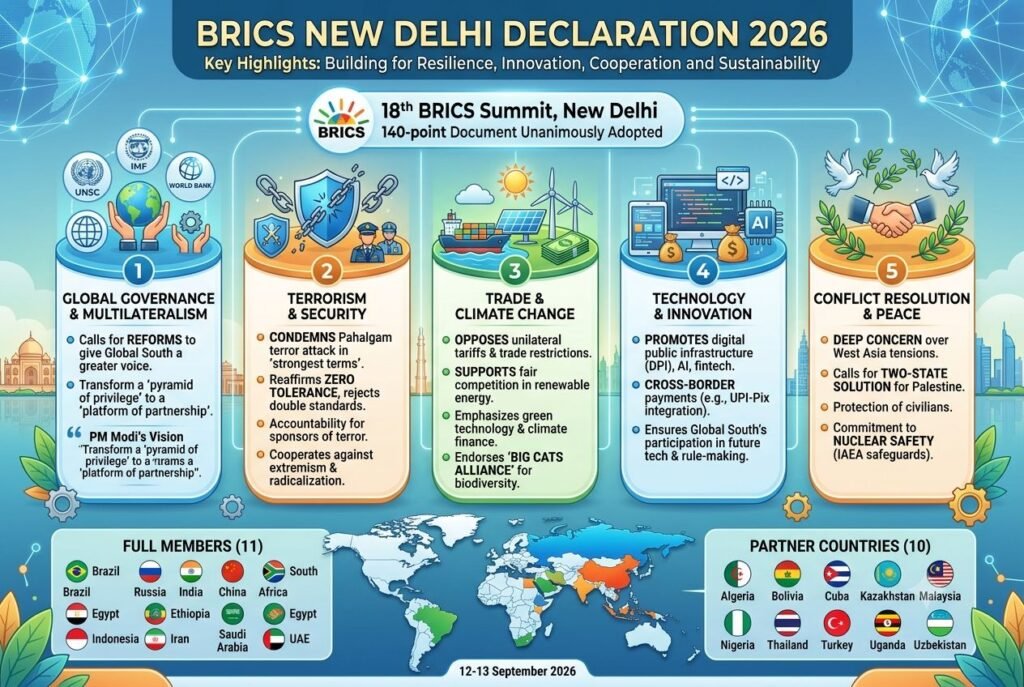
The BRICS New Delhi Declaration 2026 was unanimously adopted at the 18th BRICS Summit (12–13 September 2026) in New Delhi. It is a 140-point document titled “Building for Resilience, Innovation, Cooperation and Sustainability”, covering terrorism, global governance reforms, trade, climate change, technology, and conflict resolution.
📌 Key Highlights of the New Delhi Declaration 2026
1. Global Governance & Multilateralism
- Called for reforms in UNSC, IMF, and World Bank to give greater voice to the Global South.
- PM Modi described the current system as a “pyramid of privilege” that must become a “platform of partnership”.
2. Terrorism & Security
- Condemned the Pahalgam terror attack in the “strongest terms.”
- Reaffirmed zero tolerance for terrorism, rejected double standards, and emphasized accountability for sponsors of terror.
- Stressed cooperation against extremism and radicalization, especially among youth.
3. Conflicts & Peace
- Expressed deep concern over West Asia tensions and urged restraint.
- Called for a two-state solution for Palestine and protection of civilians in conflict zones.
4. Trade & Economy
- Opposed unilateral tariffs and trade restrictions.
- Supported fair competition in renewable energy markets and sustainable energy transitions.
5. Climate & Sustainability
- Emphasized renewable energy, green technology, and climate finance.
- Endorsed initiatives like the “Big Cats Alliance” for biodiversity protection.
6. Technology & Innovation
- Promoted digital public infrastructure, AI, fintech, and cross-border payment systems (UPI–Pix integration).
- Stressed equitable participation of the Global South in future technologies and rule-making.
7. Nuclear Safety
- Expressed concern over attacks on civilian nuclear facilities under IAEA safeguards.
- Reaffirmed commitment to nuclear safety and security during armed conflicts.
🌍 Membership Context
- Full Members (11): Brazil, Russia, India, China, South Africa, Egypt, Ethiopia, Indonesia, Iran, Saudi Arabia, UAE.
- Partner Countries (10): Belarus, Bolivia, Kazakhstan, Cuba, Malaysia, Nigeria, Thailand, Uganda, Uzbekistan, Vietnam.