On 27 October 2025, Argentine President Javier Milei led his party La Libertad Avanza to a landslide victory in the midterm elections. The party secured 41% of the vote, winning 13 of 24 Senate seats and 64 of 127 lower-house seats, a major gain from its earlier tally of 7 Senate and 37 lower-house seats.
Milei celebrated the result as a rejection of Argentina’s past economic failures, following two years of his radical spending cuts and free-market reforms.
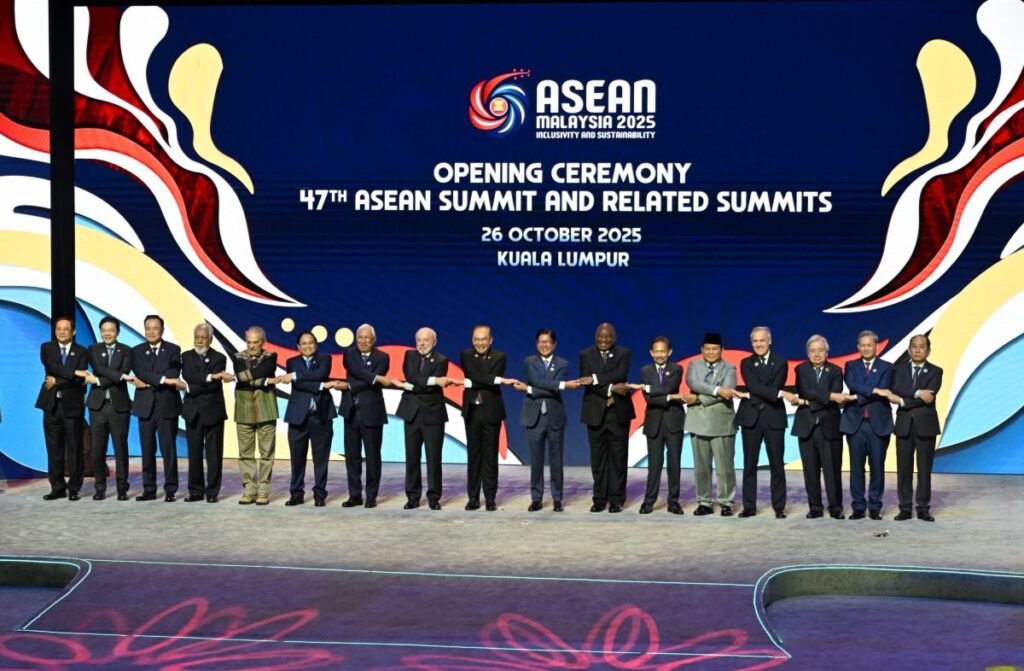
The 47th ASEAN Summit 2025, held in Kuala Lumpur under the theme “Inclusivity and Sustainability”, marked a historic expansion as East Timor (Timor-Leste) became ASEAN’s 11th member. Hosted by Malaysian Prime Minister Anwar Ibrahim, the summit gathered leaders from ASEAN nations along with major partners including the US, China, Japan, South Korea, Australia, and New Zealand.
Key discussions focused on regional stability, economic integration, climate action, and digital connectivity. Notably, US President Donald Trump attended in person, while Indian PM Narendra Modi joined virtually, reaffirming India’s commitment to the Act East Policy and maritime cooperation.
Major outcomes included progress in US-China trade dialogue, efforts toward a Thailand–Cambodia peace deal, and commitments to green growth, health security, and maritime safety. The summit also outlined ASEAN’s Vision 2045, emphasizing a resilient, sustainable, and people-centered regional community.
ASEAN Member Countries
As of 2025, the Association of Southeast Asian Nations (ASEAN) has 11 member countries, after the inclusion of East Timor (Timor-Leste).
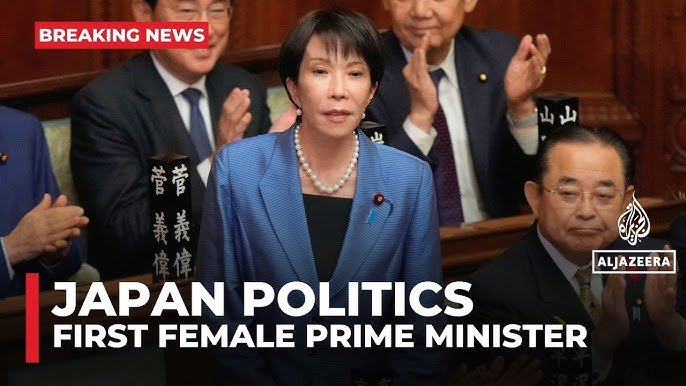
On 21 October 2025, Sanae Takaichi became Japan’s first female Prime Minister, elected by both Houses of Parliament with narrow majorities. A former TV anchor, Takaichi began her political career in 1993 and joined the Liberal Democratic Party (LDP) in 1996.
She has previously served in the Cabinet under Shinzo Abe, including as Economic Security Minister (2022–2024). The 64-year-old lawmaker from Nara Prefecture now faces major challenges such as slow economic growth, inflation, and yen depreciation.
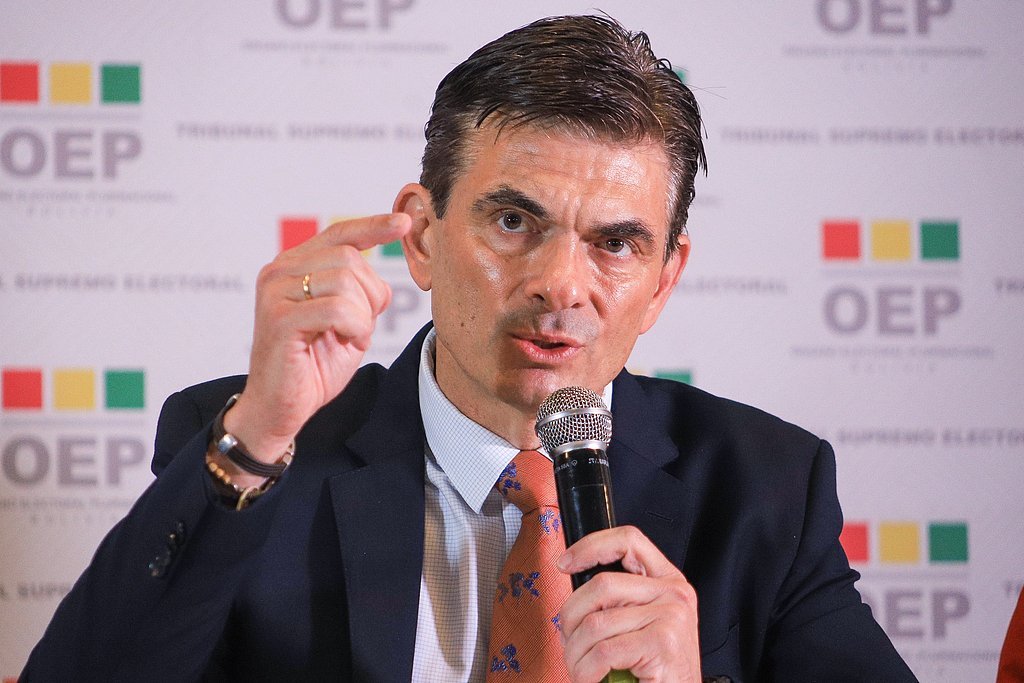
Rodrigo Paz, leader of the Christian Democratic Party (PDC), won Bolivia’s 2025 presidential election with 54.5% of the vote, defeating former interim President Jorge “Tuto” Quiroga (45.5%) in the October 19 runoff. He will assume office on November 8, 2025.
Paz’s victory marks the end of nearly two decades of socialist dominance by the Movement Toward Socialism (MAS), once led by Evo Morales. A 58-year-old economist educated in the U.S., Paz ran on a centrist and reform-oriented platform, pledging “capitalism for all”—balancing market reforms with social welfare.
Bolivia is currently facing a severe economic crisis with high inflation and fuel shortages, which fueled voter dissatisfaction. Paz now faces the challenge of governing without a legislative majority, requiring alliances to stabilize the economy, rebuild investor trust, and strengthen democracy.
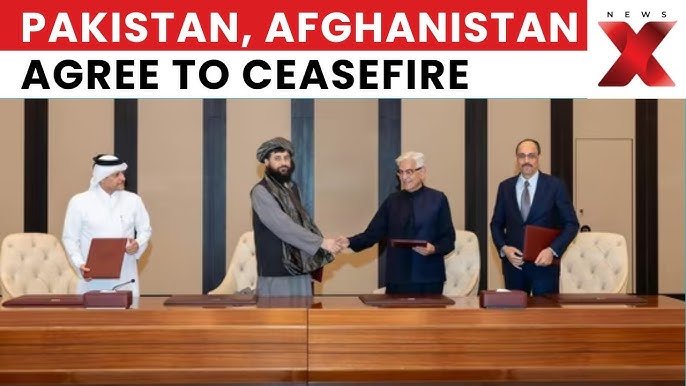
Afghanistan and Pakistan reached an immediate ceasefire on October 18, 2025, after a week of deadly border clashes that left dozens dead and hundreds injured. The truce was brokered in Doha with mediation by Qatar and Turkiye, marking a key step toward easing tensions along the 2,600 km border.
The agreement calls for:
Immediate end to hostilities
Monitoring mechanisms for compliance
Follow-up peace talks for lasting stability
The conflict began on October 11, 2025, when Pakistan launched airstrikes in Kabul and Paktika, blaming Afghan-based groups for cross-border attacks—claims denied by Afghanistan.
India Post announced that all international postal services to the U.S. will resume from October 15, 2025. The services were suspended since August 2025 due to new U.S. Customs (CBP) rules.
A new Delivery Duty Paid (DDP) system now allows customs duties to be collected in India before dispatch, ensuring smooth delivery in the U.S. without extra fees. A flat 50% customs duty applies on the declared value.
Postal rates remain unchanged, benefiting MSMEs, artisans, and small exporters. Services like EMS, Air Parcels, Registered and Tracked Packets to the U.S. can now be booked at Post Offices, IBCs, DNKs, or indiapost.gov.in.
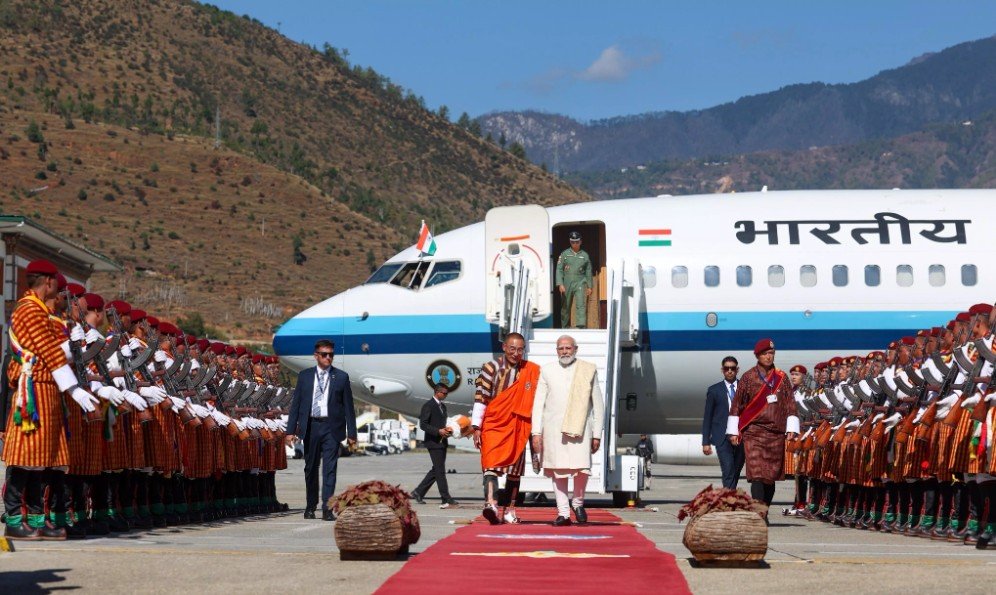
Mongolian President Khurelsukh Ukhnaa is on a four-day state visit to India (October 13–16, 2025) — his first as Head of State — marking the 70th anniversary of India-Mongolia diplomatic ties.
The visit highlights the growing strategic partnership between the two democracies, focusing on energy, mining, defense, education, and cultural cooperation. High-level talks with Prime Minister Narendra Modi and President Droupadi Murmu aim to strengthen bilateral relations through new MoUs and discussions on regional security and connectivity.
The visit also underscores the “Third Neighbor” policy of Mongolia and India’s engagement with Central Asia, reinforcing shared values of democracy, peace, and development.
The Indian Army will host the United Nations Troop Contributing Countries (UNTCC) Chiefs’ Conclave in New Delhi from 14–16 October 2025, bringing together senior military leaders from 32 nations engaged in UN peacekeeping operations.
The conclave will provide a platform to discuss operational challenges, interoperability, inclusivity, evolving threats, and the role of technology and training in strengthening global peacekeeping. As one of the largest contributors to UN missions, India aims to promote cooperation, knowledge-sharing, and a shared vision for future UN peacekeeping strategies.
Participating nations include Australia, Bangladesh, France, Nepal, Nigeria, Sri Lanka, Vietnam, and several others from Asia, Africa, Europe, and South America. The conclave reaffirms India’s commitment to global peace, stability, and cooperation.
Afghan Foreign Minister Mawlawi Amir Khan Muttaqi visited India from 9 to 16 October 2025, marking the first Taliban ministerial visit to India since 2021. His week-long trip included stops in New Delhi, Deoband, and Agra, symbolizing a blend of diplomatic, religious, and cultural outreach.
Muttaqi held talks with External Affairs Minister S. Jaishankar and NSA Ajit Doval on regional security, counterterrorism, and humanitarian cooperation. His visit to Darul Uloom Deoband represented a gesture of religious solidarity, while his tour of the Taj Mahal in Agra served as an act of cultural diplomacy.
India will upgrade its Technical Mission in Kabul to a full Embassy, signaling full diplomatic re-engagement with Afghanistan. Announcing this on 10 October 2025, External Affairs Minister S. Jaishankar reaffirmed India’s support for Afghanistan’s sovereignty, stability, and development.
India pledged continued development aid, including 20 ambulances, medical equipment, vaccines, food supplies, and help in rebuilding earthquake-hit and refugee housing. Six new projects will also be launched.
Jaishankar said India will resume work on infrastructure, water management, and mining cooperation, and expand educational and sports exchanges, especially in cricket. He also stressed joint efforts against cross-border terrorism.
Afghan Foreign Minister Amir Khan Muttaqi is visiting India after the UN temporarily lifted his travel ban to allow diplomatic talks.
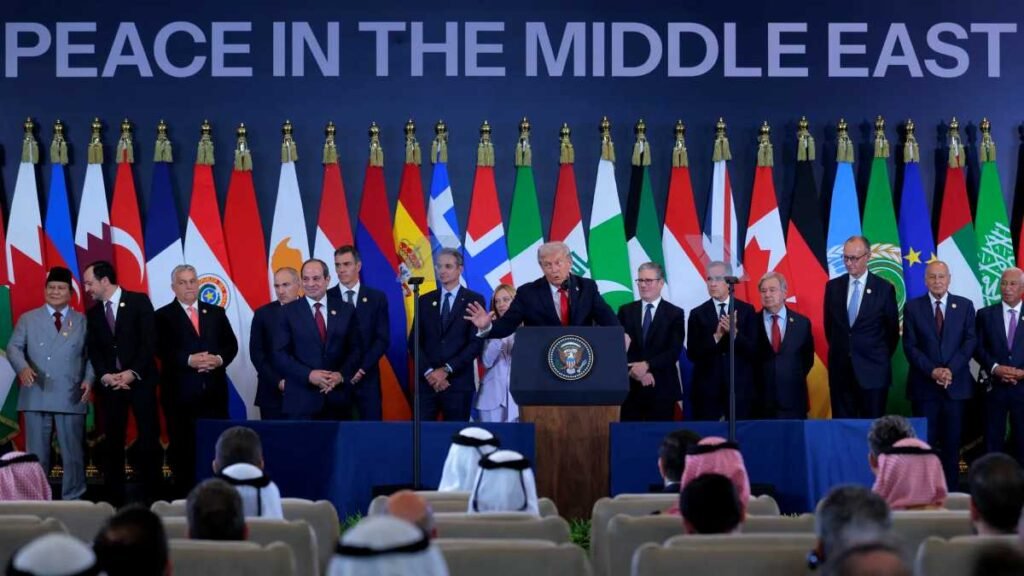
On 9 October 2025, Israel and Hamas signed the first phase of a landmark peace agreement aimed at ending a two-year war that has devastated Gaza and strained regional stability. The deal, brokered by Egypt, Qatar, Turkey, and the United States, includes:
Release of 20 Israeli hostages in exchange for nearly 2,000 Palestinian prisoners
Israeli troop withdrawal to a designated line within Gaza
Humanitarian aid: 400 trucks per day allowed into Gaza for the first five days
Framework for future negotiations on governance, disarmament, and reconstruction
The agreement was signed in Sharm el-Sheikh, Egypt, and hailed by leaders as a breakthrough. While critical issues remain unresolved, the deal marks a hopeful step toward lasting peace in the region.
From October 8–9, 2025, UK Prime Minister Keir Starmer made his first official visit to India, marking a significant step forward in India–UK bilateral relations. The visit, hosted by Prime Minister Narendra Modi, focused on strengthening the Comprehensive Strategic Partnership under the Vision 2035 Roadmap, covering areas such as trade, defence, climate, energy, education, and innovation.
Starmer led the UK’s largest-ever trade delegation of over 100 leaders, promoting the India–UK Comprehensive Economic and Trade Agreement (CETA), which aims to remove tariffs on 90% of goods and boost trade by £25.5 billion annually. Both leaders also launched the Technology Security Initiative (TSI) to collaborate on AI, quantum computing, biotech, and critical minerals.
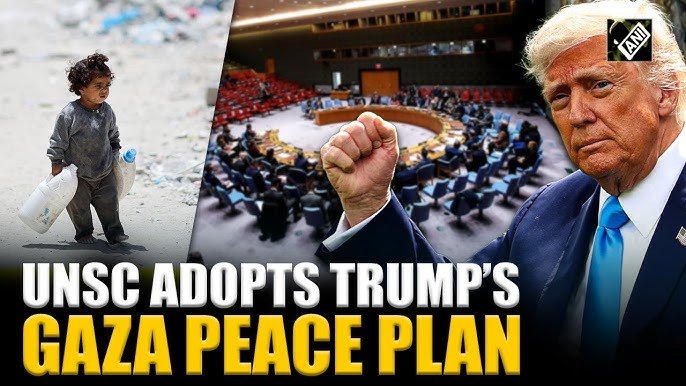
The US Peace Plan for Gaza, proposed by President Donald Trump in September 2025, aims to end the Israel-Hamas conflict through a 20-point framework.
Key provisions include an immediate ceasefire, hostage exchange, Gaza’s demilitarization, and governance by a technocratic Palestinian committee under international oversight.
Hamas is excluded from future rule, and reconstruction—estimated at $200 billion—will involve global partners like India. An international peacekeeping force will ensure security. Hamas has 3–4 days to accept; rejection may trigger full US support for Israeli military action.
On 21 September 2025, the United Kingdom, Canada, and Australia formally recognized the State of Palestine, marking a historic diplomatic shift. Canada became the first G7 nation to do so, followed by the UK and Australia.
Leaders emphasized the move as a step toward reviving hope for a two-state solution, strengthening peaceful Palestinian leadership, and promoting stability in the Middle East. France, Belgium, and other nations are also expected to follow during the upcoming UN General Assembly.
On September 20, 2025, U.S. President Donald Trump signed a proclamation introducing a $100,000 fee for new H-1B visa petitions filed from outside the United States.
Key Points
Effective from: September 21, 2025, 12:01 AM EDT.
Applies to: Only new H-1B petitions from outside the U.S.
Exemptions: Existing holders, renewals, and cases deemed in national interest.
Rationale: To curb system abuse and attract only “extraordinary talent.”
Impact
Employers: Sharp rise in costs → shift toward local hiring.
Workers: Entry barrier for junior/mid-level professionals; travel concerns for dependents.
Indian IT firms: Nasscom warns of disruption; firms may accelerate local recruitment.
Historic Appointment: Former Chief Justice Sushila Karki was sworn in as Nepal’s interim Prime Minister on 12 Sept 2025, becoming the first woman to hold the post. President Ramchandra Paudel administered the oath at Sheetal Niwas, Kathmandu.
She replaces KP Sharma Oli, who resigned amid Gen Z-led protests against corruption and poor governance. Karki was chosen through a youth-driven online vote on Discord, gaining support from both activists and political parties.
On 9 Sept 2025, Nepal Prime Minister KP Sharma Oli resigned after violent Gen Z–led protests over the government’s social media ban. Demonstrators stormed his office, set his Balkot residence on fire, and attacked the homes of several leaders, including ministers Prithvi Subba Gurung and Bishnu Paudel.
Despite curfews in Kathmandu Valley and other districts, youths continued protests by burning tyres, blocking roads, and clashing with police. Violence also spread to Rautahat district, where protesters torched a police vehicle. Authorities restricted movement but allowed essential services during the unrest.
On 8 Sept 2025, the Nepal government withdrew its decision to ban 26 social media platforms, including Facebook and X, after massive youth-led protests turned violent, leaving at least 19 people dead and over 300 injured. Minister for Communication and Information Prithvi Subba Gurung announced the rollback after an emergency Cabinet meeting, saying agencies had been ordered to resume social media services as demanded by ‘Gen Z’ protesters in Kathmandu. The demonstrations had escalated after some protesters stormed the Parliament complex, forcing police to use water cannons, tear gas, and even live rounds.
Prime Minister KP Sharma Oli promised an investigation into the deadly crackdown, announcing relief for victims’ families and free treatment for the injured. Curfews had earlier been imposed in several major cities to contain unrest. Meanwhile, Home Minister Ramesh Lekhak resigned on moral grounds amid widespread criticism over the handling of what is being called one of Nepal’s deadliest protests in recent years.
Japanese Prime Minister Shigeru Ishiba, 68, announced his resignation after just 11 months in office, citing responsibility for the Liberal Democratic Party’s (LDP) electoral defeats.
The resignation follows the LDP-Komeito coalition’s loss of majority in Upper House elections. An emergency LDP leadership contest will now take place, with contenders including Sanae Takaichi (a critic of BoJ’s rate hikes) and Shinjiro Koizumi (Farm Minister and rising political figure).
Singapore’s Prime Minister Lawrence Wong paid a three-day official visit to India (September 2–4, 2025), marking his first trip as PM and celebrating 60 years of India–Singapore diplomatic relations.
He held talks with PM Narendra Modi, President Droupadi Murmu, and key Indian ministers on strengthening cooperation in digital innovation, fintech, green energy, advanced manufacturing, skill development, healthcare, and education.
The 21st edition of the India–US Joint Military Exercise Yudh Abhyas 2025 is being held from 1–14 September 2025 at Fort Wainwright, Alaska. The Indian Army’s Madras Regiment is participating alongside the US 5th Infantry Regiment (Arctic Wolves Brigade, 11th Airborne Division).
Over two weeks, both sides will practice heliborne operations, mountain warfare, UAS/Counter-UAS tactics, artillery, aviation, and electronic warfare. Experts will also conduct sessions on information warfare, communications, and logistics. The exercise will conclude with joint tactical manoeuvres, live-fire drills, and high-altitude warfare training, focusing on UN peacekeeping operations and enhancing readiness for multi-domain challenges.
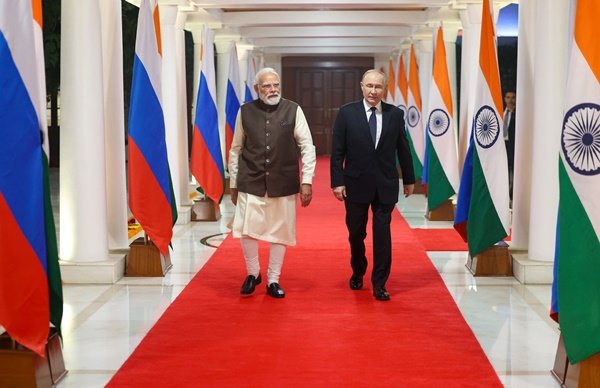
25th Shanghai Cooperation Organisation (SCO) Summit held in Tianjin from 31 Aug – 1 Sep 2025, the largest in history with leaders from 20+ countries and 10 international organizations.
🔹 Key Highlights
PM Narendra Modi attends; speaks at plenary session on India’s regional vision.
Modi–Xi Jinping talks: focus on border issues, trade, and connectivity.
Meeting with Vladimir Putin amid global tensions and trade disputes.
Main focus: regional security, economic frameworks, Global South’s voice.
China (rotating chair) hosted 100+ events before summit, driving reform & innovation.
Members
10 full members: China, Russia, India, Pakistan, Kazakhstan, Kyrgyzstan, Tajikistan, Uzbekistan, Iran (2023), Belarus (2024).
Also has observer states (e.g., Afghanistan, Mongolia) and dialogue partners (e.g., Turkey, Egypt, Saudi Arabia).
On 29 August 2025, India and Japan signed a Memorandum of Cooperation (MoC) to strengthen collaboration in the critical minerals and mining sector during PM Modi’s visit to Tokyo for the 15th India-Japan Annual Summit. The pact, signed between India’s Ministry of Mines and Japan’s METI, focuses on building resilient supply chains, joint mineral projects, sustainable deep-sea mining, stockpiling strategies, and investments in India and third countries.
PM Modi and Japanese PM Shigeru Ishiba also set a target of 10 trillion yen Japanese investment in India over 10 years, emphasizing cooperation in SMEs, start-ups, and eight pillars: investment, innovation, economic security, environment, technology, health, mobility, people-to-people exchanges, and state-prefecture ties. ISRO and JAXA to collaborate on Chandrayaan-5 under LUPEX programme.
India has appointed Dinesh K. Patnaik (IFS, 1990 batch), currently Ambassador to Spain, as the next High Commissioner to Canada.
Canada has named veteran diplomat Christopher Cooter as its new High Commissioner to India.
These appointments mark a step toward restoring diplomatic ties strained in October 2024 when India recalled High Commissioner Sanjay Kumar Verma after tensions with then-PM Justin Trudeau.
Relations began improving after Mark Carney became Canadian PM, leading to a positive Modi–Carney bilateral meeting at the G7 Outreach Summit (June 18, 2025).
Both sides agreed to reinstate High Commissioners as the first step in normalizing ties.
On 19 August 2025, India and China agreed to resume direct flight connectivity between the Chinese mainland and India and to finalise an updated Air Services Agreement.
The decision came after talks in New Delhi between Chinese Foreign Minister Wang Yi and External Affairs Minister Dr. S. Jaishankar.
Direct flights, suspended since the COVID-19 pandemic and earlier tensions after the Doklam standoff and 2020 Galwan Valley clash, will now be restored.
Chinese Foreign Minister Wang Yi’s visit to Indi from August 18–19, 2025. First visit by Wang Yi since Galwan Valley clashes (2020) and LAC disengagement (2024).
Meetings with EAM S. Jaishankar, NSA Ajit Doval, and PM Modi.
SR-level boundary talks (24th round) with Ajit Doval on LAC peace.
China pledged support in fertilisers, rare earths, and tunnel boring machines.
The high-stakes summit between Russian President Vladimir Putin and US President Donald Trump in Anchorage, Alaska lasted nearly three hours but ended without a deal on the Ukraine–Russia conflict.
Putin called the war a tragedy, stressed removing the primary causes, and suggested the next meeting in Moscow. He also claimed the conflict would not have happened if Trump were president in 2022.
Trump termed the talks “extremely productive”, saying many points were agreed but “no deal until there’s a deal.” He added he would consult NATO allies and Ukraine’s Zelensky.
Australian PM Anthony Albanese announced that Australia will formally recognize the State of Palestine at the 80th UN General Assembly, joining nations like France, Britain, and Canada in supporting a two-state solution. Nearly 150 UN member states already recognize Palestine.
The move comes amid public pressure and the humanitarian crisis in Gaza. Recognition is conditional on no Hamas role, Gaza demilitarization, and holding general elections. Albanese said the step is a practical contribution toward peace, coordinated with leaders from Britain, France, New Zealand, and Japan.
🔔
Stay Updated!
Get latest updates, jobs, results & quizzes directly on your device.