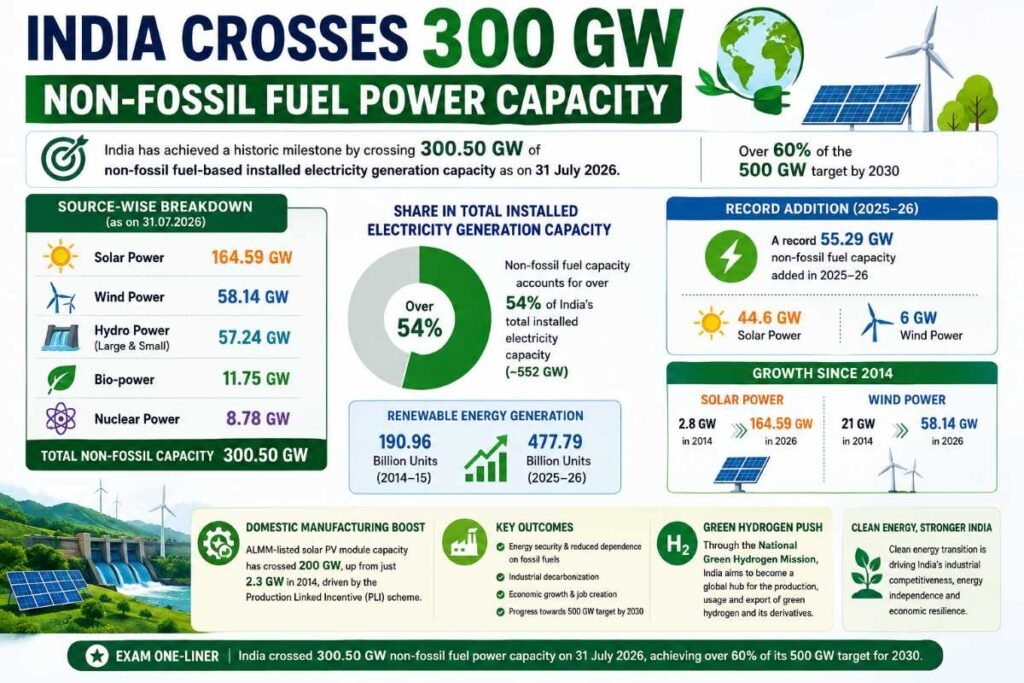
India has crossed a historic milestone of 300.50 GW of installed non-fossil fuel-based electricity generation capacity as of 31 July 2026, achieving over 60% of its target of 500 GW by 2030. Non-fossil sources now account for over 54% of India’s total installed power capacity.
Source-wise capacity:
- ☀️ Solar: 164.59 GW
- 🌬️ Wind: 58.14 GW
- 💧 Hydro: 57.24 GW
- 🌱 Bio-power: 11.75 GW
- ⚛️ Nuclear: 8.78 GW
- Total: 300.50 GW
During 2025–26, India added a record 55.29 GW of non-fossil capacity, including 44.6 GW solar and 6 GW wind. Renewable electricity generation increased from 190.96 billion units in 2014–15 to 477.79 billion units in 2025–26.
✅ One-Liner Quick Revision and Extra Facts
- India crosses 300 GW non-fossil fuel capacity on 31 July 2026,.
- Target: 500 GW by 2030.
- India’s first solar park: Charanka Solar Park, Gujarat (2012).
- Largest solar project: Bhadla Solar Park, Rajasthan (2.25 GW).
- COP28 Commitment: India pledged net-zero emissions by 2070.
- Hydrogen Train Pilot: Jind–Sonipat section in Haryana (2026).