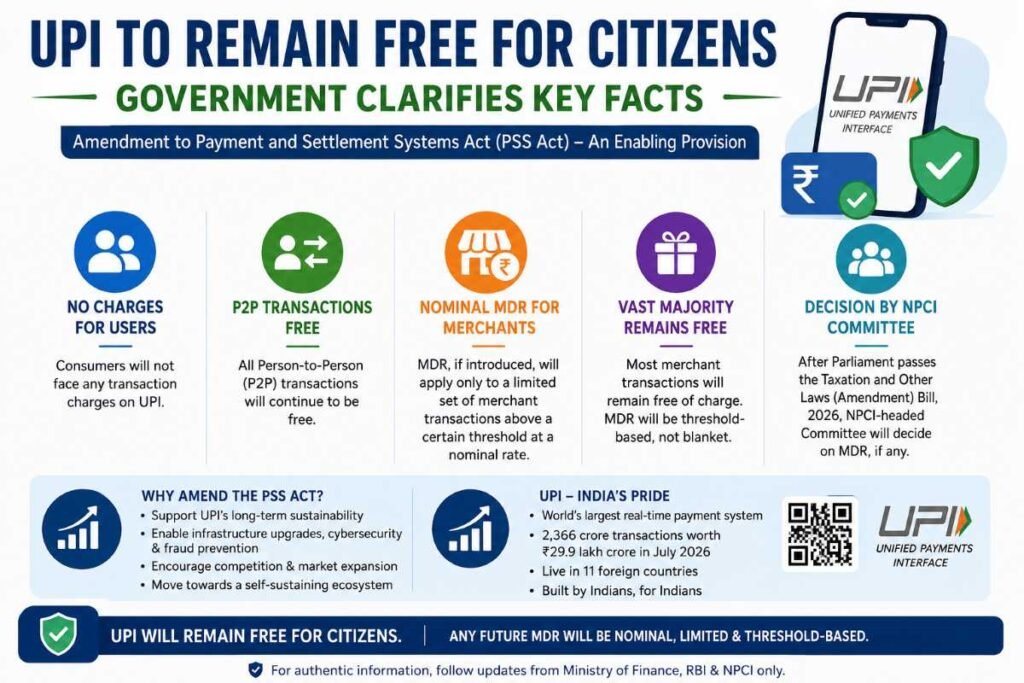
The Government of India has clarified that UPI payments will remain free for citizens. The recent amendment to the Payment and Settlement Systems (PSS) Act, 2007 is an enabling provision aimed at ensuring the long-term sustainability, technological advancement and resilience of India’s UPI ecosystem.
- No charges for users: Citizens will not have to pay transaction charges for UPI payments.
- P2P transactions remain free: Person-to-Person (P2P) UPI transactions will continue to be free.
- MDR for merchants: If introduced in future, Merchant Discount Rate (MDR) will apply only to a limited set of merchant transactions above a specified threshold and at a nominal rate.
- Most merchant transactions remain free: MDR will not be a blanket charge on all UPI merchant transactions.
- Decision on MDR: After Parliament passes the Taxation and Other Laws (Amendment) Bill, 2026, the UPI and Services Steering Committee headed by NPCI will decide whether MDR should be introduced.
- Reason for amendment: The measure aims to support UPI’s growing infrastructure, cybersecurity, fraud prevention, technological upgrades and financial sustainability.
- UPI growth: In July 2026, UPI processed 2,366 crore transactions worth ₹29.9 lakh crore.
- Global reach: UPI is now live in 11 foreign countries and has emerged as the world’s largest real-time payment system.
- UPI background: Developed by NPCI and launched in 2016, UPI enables instant interoperable payments through mobile numbers, VPA and QR codes.