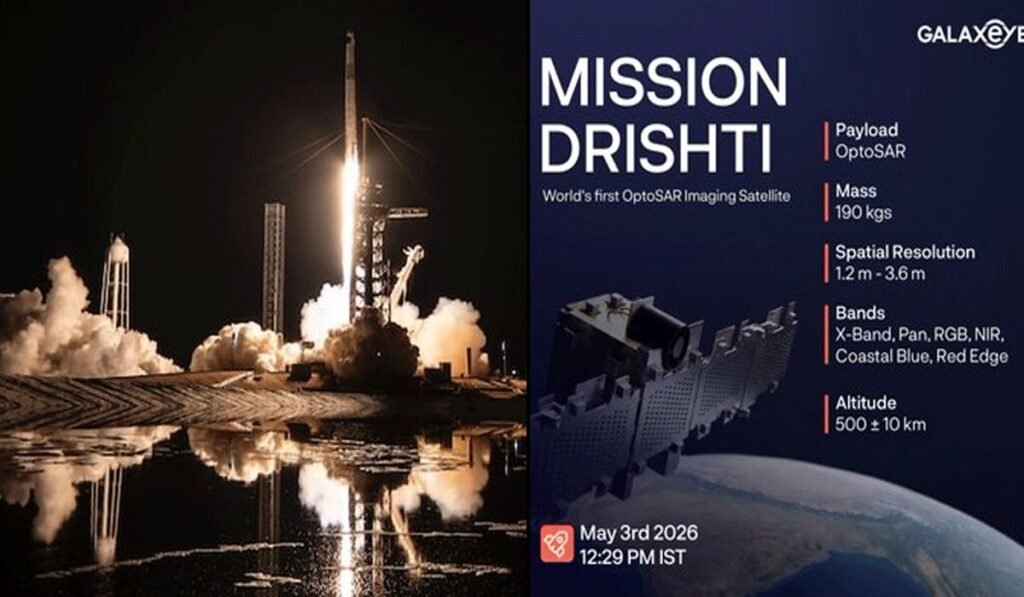
Indian space start-up GalaxEye has successfully launched Mission Drishti on 3 May 2026, placing the world’s first OptoSAR satellite into orbit aboard a SpaceX Falcon 9 rocket. This 190 kg satellite is India’s largest privately built Earth observation spacecraft, combining optical and radar sensors to deliver all-weather, day-and-night imagery.
🚀 Mission Drishti: Key Facts
- Launched on: 3 May 2026, 12:30 PM IST
- Launch Vehicle: SpaceX Falcon 9, from Vandenberg Space Force Base, California
- Developer: Bengaluru-based start-up GalaxEye Space Solutions, founded by IIT Madras alumni in 2021
- Satellite Mass: ~190 kg (India’s largest privately built EO satellite)
- Orbit: Sun-synchronous LEO at ~500 km altitude
- Technology: Proprietary OptoSAR (Optical + Synthetic Aperture Radar) fusion
- Resolution: 1.2–3.6 metres (combined SAR + optical)
- Processing: Onboard AI with NVIDIA Jetson Orin chip for real-time analysis
- Special Feature: Deployable 3.5 m radar antenna + electric propulsion system
🌐 What is OptoSAR Technology?
- Optical Imaging: Provides clear, photo-like images but fails in cloudy or dark conditions.
- SAR Imaging: Works day/night and through clouds, but produces coarse, harder-to-interpret data.
- OptoSAR Fusion: Drishti combines both sensors on a single platform, capturing data simultaneously and fusing it in real time.
- Advantage: Delivers three times more information than traditional satellites, ensuring sharper, analysis-ready datasets.