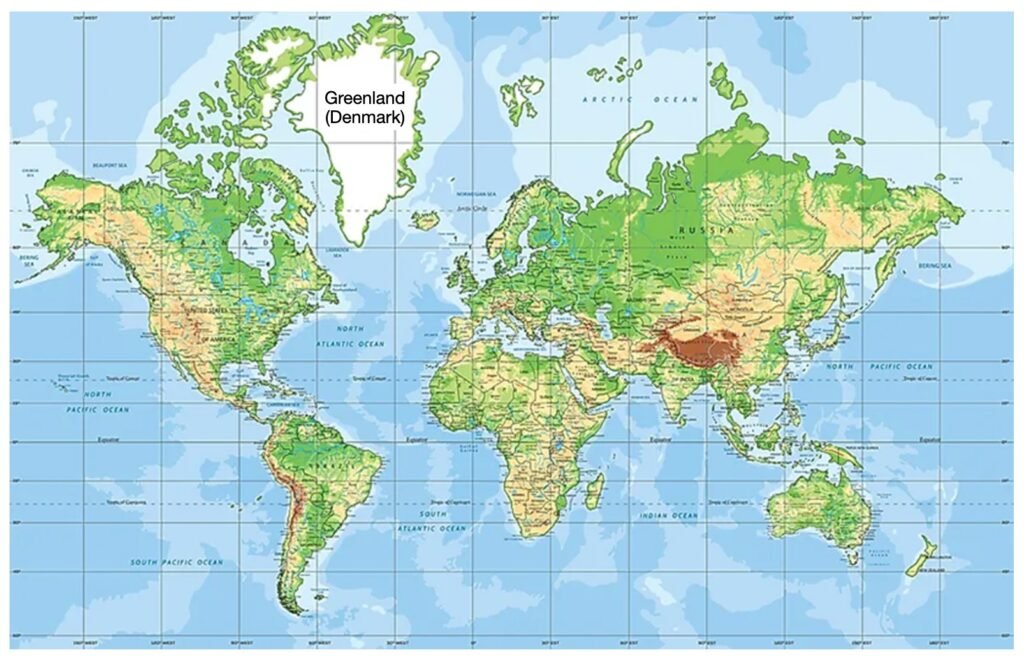
Greenland, the world’s largest island, is a self-governing territory under the Kingdom of Denmark and has become strategically important due to its Arctic location, mineral resources, and geopolitical relevance. Positioned near newly emerging Arctic shipping routes, it has attracted interest from the US, Russia, and China. The island hosts important Western military installations, including the US Thule Air Base, making it crucial for NATO’s Arctic defense strategy.
Greenland debates greater autonomy and potential independence, but continues to rely heavily on Danish financial subsidies, despite efforts to build economic self-sufficiency through sectors like rare earth mineral extraction, which could reduce global dependence on China. The island is also central to climate research, as the Greenland Ice Sheet, covering about 80% of its surface, is melting rapidly; a full melt would raise global sea levels by roughly 7 meters.
Geographically, Greenland spans 2.16 million sq km, lies largely within the Arctic Circle, and has a polar climate. Its population of roughly 56,500—primarily Inuit—lives along coastal ice-free zones, with Nuuk serving as the capital. Historically, Greenland was settled by Inuit peoples, later colonized by Norse Vikings, and became a Danish colony in the 18th century. Denmark granted Home Rule in 1979 and Self-Government in 2009, allowing Greenland control over domestic affairs while Denmark oversees defense and foreign policy. The independence movement continues, but economic challenges remain a key constraint.
Q. Greenland is a self-governing territory under the sovereignty of which country?
A) Norway
B) Denmark
C) Iceland
D) Canada
Answer: B) Denmark
Greenland, the world’s largest island, is a self-governing territory under the Kingdom of Denmark and has become strategically important due to its Arctic location, mineral resources, and geopolitical relevance.