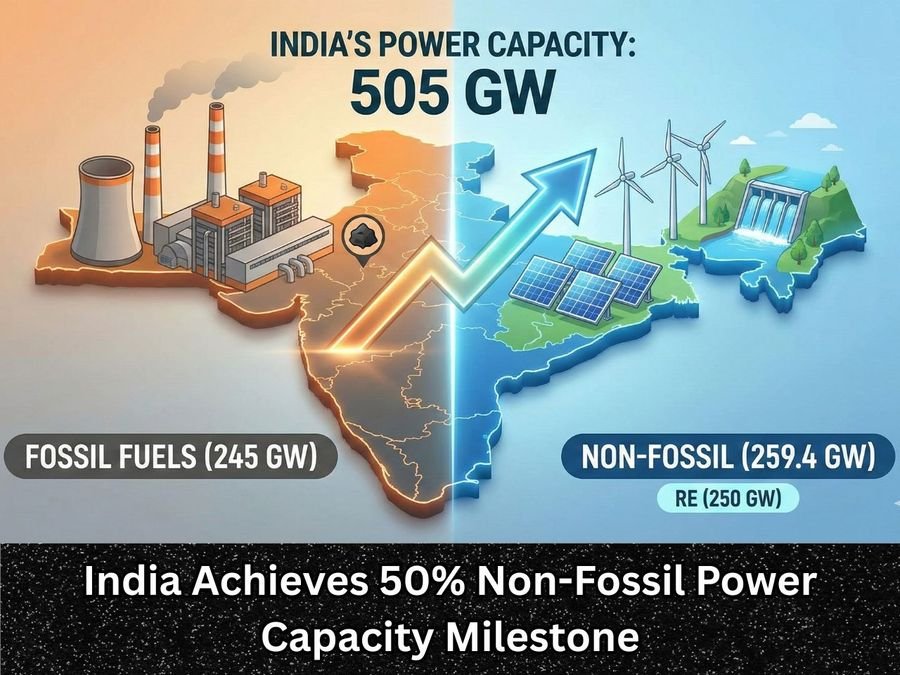
India has achieved a major clean energy milestone by installing 50% of its total power capacity from non-fossil fuel sources, reaching its Panchamrit target five years ahead of the 2030 deadline. As per data tabled in the Lok Sabha on 8 December 2025, India’s total installed power capacity stood at 485 GW as of 30 June 2025, out of which 243 GW came from non-fossil sources. The Standing Committee on Energy praised the MNRE, Ministry of Power, and stakeholders for this progress.
India has already installed 116 GW of solar capacity and aims to reach 292 GW by 2030 as part of its larger 500 GW non-fossil power target. To achieve this, around 176 GW of new solar capacity must be added in the next five years. Currently, 128 GW is under implementation, while 62 GW is in the tendering stage.
However, the Committee highlighted key challenges such as land acquisition delays, grid connectivity issues, inadequate energy storage, and the need to strengthen domestic manufacturing. Land requirements are particularly critical, as 4–7 acres are needed per MW of solar power, and India may need 1.4–2 million hectares of land for long-term solar expansion. This could lead to conflicts with agriculture and ecologically sensitive areas. The Committee urged strict adherence to the planned energy transition roadmap to sustain progress.