|

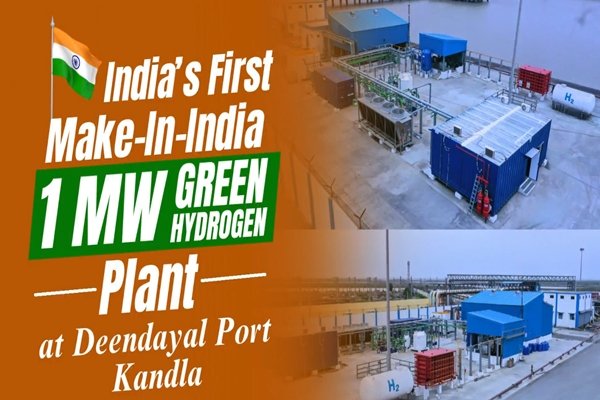
India’s First Make-in-India Green Hydrogen Plant Commissioned at Kandla Port

On 31 July 2025, India commissioned its first Make-in-India Green Hydrogen Plant at Deendayal Port Authority (DPA), Kandla, Gujarat. Developed by Larsen & Toubro (L&T), the 1 MW facility will produce 140 metric tonnes of green hydrogen annually.

This fully indigenous project aligns with the Maritime India Vision 2030 and supports India’s Net Zero emissions goal. It will power port operations like electric buses and street lighting, showcasing rapid execution (in just 4 months) and India’s push toward green port infrastructure.


Similar Posts

  • Indian Navy Inducts First Indigenous Diving Support Vessel ‘Nistar’

    On 8 July 2025, the Indian Navy inducted its first indigenously designed and built Diving Support Vessel (DSV), Nistar, at a ceremony in Visakhapatnam, officially handed over by Hindustan Shipyard Limited.

    Nistar, derived from Sanskrit meaning liberation or rescue, is a highly specialized warship built to perform deep sea diving and submarine rescue operations—a capability only a few navies in the world possess.

    • The vessel is 118 meters long, with a displacement of 10,000 tons.
    • It can conduct saturation diving up to 300 meters and side diving operations up to 75 meters.
    • Acts as a “Mother Ship” for Deep Submergence Rescue Vessel (DSRV), crucial for submarine emergencies.
    • Equipped with advanced ROVs (Remotely Operated Vehicles) for operations up to 1000 meters deep.

    With about 75% indigenous content, Nistar represents a major step forward in India’s self-reliance in defence manufacturing and boosts the Navy’s deep sea operational capabilities.

  • PM Modi in Washington DC for bilateral talks with US President

    Prime Minister Narendra Modi arrived in Washington DC on February 12, 2025, for a crucial two-day visit. His visit aims to strengthen India-US ties and hold key discussions with President Donald Trump on trade, immigration, and defense. Modi was warmly welcomed by members of the Indian-American community at Blair House, the US presidential guest house.

    The visit comes amid concerns over the US’s “America First” trade policy and its immigration stance. Modi’s discussions with Trump are expected to address these issues and explore ways to enhance cooperation in sectors like trade, investment, energy, technology, and defense.

  • PMO Renamed and Shifted to New ‘Sewa Tirth’ Complex Under Central Vista Project

    India’s Prime Minister’s Office (PMO) is being relocated from the historic South Block to a newly built complex named Sewa Tirth, marking a symbolic shift in governance from “power” (satta) to “service” (seva).

    The move is part of the Central Vista Redevelopment Project.

    🏛 New Sewa Tirth Complex

    The new Executive Enclave will have three main blocks:

    • Sewa Tirth-1: Prime Minister’s Office
    • Sewa Tirth-2: Cabinet Secretariat
    • Sewa Tirth-3: Office of the National Security Advisor (NSA)

    Located near Vayu Bhawan, the complex features modern infrastructure, advanced security systems, and sustainable design.

    🌐 Meaning & Symbolism

    • Sewa Tirth” means a pilgrimage of service, emphasizing duty, humility, and citizen-centric governance.
    • Reflects a broader government effort to rename institutions—e.g., Raj Bhavan → Lok Bhavan, Raj Niwas → Lok Niwas.
  • Parliament Passes Coastal Shipping Bill, 2025 to Boost India’s Maritime Economy

    The Coastal Shipping Bill, 2025 was passed by the Rajya Sabha on 7 August 2025, after clearance from the Lok Sabha on April 3, 2025.

    • The bill replaces Part XIV of the Merchant Shipping Act, 1958 with a modern legal framework aligned with global cabotage norms.
    • Union Minister Sarbananda Sonowal, who introduced the bill, stated it will help increase India’s coastal cargo share to 230 million metric tonnes by 2030.
    • Key Features:
      • Introduces a simplified licensing system for coastal shipping.
      • Provides a framework for regulating foreign vessels in coastal trade.
      • Mandates a National Coastal and Inland Shipping Strategic Plan to guide future policy and infrastructure.
      • Proposes a National Database for Coastal Shipping to support transparency and investment.
    • The bill aims to enhance supply-chain security, promote Indian vessel usage, reduce foreign dependence, and generate local employment.
    • With its passage, all three key maritime laws are now approved:
      1. Merchant Shipping Bill, 2025
      2. Carriage of Goods by Sea Bill, 2025
      3. Coastal Shipping Act, 2025
  • India and Indonesia Conduct 5th Edition of Naval Exercise ‘Samudra Shakti’ at Visakhapatnam

    The Indian Navy and the Indonesian Navy are conducting the 5th edition of the bilateral maritime exercise “Samudra Shakti” from October 14 to 17 at Visakhapatnam. The exercise aims to strengthen maritime cooperation and interoperability between the two navies.

    INS Kavaratti, an anti-submarine warfare corvette, and KRI John Lie, an Indonesian corvette with a helicopter, are participating. The event includes a harbour phase with professional exchanges, yoga, and sports, and a sea phase involving advanced naval drills like helicopter manoeuvres, air defence, weapon firing, and Visit, Board, Search and Seizure (VBSS) operations to boost tactical coordination and joint operational skills.

  • US Removes Sanctions on Major Indian Nuclear Facilities

    Sanctions lifted on Indian entities: The US has removed sanctions on three Indian entities—Bhabha Atomic Research Centre (BARC), Indian Rare Earths Ltd (IREL), and Indira Gandhi Centre for Atomic Research (IGCAR).

    Reason for lifting sanctions: The sanctions, imposed during the Cold War era, were lifted to enhance US foreign policy goals, support shared energy security needs, and strengthen joint efforts in science and technology between India and the US.

    Strengthened India-US collaboration: Recent years have seen increased cooperation in peaceful nuclear activities and related research, benefiting global partner countries.

    US action against Chinese companies: The US added 11 Chinese companies to the Entity List for activities deemed contrary to US national security and foreign policy interests.

    About the Entity List: It is a US government compilation of foreign individuals, companies, and organizations considered a national security concern.