|

First Freight Train Reaches Kashmir Valley – Boost to Connectivity & Commerce

On 9 August 2025, the first-ever freight train arrived at the Anantnag Goods Shed, integrating the Kashmir Valley with India’s national freight network. Originating from Rupnagar, Punjab, it carried 21 BCN wagons of cement for infrastructure projects, covering ~600 km in under 18 hours via a WAG-9 electric locomotive.

Part of the Udhampur–Srinagar–Baramulla Rail Link (USBRL) project, this milestone promises lower transport costs, better market access for Kashmir’s produce, and year-round connectivity despite winter highway closures.

Similar Posts

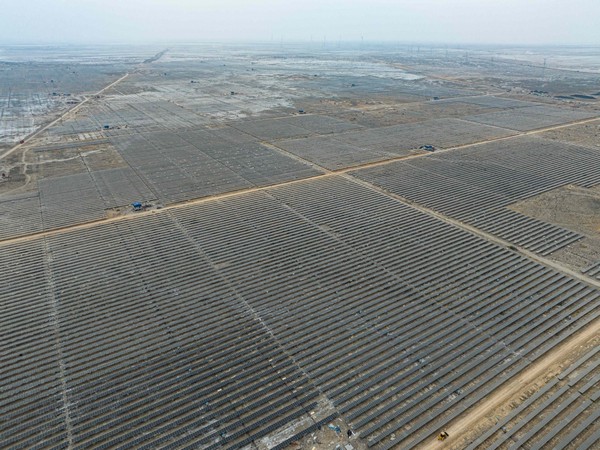
  • India Achieves Record 25 GW Renewable Energy Addition

    India’s renewable energy sector recorded its highest-ever capacity addition of 25 gigawatts (GW) in the 2024-2025 financial year, marking a 35% increase from the 18.57 GW installed in 2023-24. Solar energy led the growth, rising from 15 GW to nearly 21 GW, a 38% increase.

    New and Renewable Energy Minister Pralhad Joshi announced initiatives to decarbonize transportation and households, including mandating bioCNG blending with compressed and piped natural gas. Solar PV cell manufacturing capacity tripled to 9 GW, and the PM KUSUM Scheme showed significant progress. The PM Surya Ghar Muft Bijli Yojana benefited 1.1 lakh households and generated 7 lakh jobs.

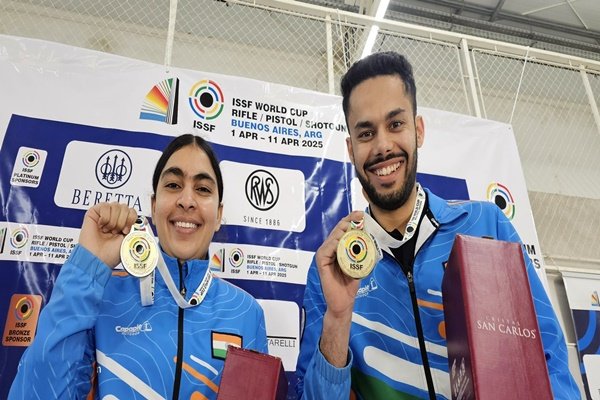
  • India Shines at ISSF World Cup 2025 as Suruchi Singh and Vijayveer Sidhu Strike Gold

    India continued its dominance in shooting at the ISSF World Cup 2025 in Buenos Aires, Argentina, with stellar performances on April 8, 2025, by Suruchi Singh and Vijayveer Sidhu.

    • Suruchi Singh, just 18 years old, won her first-ever gold in the women’s 10m air pistol event, defeating top Chinese contenders. With a final score of 244.6, she outshot China’s Qian Wei and Jiang Ranxin, securing a major international breakthrough.
    • Vijayveer Sidhu made history by becoming the first Indian ever to win gold in the men’s 25m rapid fire pistol. His composed, world-class performance reaffirmed his place among India’s elite shooters.

    These victories lifted India to the top of the medal tally, with a total of 4 gold, 1 silver, and 1 bronze, marking a remarkable run at the event. This performance reflects India’s growing prowess in shooting and raises high hopes for upcoming Olympic shooting events.

  • U.S. Military Operation in Venezuela: Key Event & Global Implications

    In January 2026, a U.S. military action in Venezuela—codenamed Operation Absolute Resolve—triggered intense global debate after the capture of Venezuelan President Nicolás Maduro and First Lady Cilia Flores. The operation, carried out on January 3, 2026, involved elite U.S. units such as Delta Force, backed by intelligence and air–naval support, and was justified by Washington on allegations of drug trafficking and narco-terrorism.

    Following the operation, Maduro and Flores were transported to the United States and detained in New York to face trial. The strikes caused explosions and widespread fear in Caracas, leading to shutdowns across the city and uncertainty among civilians about the country’s future leadership.

    Internationally, the action raised sharp concerns over sovereignty and international law, with critics calling it a violation of Venezuelan independence, while supporters framed it as a necessary step against transnational crime. Statements attributed to former U.S. President Donald Trump about stabilizing Venezuela and restoring oil flows added to the controversy.

    The fallout extended beyond Latin America. Analysts warned the precedent of unilateral intervention could influence other flashpoints involving Russia and China, while regional governments remained divided. Overall, the operation marked a major geopolitical turning point, reshaping Venezuela’s political landscape and intensifying debates over power, legality, and global order.
    On January 3, 2026, a U.S. military action in Venezuela—codenamed Operation Absolute Resolve— capture of Venezuelan President Nicolás Maduro and First Lady Cilia Flores.

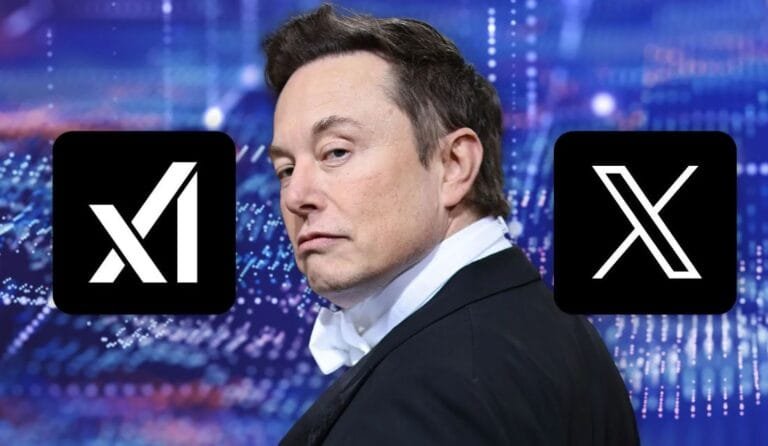
  • Social Media Site X Sold to xAI for $33 Billion

    Tech billionaire Elon Musk has sold the social media site X (formerly Twitter) to his AI company, xAI, in a $33 billion deal on 28 March 2025. Musk announced the sale, emphasizing that the merger will unlock significant potential by combining xAI’s advanced AI capabilities with X’s massive reach.

    The deal also values xAI at $80 billion, underscoring its growing influence in the AI sector. Musk, who acquired X for $44 billion in 2022, launched xAI a year later to advance artificial intelligence technology. As the CEO of Tesla and SpaceX, as well as an advisor to President Donald Trump, Musk continues to make bold moves in the tech industry.

    With xAI’s expertise, X is expected to undergo major enhancements, incorporating AI-driven content curation, advanced moderation, and interactive features. While the potential for innovation excites many, concerns over privacy and AI governance remain.

    This landmark deal highlights Musk’s ambition to reshape digital communication through AI integration, signaling a transformative shift in the online experience.

  • Ramon Magsaysay Award 2025 – Educate Girls (India)

    The Indian NGO Foundation to Educate Girls Globally (popularly Educate Girls) has been named a 2025 Ramon Magsaysay Awardee, often called Asia’s Nobel Prize.

    Founded in 2007 by Safeena Husain in Rajasthan, the organisation focuses on mobilising communities and government resources to ensure girls’ education in rural and disadvantaged areas.

    Educate Girls is the first Indian organisation to win this award.

    The 67th Ramon Magsaysay Award will be presented on 7 November 2025 at the Metropolitan Theatre, Manila.

  • VB-G RAM G Bill 2025: New Law to Replace MGNREGA

    The Viksit Bharat–Guarantee for Rozgar and Ajeevika Mission (Gramin) Bill, 2025 (VB-G RAM G Bill) was introduced in the Lok Sabha on 16 December 2025. It proposes to replace the Mahatma Gandhi National Rural Employment Guarantee Act (MGNREGA), marking the biggest reform in India’s rural employment framework in over two decades.

    About MGNREGA

    MGNREGA, enacted in 2005, guarantees 100 days of wage employment per year to rural households. It has been one of India’s largest social security schemes, providing livelihood support, reducing rural distress, and creating basic rural assets.

    What the New Bill Proposes

    • Guaranteed Employment: Increases assured work from 100 days (MGNREGA) to 125 days annually.
    • Infrastructure Focus: Shifts from temporary works to durable rural infrastructure like roads and irrigation.
    • Digital & Transparent System: Real-time wage payments, digital tracking, and stricter audits.
    • Skill Development: Training for rural workers to meet modern economic needs.
    • Funding Change: Revises the Centre–State funding ratio, raising concerns among states.