Current Affairs is one of the most important sections of competitive examinations in India. At GK Now, we provide daily, accurate, and exam-oriented current affairs covering the latest national and international developments that are important for competitive exam preparation.
This category brings together short, easy-to-read current affairs articles designed to help aspirants quickly understand and revise important events, facts, appointments, government decisions, schemes, sports, science and technology, and other exam-relevant developments.
Topics Covered
National Current Affairs – Important government decisions, policies, bills, major developments, and national events
International Affairs – Global events, international relations, agreements, organisations, and major developments
Appointments – Important appointments, transfers, and new heads of organisations and institutions
Polity & Governance – Constitutional developments, Parliament, Supreme Court and High Court decisions, committees, and governance
Government Schemes & Policies – New schemes, initiatives, Cabinet decisions, programmes, and policy updates
Science & Technology – ISRO, DRDO, space missions, scientific discoveries, technology, and important innovations
Sports Current Affairs – Major tournaments, championships, records, medals, athletes, and sports-related developments
Awards & Honours – Important national and international awards, honours, and recognitions
Defence & Security – Defence exercises, military developments, weapons systems, appointments, and national security
Economy & Banking – Important economic developments, RBI updates, banking, finance, budgets, and major reports
Culture & Heritage – Festivals, traditions, heritage sites, cultural events, and important personalities
Important Days & Themes – National and international days, annual themes, and their significance
Why Follow GK Now Current Affairs?
✅ Daily Updated – 2–3 important current affairs articles are added regularly.
✅ Exam-Oriented – Focused on facts and developments relevant to competitive examinations.
✅ Short & Easy to Read – Important information is presented in a simple and concise format.
✅ Multiple Subjects – Covers national, international, polity, economy, science, sports, defence, awards, and other important areas.
✅ Useful for Revision – Key facts are presented in a format suitable for quick revision and MCQ preparation.
GK Now Current Affairs is useful for aspirants preparing for SSC, UPSC, Banking, Railways, Defence, State PCS, Police, Teaching, and other government and competitive examinations.
Bookmark this page and follow GK Now for daily current affairs updates and exam-relevant news.
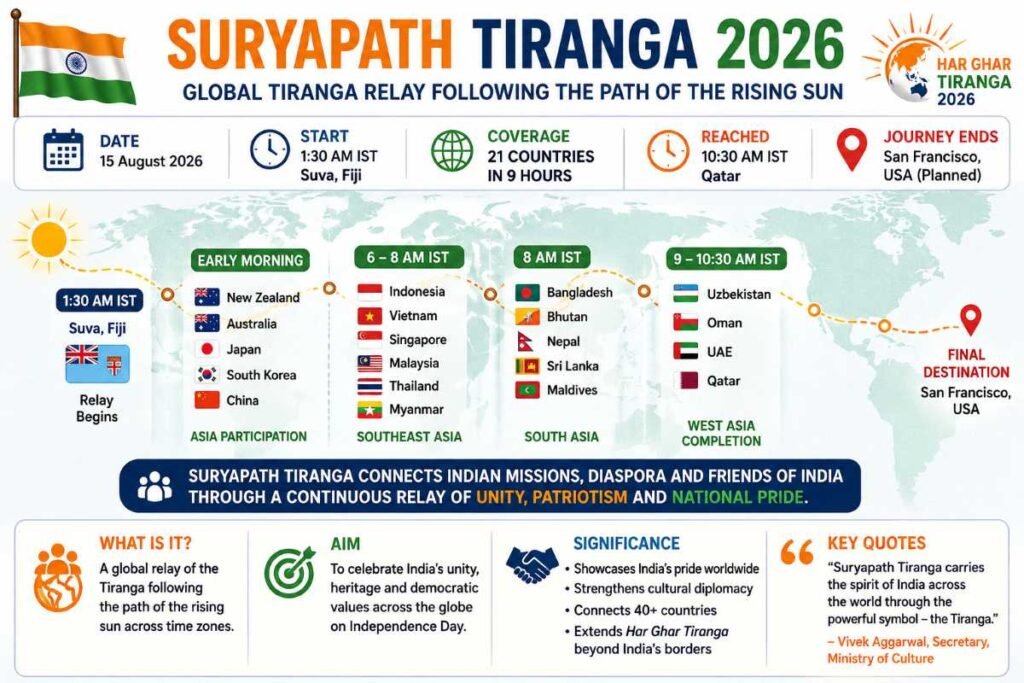
Suryapath Tiranga is a global Tiranga relay launched as part of Har Ghar Tiranga 2026 to mark India’s 80th Independence Day. The national flag was hoisted successively at Indian Missions and Posts across different time zones, symbolically following the path of the rising sun from East to West.
📅 Launch: 15 August 2026
📍 Started: Suva, Fiji — 1:30 AM IST
🌍 Initial coverage: 21 countries in the first 9 hours
🕥 Reached: Qatar — 10:30 AM IST
🇺🇸 Planned conclusion: San Francisco, USA
🎯 Aim: Promote national unity, patriotism, Indian heritage and global connection through the Tiranga.
🌐 Participants: Indian Missions, diaspora and friends of India worldwide.
🇮🇳 Campaign:Har Ghar Tiranga 2026
Exam Point:Suryapath Tiranga symbolically carries the Tiranga with the movement of the sun across time zones, connecting India and the global Indian community on Independence Day.
Magnus Carlsen successfully defended his Esports World Cup Chess 2026 title in Paris by defeating Denis Lazavik 2–0 in the grand final. The Norwegian star remained unbeaten throughout the tournament, winning his second consecutive EWC Chess title and earning $250,000.
🏆 Winner: Magnus Carlsen (Norway, Team Liquid)
🥈 Runner-up: Denis Lazavik (Belarus)
🥉 Third: Hikaru Nakamura (USA)
📅 Dates: 11–15 August 2026
📍 Venue: Paris, France
💰 Prize: $250,000 for Carlsen
♟️ Format: Rapid chess (10-minute games)
⭐ Key Record: First player to win the EWC Chess title twice consecutively (2025 & 2026).
Exam Point: Magnus Carlsen won the Esports World Cup Chess 2026 title and became the first back-to-back champion of the event.
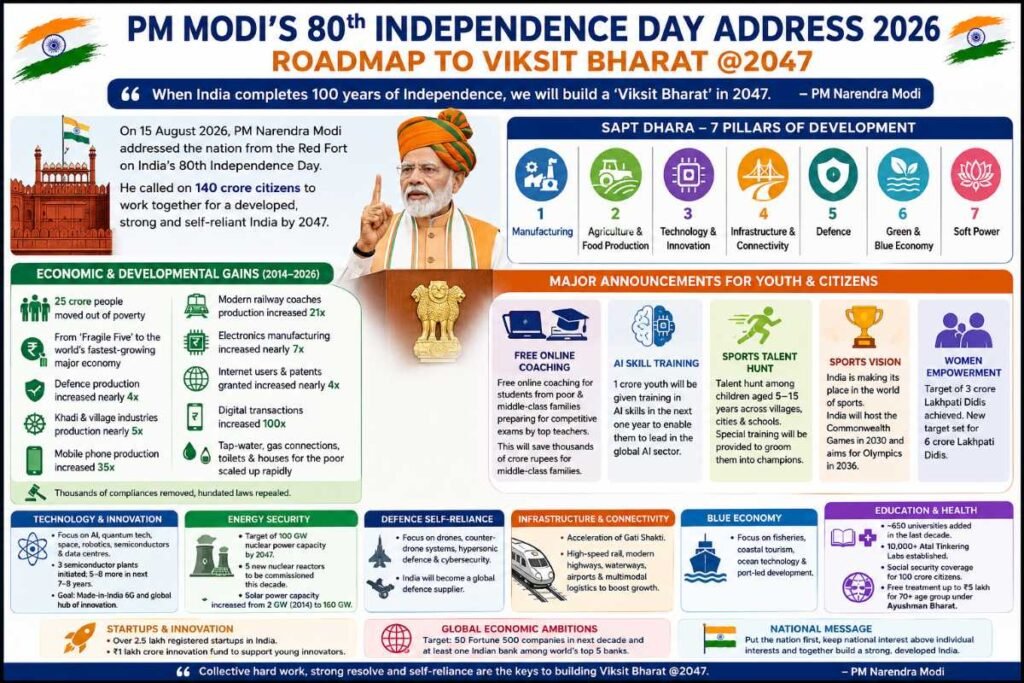
On 15 August 2026, Prime Minister Narendra Modi addressed the nation from the Red Fort on India’s 80th Independence Day, presenting an ambitious roadmap to build a “Viksit Bharat” by 2047. He emphasized self-reliance, economic growth, technology, defence, education, youth empowerment and innovation.
Major Announcements & Key Points
Viksit Bharat @2047: PM Modi called for collective efforts of 140 crore citizens to make India a developed nation by 2047.
Sapt Dhara: India’s development strategy will focus on seven pillars—manufacturing; agriculture & food production; technology & innovation; infrastructure & connectivity; defence; green & blue economy; and soft power.
Free Online Coaching: Free online coaching will be provided to students from poor and middle-class families preparing for competitive examinations, with teaching by top educators, to reduce the financial burden of coaching.
AI Skill Training:1 crore youth will be trained in AI skills over the next one year, with the aim of enabling India’s youth to take a leading role in the global AI sector.
Technology & Innovation: Focus areas include AI, quantum technology, space, robotics, semiconductors and data centres, with the goal of making India a global innovation hub.
Nuclear Power: India aims to achieve 100 GW of nuclear power capacity by 2047 and commission five new nuclear reactors during the current decade.
Defence Self-Reliance: India will strengthen capabilities in drones, counter-drone systems, hypersonic defence and cybersecurity and seek to become a global defence supplier.
Manufacturing: India aims to develop the complete manufacturing value chain—from components and design to finished products—and become a trusted global manufacturing hub.
Agriculture & Exports: Greater emphasis will be placed on food processing, chemical-free farming and agricultural exports, with farmers encouraged to meet global quality standards.
Infrastructure:Gati Shakti, high-speed rail, modern highways, inland waterways, airports and multimodal logistics will drive faster connectivity.
Youth & Startups: India has more than 2.5 lakh registered startups, while a ₹1 lakh crore innovation fund will support young innovators.
Sports Talent Hunt: A nationwide talent hunt will identify sporting talent among children aged 5–15 years across villages, cities and schools. Selected children will receive specialised training to prepare them for international competition.
Sports Events: India is preparing for its 2036 Olympics ambition and will host the Commonwealth Games in 2030.
Women Empowerment: The target of creating 3 crore Lakhpati Didis has already been surpassed, with a new target of 6 crore Lakhpati Didis.
Education: Nearly 650 universities have been added over the past decade, while more than 10,000 Atal Tinkering Labs have been established.
Healthcare: Social security coverage has expanded to 100 crore citizens, while people aged 70+ are covered for free treatment up to ₹5 lakh under Ayushman Bharat.
Economic Growth: PM Modi highlighted that 25 crore people have moved out of poverty and pointed to major increases in defence, electronics, mobile-phone and railway production.
Global Economic Ambition: India aims to have 50 Fortune 500 companies within the next decade and at least one Indian bank among the world’s top five banks.
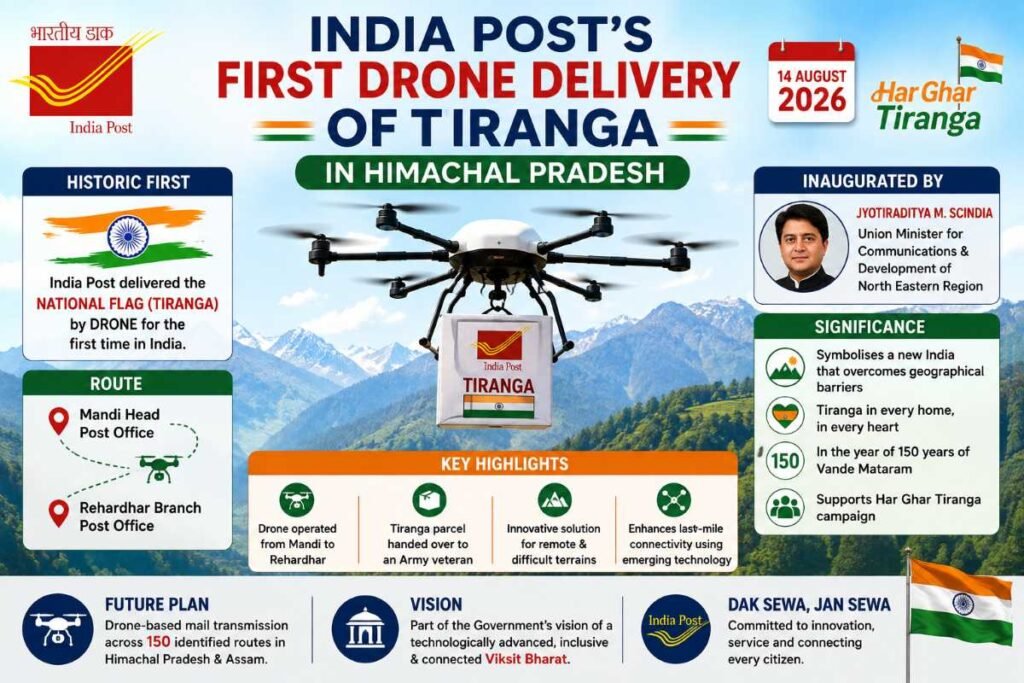
On 14 August 2026, India Post created history by making its first-ever drone delivery of the National Flag (Tiranga) in Himachal Pradesh, ahead of Independence Day.
Route: Mandi Head Post Office → Rehardhar Branch Post Office, Himachal Pradesh.
Inaugurated by:Jyotiraditya M. Scindia, Union Minister for Communications and Development of North Eastern Region, who witnessed the live drone take-off virtually.
The Tiranga parcel was received at Rehardhar and formally handed over to an Army veteran.
The initiative demonstrates how drone technology can improve last-mile postal connectivity, especially in remote and difficult terrains.
India Post plans drone-based mail transmission across 150 identified routes in Himachal Pradesh and Assam.
The initiative supports the vision of a technologically advanced and connected Viksit Bharat and reflects India Post’s service ethos: “Dak Sewa, Jan Sewa.”
It was also linked with the Har Ghar Tiranga campaign, encouraging citizens to display the National Flag.
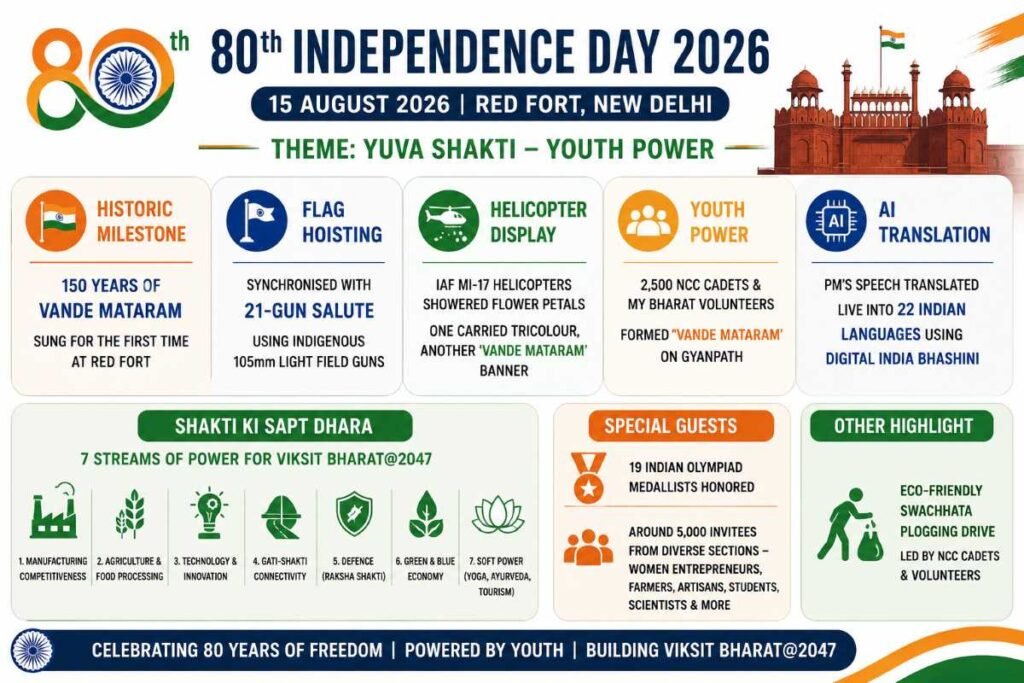
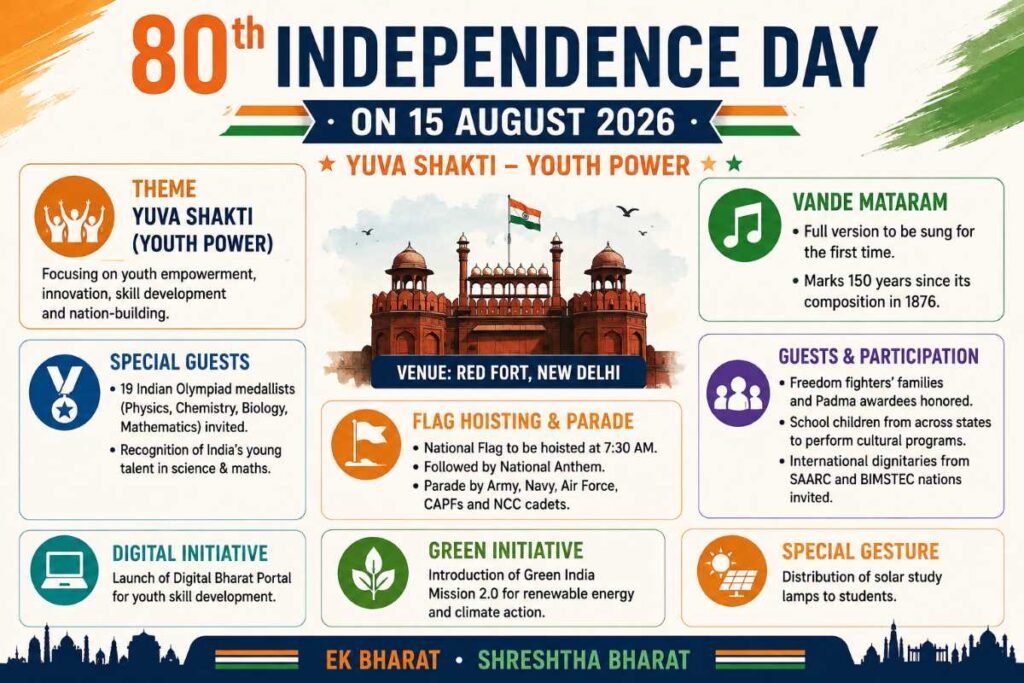
India celebrated its 80th Independence Day on 15 August 2026 at the Red Fort, New Delhi, with Prime Minister Narendra Modi leading the national celebrations.
Theme:Yuva Shakti (Youth Power), highlighting the role of youth in building Viksit Bharat@2047.
Vande Mataram: The celebrations marked 150 years of Vande Mataram, which was rendered at the Red Fort for the first time during Independence Day celebrations.
Flag Hoisting: The National Flag was hoisted with a 21-gun salute, while two IAF Mi-17 helicopters showered flower petals.
Shakti ki Sapt Dhara: PM Modi outlined seven areas of national strength—manufacturing, agriculture & food processing, technology & innovation, connectivity, defence, green & blue economy, and soft power.
AI Translation: The Prime Minister’s speech was translated live into 22 Indian languages using Digital India Bhashini.
Youth Participation: Around 2,500 NCC cadets and MY Bharat volunteers formed “Vande Mataram” on Gyanpath.
Special Guests:19 Indian Olympiad medallists and around 5,000 invitees from diverse sections of society attended the celebrations.
Other Highlight: An eco-friendly Swachhata Plogging Drive was conducted after the event.
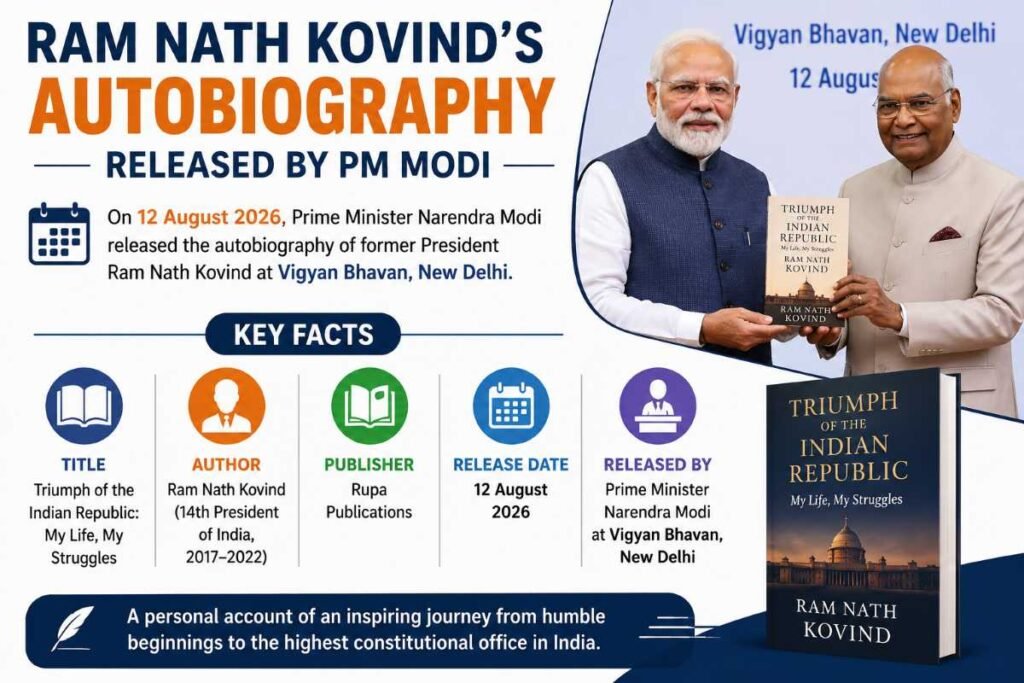
On 12 August 2026, Prime Minister Narendra Modi released the autobiography of former President Ram Nath Kovind, titled “Triumph of the Indian Republic: My Life, My Struggles”, at Vigyan Bhavan, New Delhi. The book offers a deeply personal account of Kovind’s journey from humble beginnings in Paraunkh village, Uttar Pradesh, to becoming the 14th President of India.
📖 Key Facts about the Autobiography
Title:Triumph of the Indian Republic: My Life, My Struggles
Author: Ram Nath Kovind (14th President of India, 2017–2022)
Publisher: Rupa Publications
Release Date: 12 August 2026
Released By: Prime Minister Narendra Modi at Vigyan Bhavan, New Delhi
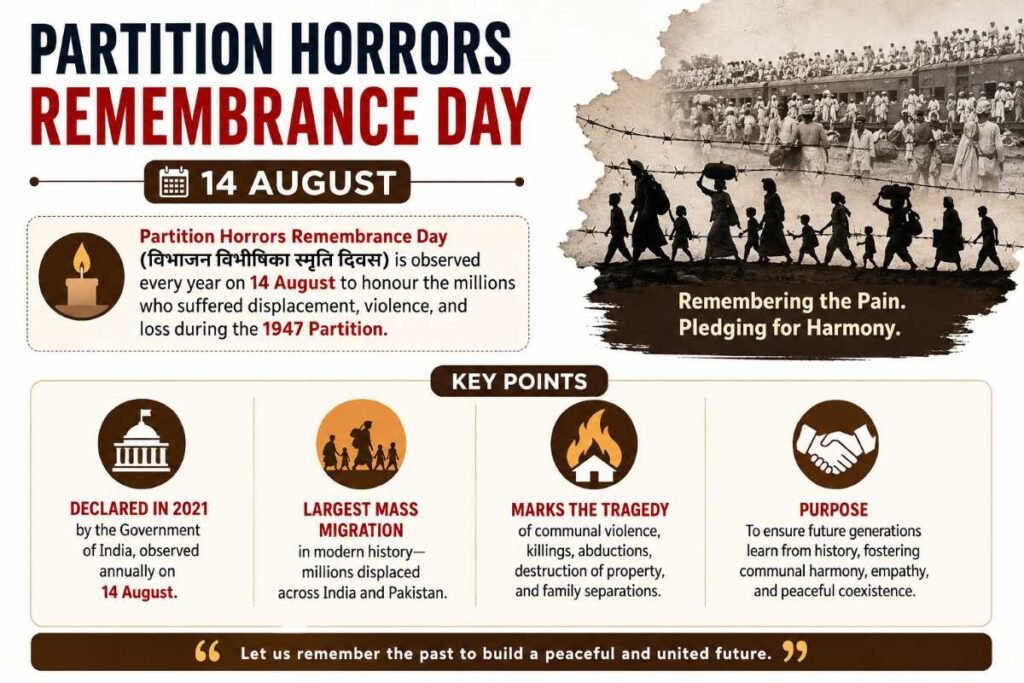
Partition Horrors Remembrance Day(विभाजन विभीषिका स्मृति दिवस) is observed every year on 14 August to honour the millions who suffered displacement, violence, and loss during the 1947 Partition.
📜 Background & Significance
Declared in 2021 by the Government of India, observed annually on 14 August.
Commemorates the largest mass migration in modern history — millions displaced across India and Pakistan.
Highlights communal violence, killings, abductions, destruction of property, and family separations during Partition.
Purpose: To ensure future generations learn from history, fostering communal harmony, empathy, and peaceful coexistence.
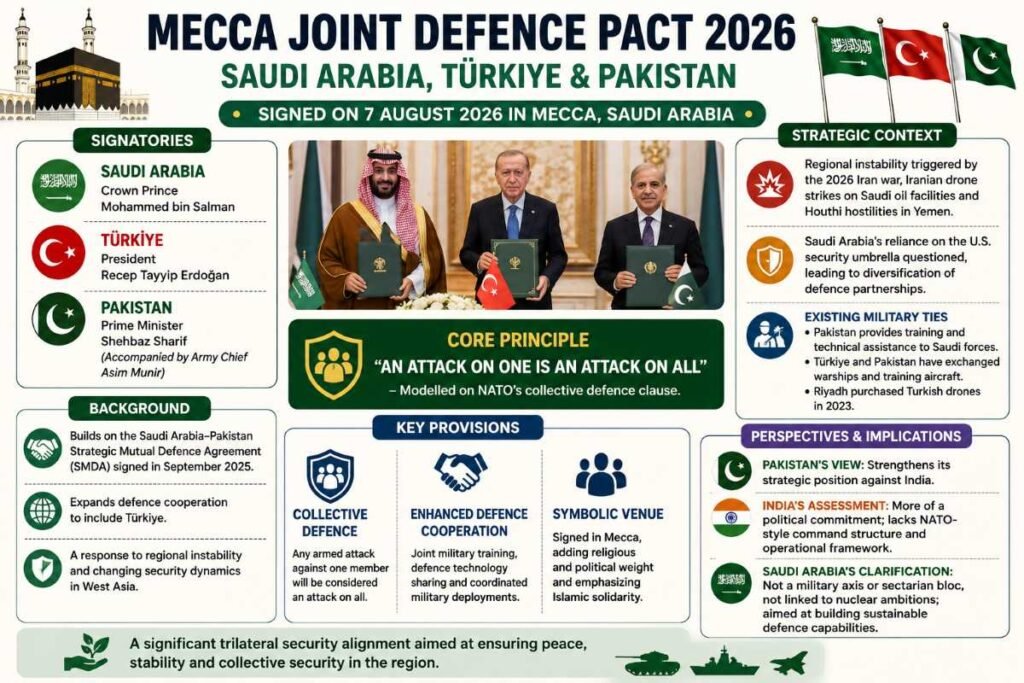
On 7 August 2026, Saudi Arabia, Türkiye and Pakistan signed the Mecca Joint Defence Pact in Mecca, Saudi Arabia, establishing a collective-defence commitment that an armed attack on one member will be treated as an attack on all three.
Signatories: Saudi Crown Prince Mohammed bin Salman, Turkish President Recep Tayyip Erdoğan, and Pakistani Prime Minister Shehbaz Sharif.
Core principle:“An attack on one is an attack on all,” similar to NATO’s collective-defence principle.
Background: The pact builds on the Saudi-Pakistan Strategic Mutual Defence Agreement (SMDA) signed in September 2025, with Türkiye now joining the arrangement.
Key areas: Joint military training, defence technology cooperation and coordinated military activities.
Strategic significance: The agreement reflects closer defence ties among the three countries amid regional instability and changing security dynamics in West Asia.
Saudi position: The pact was described as a mechanism for sustainable defence cooperation, not a military or sectarian bloc.
Exam Fact:Mecca Joint Defence Pact → Saudi Arabia + Türkiye + Pakistan → Signed on 7 August 2026 → “An attack on one is an attack on all.”
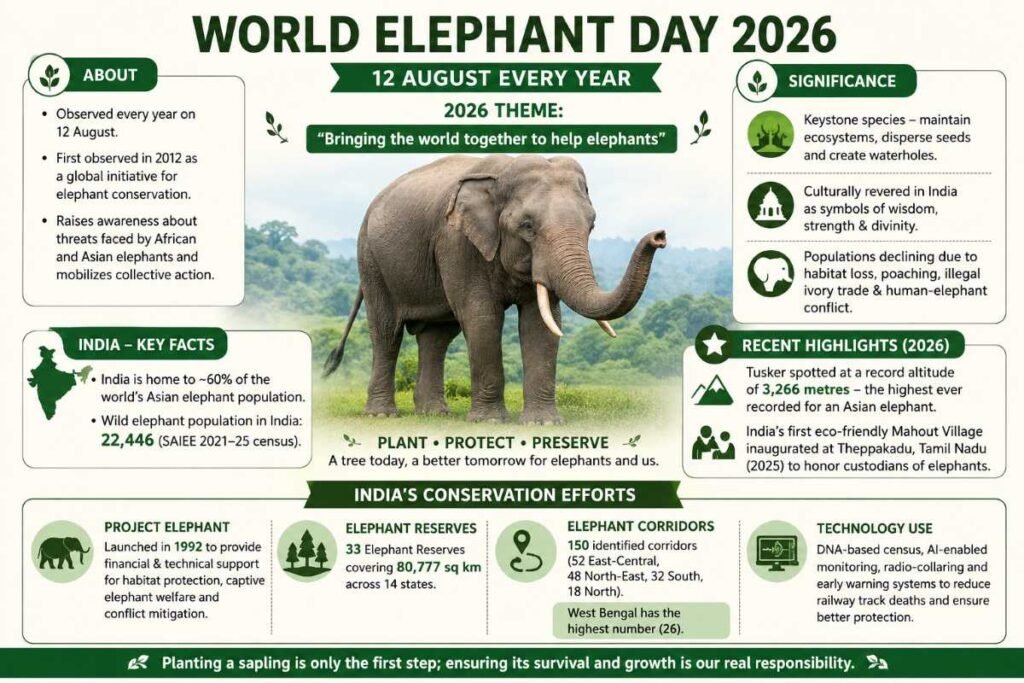
World Elephant Day is observed every year on 12 August. In 2026, the theme was “Bringing the world together to help elephants,” highlighting global efforts to protect elephants from habitat loss, poaching, illegal ivory trade and human-elephant conflict.
First observed: 2012
India’s importance: India is home to nearly 60% of the world’s Asian elephants.
Wild elephant population in India:22,446 (SAIEE 2021–25 census).
Project Elephant: Launched in 1992 for elephant habitat protection, welfare and human-elephant conflict mitigation.
Elephant Reserves:33 reserves covering about 80,777 sq km across 14 states.
Elephant corridors:150 identified corridors across India.
West Bengal: Has the highest number of identified elephant corridors (26).
Conservation technology: DNA-based census, AI monitoring, radio-collaring and early-warning systems are being used to protect elephants.
Exam Fact:World Elephant Day → 12 August | 2026 Theme → “Bringing the world together to help elephants” | Project Elephant → 1992.
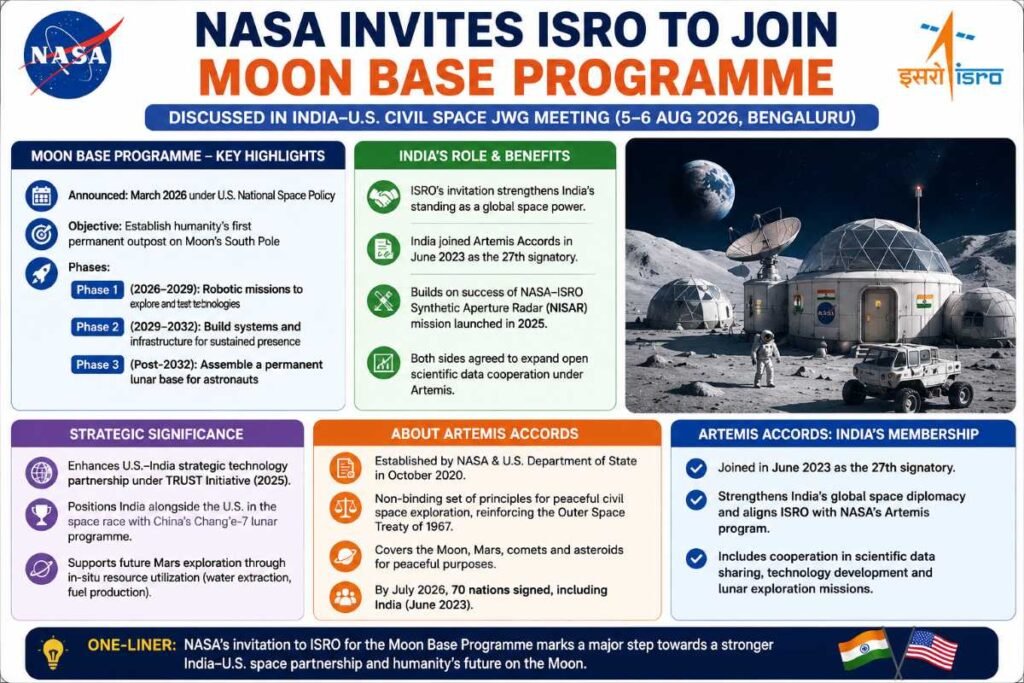
NASA has invited ISRO to participate in its Moon Base programme, discussed during the India-U.S. Civil Space Joint Working Group meeting held in Bengaluru on 5–6 August 2026. The initiative aims to establish a permanent human outpost near the Moon’s South Pole.
Phase 1 (2026–2029): Robotic exploration and technology testing.
Phase 2 (2029–2032): Development of infrastructure for sustained lunar presence.
Phase 3 (Post-2032): Establishment of a permanent lunar base.
India’s role: Strengthen lunar exploration, technology cooperation and scientific data sharing with the U.S.
Artemis Accords: India joined in June 2023 as the 27th signatory.
NISAR: The partnership builds on the NASA-ISRO Synthetic Aperture Radar mission launched in 2025.
Strategic significance: The collaboration strengthens India-U.S. space cooperation and supports future Moon and Mars exploration, including resource utilization such as extracting water and producing fuel.
One-liner extra facts: The Artemis Accords were established in October 2020 by NASA and the U.S. Department of State as a non-binding framework for peaceful civil space exploration, building on the 1967 Outer Space Treaty.
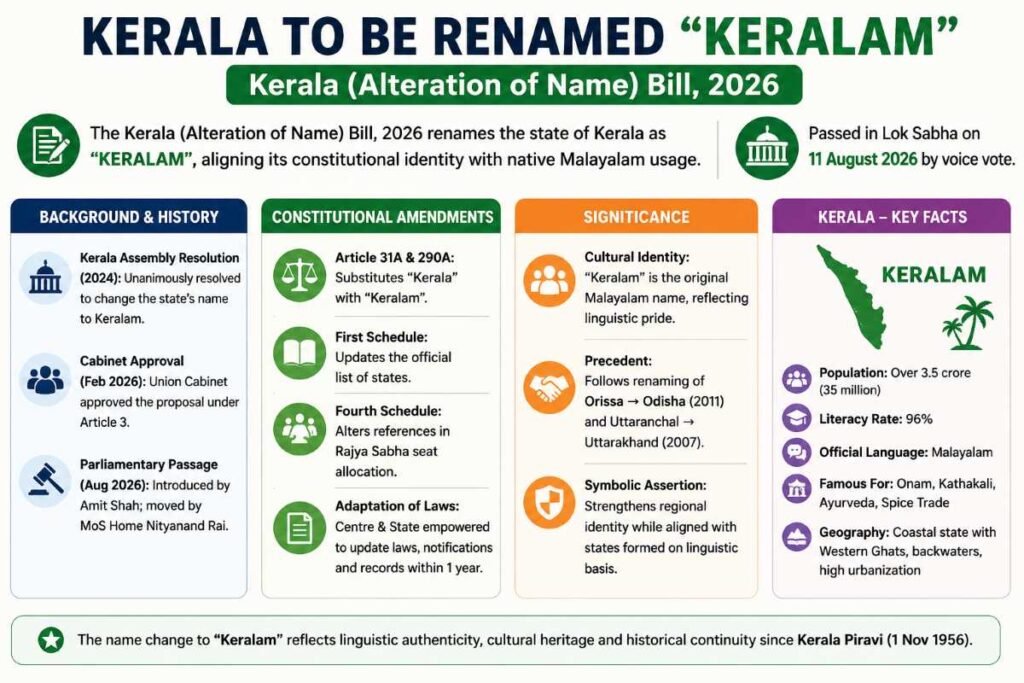
The Kerala (Alteration of Name) Bill, 2026 officially renames the state of Kerala as “Keralam,” aligning its constitutional identity with the native Malayalam usage. Passed in the Lok Sabha on 11 August 2026, the Bill amends multiple constitutional provisions to reflect the new name.
📜 Background & History
Kerala Assembly Resolution (2024): The Kerala Legislative Assembly unanimously resolved to change the state’s name to Keralam, citing linguistic and cultural authenticity.
Cabinet Approval (Feb 2026): The Union Cabinet, chaired by PM Narendra Modi, approved the proposal, following constitutional procedure under Article 3.
Parliamentary Passage (Aug 2026): The Bill was introduced by Union Home Minister Amit Shah and later moved by MoS Home Nityanand Rai.
⚖️ Constitutional Amendments
The Bill makes changes across several constitutional articles and schedules:
Article 31A & 290A: Substitutes “Kerala” with “Keralam.”
First Schedule: Updates the official list of states.
Fourth Schedule: Alters references in Rajya Sabha seat allocation.
Adaptation of Laws: Both Central and State governments empowered to update laws, notifications, and records within one year.
🌍 Significance of the Name Change
Cultural Identity: “Keralam” is the original Malayalam name, reflecting linguistic pride and historical continuity since Kerala Piravi (formation day, 1 Nov 1956).
Precedents: Similar renaming exercises include Orissa → Odisha (2011) and Uttaranchal → Uttarakhand (2007).
Symbolic Assertion: Strengthens regional identity while aligning with the principle of states formed on linguistic basis.
🦁 Kerala’s Demography & Identity
Population: Over 3.5 crore (35 million) people, with high literacy (96%) and strong human development indicators.
Language: Malayalam is the official language; “Keralam” is its authentic usage.
Cultural Heritage: Known for Onam, Kathakali, Ayurveda, and spice trade history.
Geography: Coastal state with Western Ghats biodiversity, famous backwaters, and high urbanization.
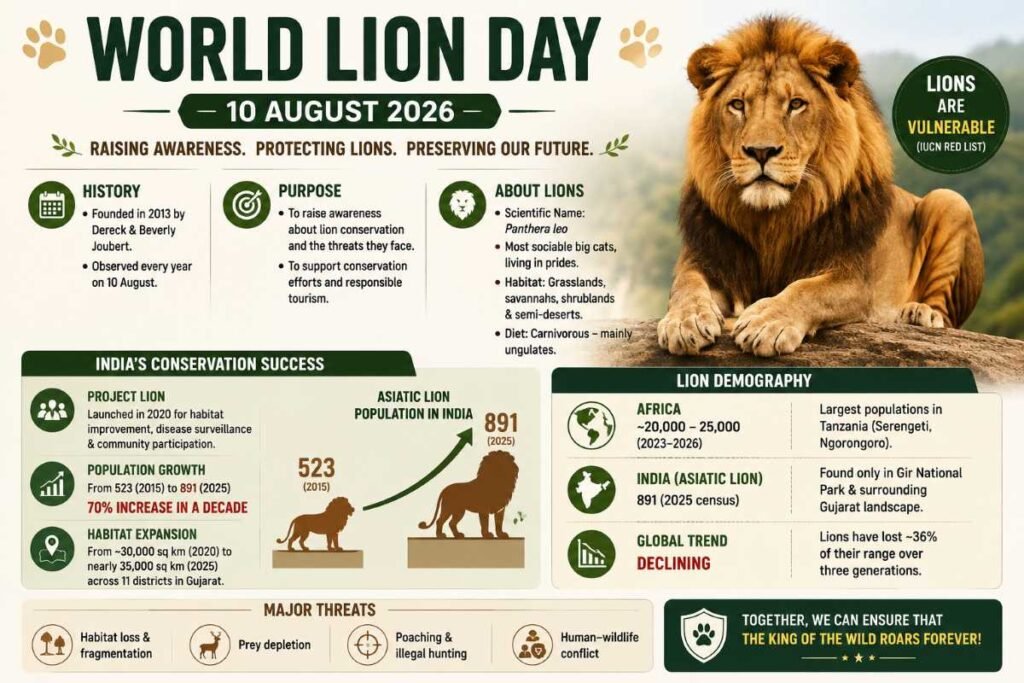
World Lion Day is observed every year on 10 August to raise awareness about lion conservation. In 2026, India highlighted its successful conservation of the Asiatic lion.
Founded: 2013 by conservationists Dereck and Beverly Joubert.
Scientific Name:Panthera leo.
India’s Asiatic Lion Population:891 in 2025, up from 523 in 2015.
Population Increase: About 70% over a decade.
Habitat Expansion: From around 30,000 sq km (2020) to nearly 35,000 sq km (2025).
Habitat: Asiatic lions are found in Gujarat, particularly the Gir landscape.
Project Lion: Launched in 2020 for habitat improvement, disease surveillance and community participation.
Major Threats: Habitat loss and fragmentation, prey depletion, poaching and human-wildlife conflict.
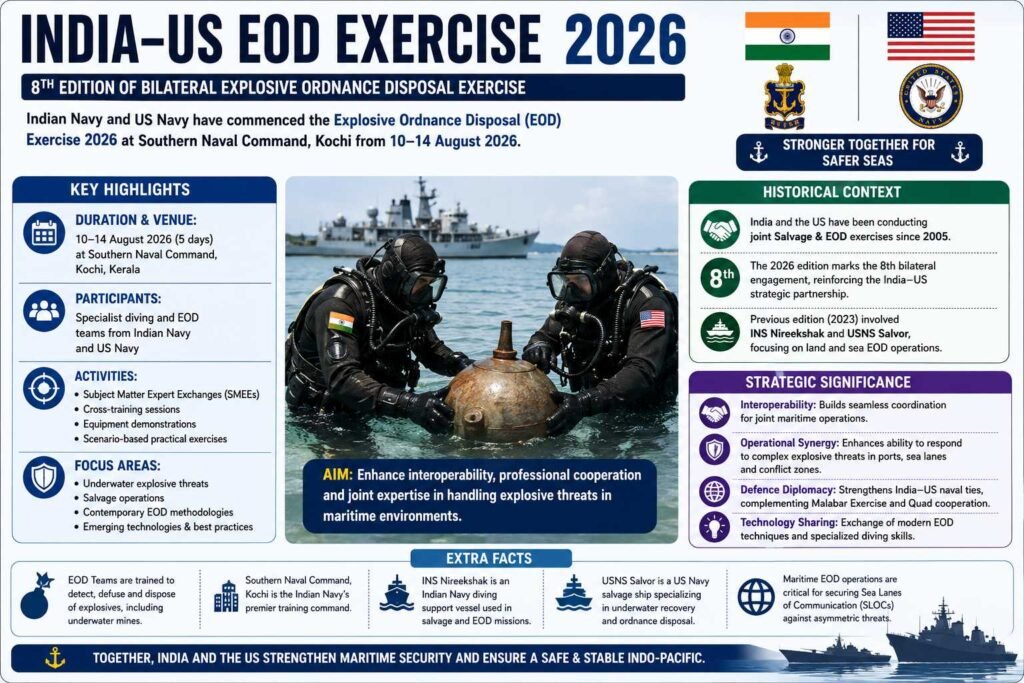
The Indian Navy and US Navy have commenced the 8th edition of the Explosive Ordnance Disposal (EOD) Exercise 2026 at Southern Naval Command, Kochi, from 10–14 August 2026. The five-day bilateral exercise involves specialist diving and EOD teams from both navies.
The exercise focuses on underwater explosive threats, salvage operations, modern EOD methodologies, emerging technologies and best practices. Activities include Subject Matter Expert Exchanges (SMEEs), cross-training, equipment demonstrations and scenario-based practical exercises.
India and the US have conducted joint Salvage & EOD exercises since 2005. The 2026 exercise aims to enhance interoperability, professional cooperation and joint operational capabilities, while strengthening the broader India–US defence partnership.
Exam Ready One-Liner : India–US EOD Exercise 2026, the 8th edition, is being held at Southern Naval Command, Kochi, from 10–14 August 2026 to enhance joint maritime EOD capabilities and interoperability.
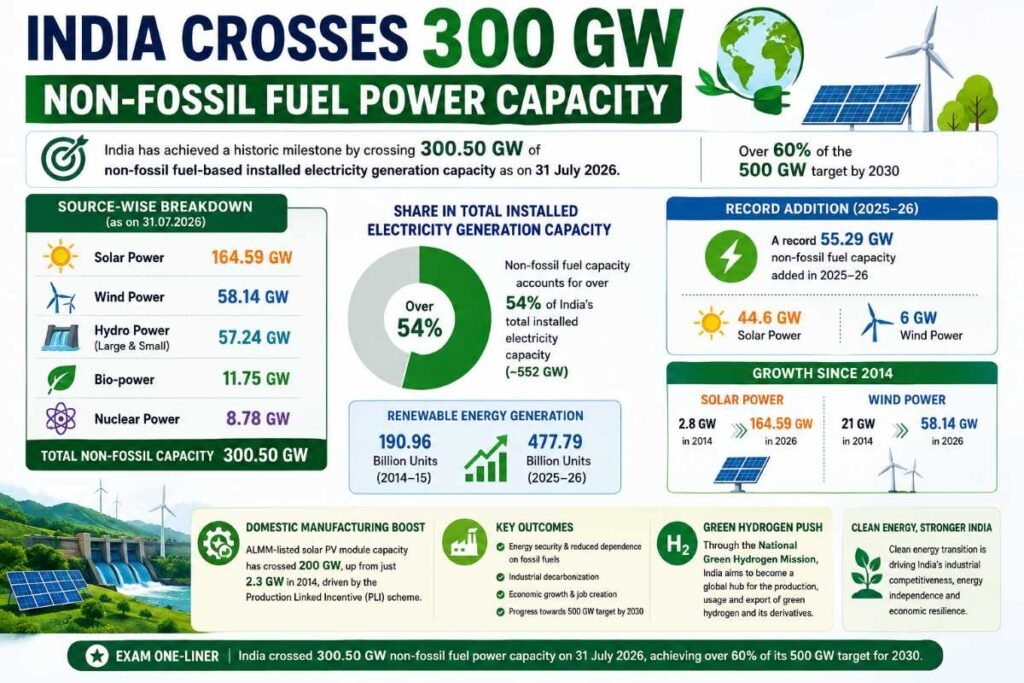
India has crossed a historic milestone of 300.50 GW of installed non-fossil fuel-based electricity generation capacity as of 31 July 2026, achieving over 60% of its target of 500 GW by 2030. Non-fossil sources now account for over 54% of India’s total installed power capacity.
Source-wise capacity:
☀️ Solar: 164.59 GW
🌬️ Wind: 58.14 GW
💧 Hydro: 57.24 GW
🌱 Bio-power: 11.75 GW
⚛️ Nuclear: 8.78 GW
Total: 300.50 GW
During 2025–26, India added a record 55.29 GW of non-fossil capacity, including 44.6 GW solar and 6 GW wind. Renewable electricity generation increased from 190.96 billion units in 2014–15 to 477.79 billion units in 2025–26.
✅ One-Liner Quick Revision and Extra Facts
India crosses 300 GW non-fossil fuel capacityon 31 July 2026,.
Target: 500 GW by 2030.
India’s first solar park: Charanka Solar Park, Gujarat (2012).
Largest solar project: Bhadla Solar Park, Rajasthan (2.25 GW).
COP28 Commitment: India pledged net-zero emissions by 2070.
Hydrogen Train Pilot: Jind–Sonipat section in Haryana (2026).
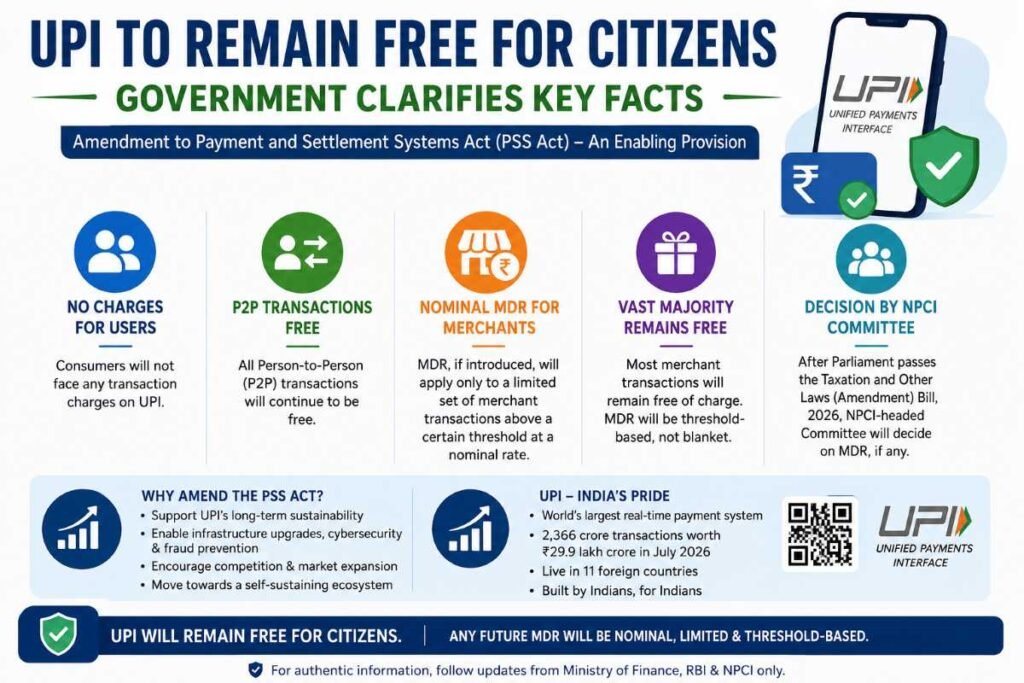
The Government of India has clarified that UPI payments will remain free for citizens. The recent amendment to the Payment and Settlement Systems (PSS) Act, 2007 is an enabling provision aimed at ensuring the long-term sustainability, technological advancement and resilience of India’s UPI ecosystem.
No charges for users: Citizens will not have to pay transaction charges for UPI payments.
P2P transactions remain free: Person-to-Person (P2P) UPI transactions will continue to be free.
MDR for merchants: If introduced in future, Merchant Discount Rate (MDR) will apply only to a limited set of merchant transactions above a specified threshold and at a nominal rate.
Most merchant transactions remain free: MDR will not be a blanket charge on all UPI merchant transactions.
Decision on MDR: After Parliament passes the Taxation and Other Laws (Amendment) Bill, 2026, the UPI and Services Steering Committee headed by NPCI will decide whether MDR should be introduced.
Reason for amendment: The measure aims to support UPI’s growing infrastructure, cybersecurity, fraud prevention, technological upgrades and financial sustainability.
UPI growth: In July 2026, UPI processed 2,366 crore transactions worth ₹29.9 lakh crore.
Global reach: UPI is now live in 11 foreign countries and has emerged as the world’s largest real-time payment system.
UPI background: Developed by NPCI and launched in 2016, UPI enables instant interoperable payments through mobile numbers, VPA and QR codes.
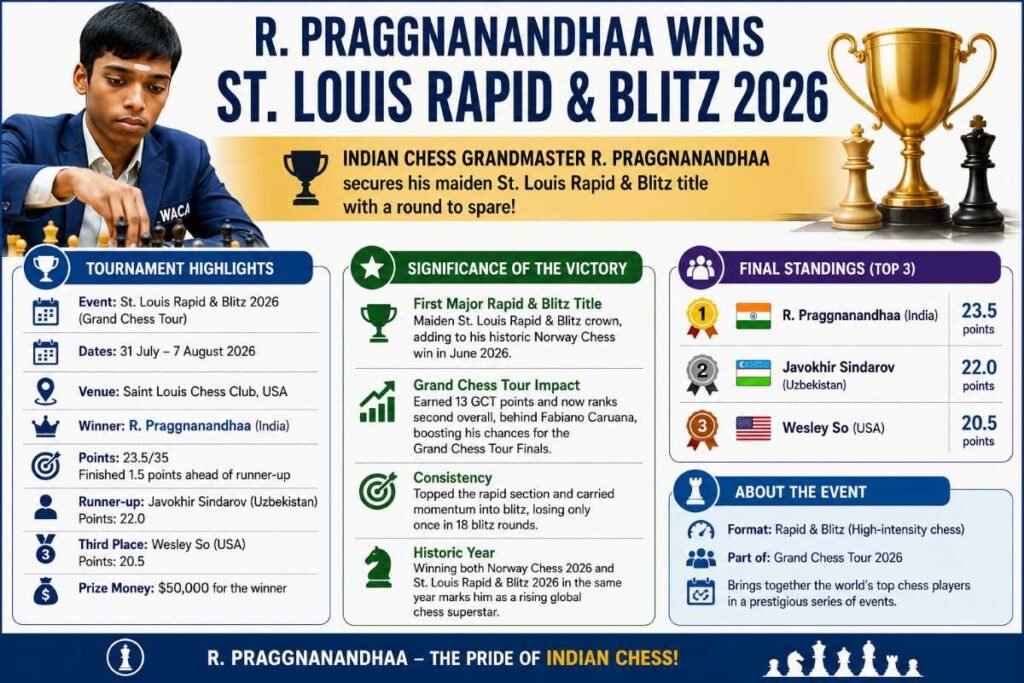
Indian chess Grandmaster R. Praggnanandhaa won his maiden St. Louis Rapid & Blitz 2026 title at the Saint Louis Chess Club, USA, held from 31 July to 7 August 2026.
He scored 23.5/35 points, finishing 1.5 points ahead of Javokhir Sindarov of Uzbekistan. Wesley So of the USA finished third with 20.5 points. Praggnanandhaa earned $50,000 and 13 Grand Chess Tour points, moving to second place in the overall Grand Chess Tour standings.
The victory is significant as Praggnanandhaa had also won Norway Chess 2026 earlier in the year.
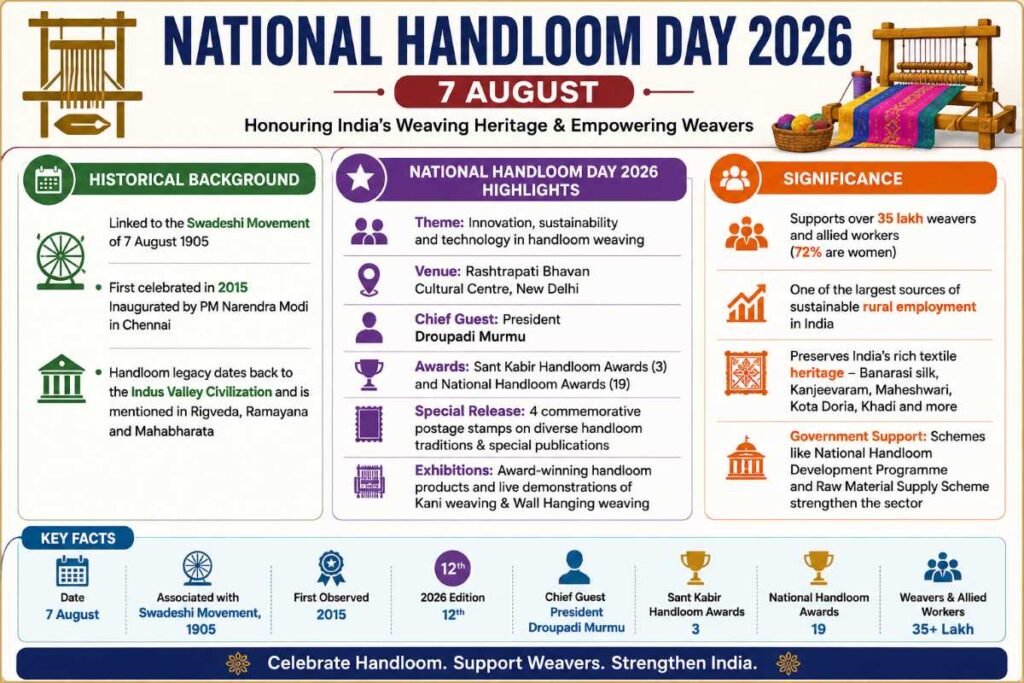
National Handloom Day is observed every year on 7 August to commemorate the Swadeshi Movement of 1905, which promoted indigenous products and the boycott of foreign goods. In 2026, the 12th National Handloom Day was celebrated at the Rashtrapati Bhavan Cultural Centre, New Delhi, with President Droupadi Murmu as the chief guest.
The 2026 celebrations highlighted innovation, sustainability and technology in the handloom sector. 3 Sant Kabir Handloom Awards and 19 National Handloom Awards were presented to outstanding weavers. Four commemorative postage stamps and publications highlighting India’s handloom traditions were also released.
The handloom sector supports over 35 lakh weavers and allied workers, with 72% being women, making it an important source of rural employment and women-led economic empowerment. Traditional textiles such as Banarasi silk, Kanjeevaram, Maheshwari, Kota Doria and Khadi reflect India’s rich cultural heritage.
Key Facts for Exams:
National Handloom Day: 7 August
Associated event: Swadeshi Movement, 1905
First observed: 2015
2026 edition: 12th
Chief Guest: President Droupadi Murmu
Venue: Rashtrapati Bhavan Cultural Centre, New Delhi
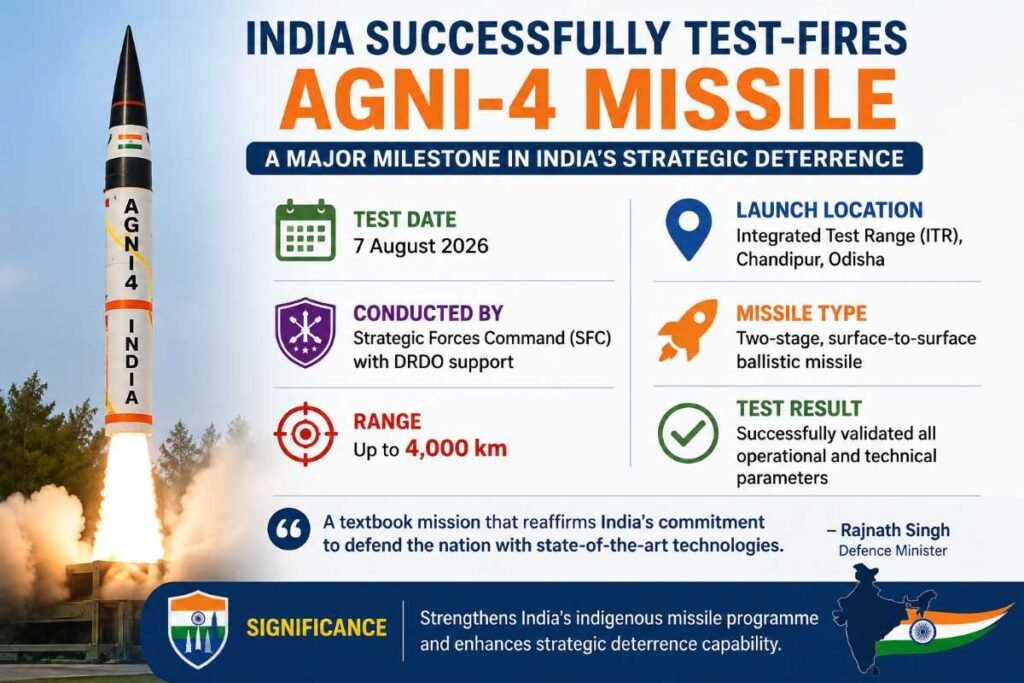
India successfully test-fired the Agni-4 Medium-Range Ballistic Missile (MRBM) on 7 August 2026 from the Integrated Test Range (ITR), Chandipur, Odisha.
Conducted by: Strategic Forces Command (SFC), with DRDO support
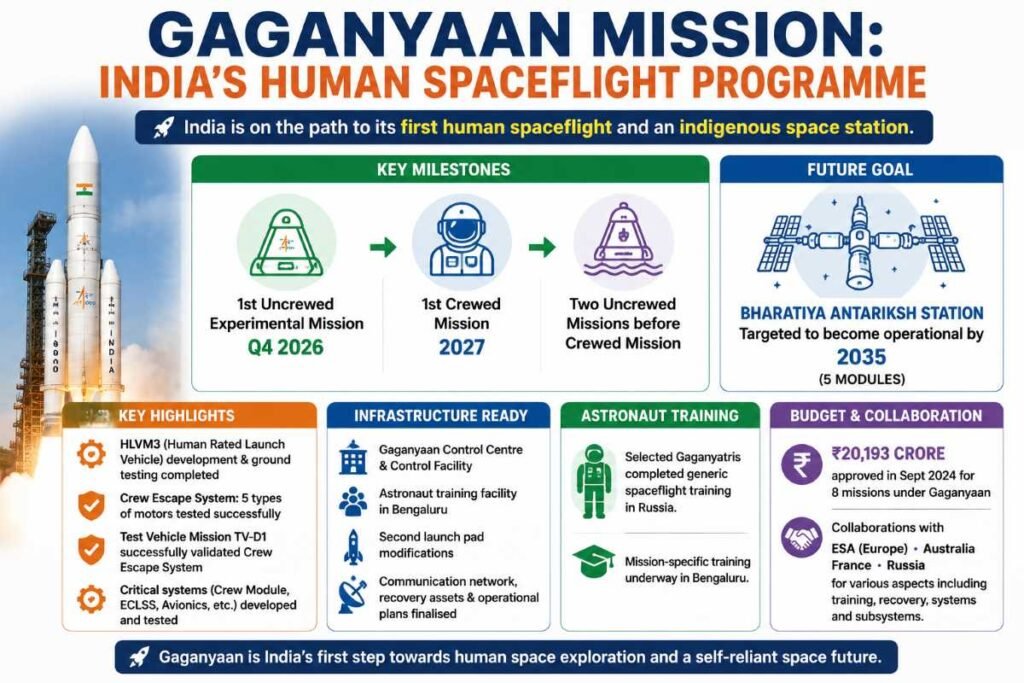
India’s Gaganyaan human spaceflight programme has made significant progress, with the first uncrewed experimental mission targeted for the fourth quarter of 2026 and the first crewed mission planned for 2027, the government informed Parliament.
First uncrewed experimental mission: Q4 2026, including Vyommitra, a half-humanoid robot.
First crewed Gaganyaan mission: Targeted for 2027.
Two additional uncrewed missions are planned before the maiden crewed flight.
The Human Rated Launch Vehicle (HLVM3) propulsion stages and structures have completed development and ground testing.
The Crew Escape System has undergone major successful tests, while Test Vehicle Mission TV-D1 successfully validated crew-escape technology.
Selected Gaganyatris have completed generic spaceflight training in Russia and are undergoing mission-specific training in Bengaluru.
The Union Cabinet approved ₹20,193 crore for eight Gaganyaan missions in September 2024.
Bharatiya Antariksh Station (BAS) is targeted to become operational by 2035 and will comprise five modules.
India is collaborating with ESA, Australia, France and Russia for various aspects of the programme.
Key Facts: 🚀 Gaganyaan first uncrewed mission → Q4 2026 👨🚀 First crewed mission → 2027 🛰️ Bharatiya Antariksh Station → 2035 💰 Gaganyaan allocation → ₹20,193 crore
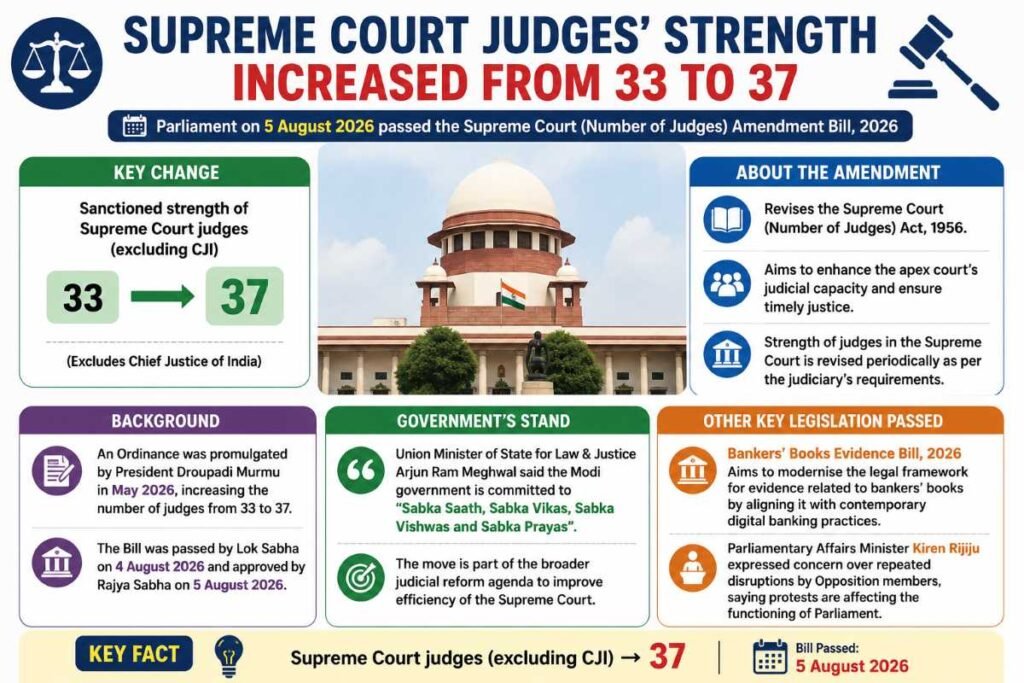
Parliament on 5 August 2026 passed the Supreme Court (Number of Judges) Amendment Bill, 2026, increasing the sanctioned strength of Supreme Court judges from 33 to 37, excluding the Chief Justice of India (CJI).
The amendment revises the Supreme Court (Number of Judges) Act, 1956.
The increase had already been provided through an Ordinance promulgated by President Droupadi Murmu in May 2026.
The government said the move aims to improve the efficiency of the Supreme Court and ensure timely justice.
Union Minister of State for Law and Justice Arjun Ram Meghwal defended the measure as part of broader judicial reforms.
On the same day, the Lok Sabha passed the Bankers’ Books Evidence Bill, 2026, aimed at modernising rules concerning banking records and digital banking evidence.
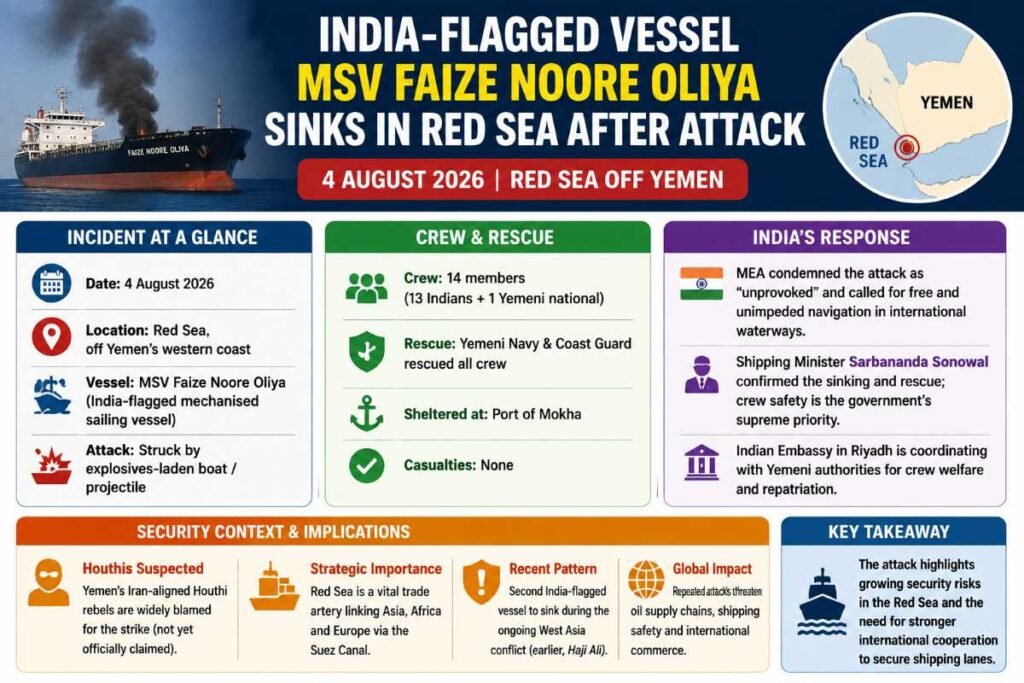
On 4 August 2026, the India-flagged cargo vessel MSV Faize Noore Oliya sank in the Red Sea off Yemen after being struck by a projectile/explosives-laden boat. All 14 crew members, including 13 Indians and one Yemeni national, were safely rescued by the Yemeni Coast Guard and taken to the Port of Mokha.
Key Points:
Vessel: MSV Faize Noore Oliya — India-flagged mechanised sailing vessel.
Date: 4 August 2026.
Location: Red Sea, off Yemen’s western coast.
Crew: 14, including 13 Indians.
Casualties: None; all crew rescued.
India’s response: The MEA condemned the attack as “unprovoked” and called for free and unimpeded navigation through international waterways.
Rescue: Yemeni Coast Guard rescued the crew and brought them to Port of Mokha.
The attack highlights continuing maritime security risks in the strategically important Red Sea shipping route.
Exam Focus:MSV Faize Noore Oliya — India-flagged vessel — Red Sea — Yemen — 4 August 2026 — 13 Indians among 14 crew rescued.
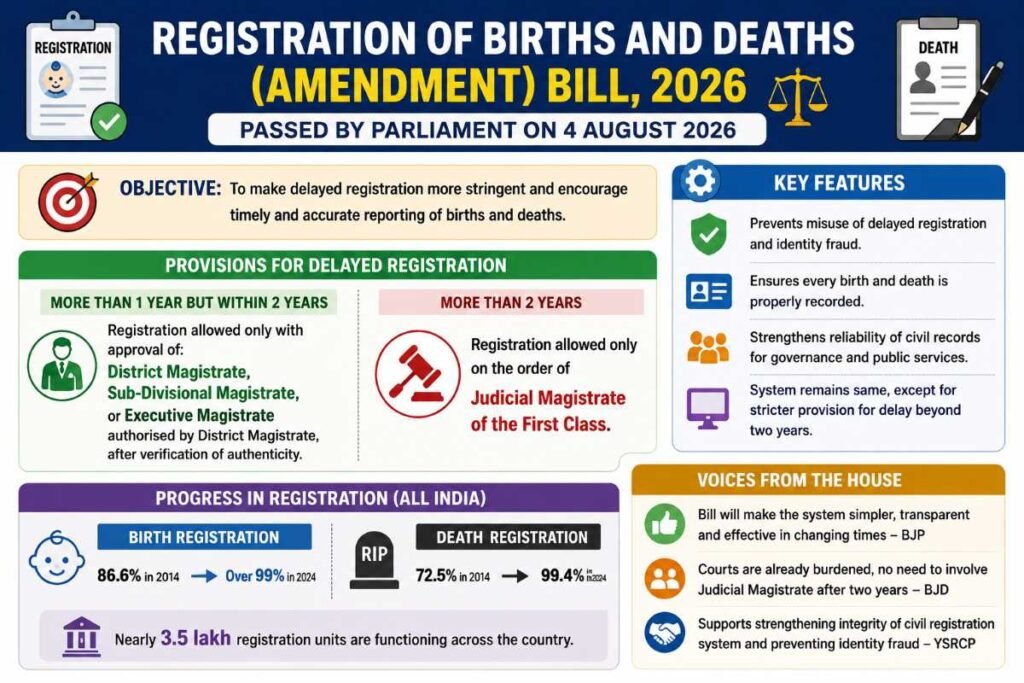
Parliament passed the Registration of Births and Deaths (Amendment) Bill, 2026 on 4 August 2026, after its approval by the Rajya Sabha; the Lok Sabha had already passed it. The Bill amends the Registration of Births and Deaths Act, 1969 and aims to make delayed registration more stringent while promoting timely and accurate registration.
Key Provisions:
1–2 years delay: Registration of a birth or death reported after one year but within two years will require approval from the District Magistrate, Sub-Divisional Magistrate, or authorised Executive Magistrate, after verification.
More than 2 years delay: Registration will require an order of a Judicial Magistrate of the First Class.
The amendment seeks to prevent misuse, manipulation and identity fraud through improper delayed registration.
It aims to ensure universal and accurate registration of births and deaths and improve the reliability of civil records.
India has nearly 3.5 lakh registration units.
Birth registration increased from 86.6% in 2014 to over 99% in 2024.
Death registration increased from 72.5% to 99.4% during the same period.
Members supporting the Bill highlighted the importance of registration for legal identity, governance, policy planning and delivery of public services.
Some members expressed concern that referring cases after two years to Judicial Magistrates could increase the burden on already overburdened courts.
Exam Point: The Bill mainly strengthens the procedure for delayed registration of births and deaths, particularly registrations made more than two years after the event.
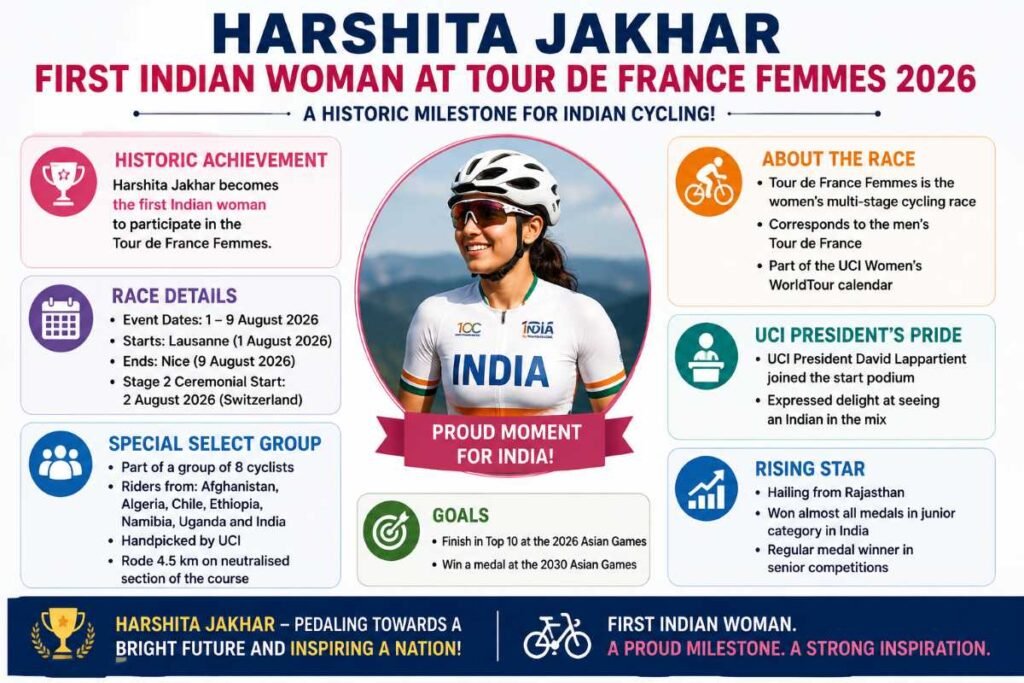
Harshita Jakhar, a 19-year-old cyclist from Rajasthan, became the first Indian woman to participate in the Tour de France Femmes. She took part in the ceremonial start of Stage 2 on 2 August 2026 in Switzerland.
Harshita was part of a specially selected group of eight cyclists from countries including Afghanistan, Algeria, Chile, Ethiopia, Namibia and Uganda.
The riders were selected by the UCI (Union Cycliste Internationale) and completed a 4.5-km neutralised section of the course.
The Tour de France Femmes is the women’s equivalent of the men’s Tour de France and is part of the UCI Women’s WorldTour calendar.
The 2026 race began on 1 August in Lausanne and is scheduled to conclude on 9 August in Nice.
Harshita has achieved several successes in junior and senior cycling competitions in India.
Her goals are to finish in the Top 10 at the 2026 Asian Games and win a medal at the 2030 Asian Games.
Exam Point: Harshita Jakhar → First Indian woman at Tour de France Femmes → Rajasthan → 2026.
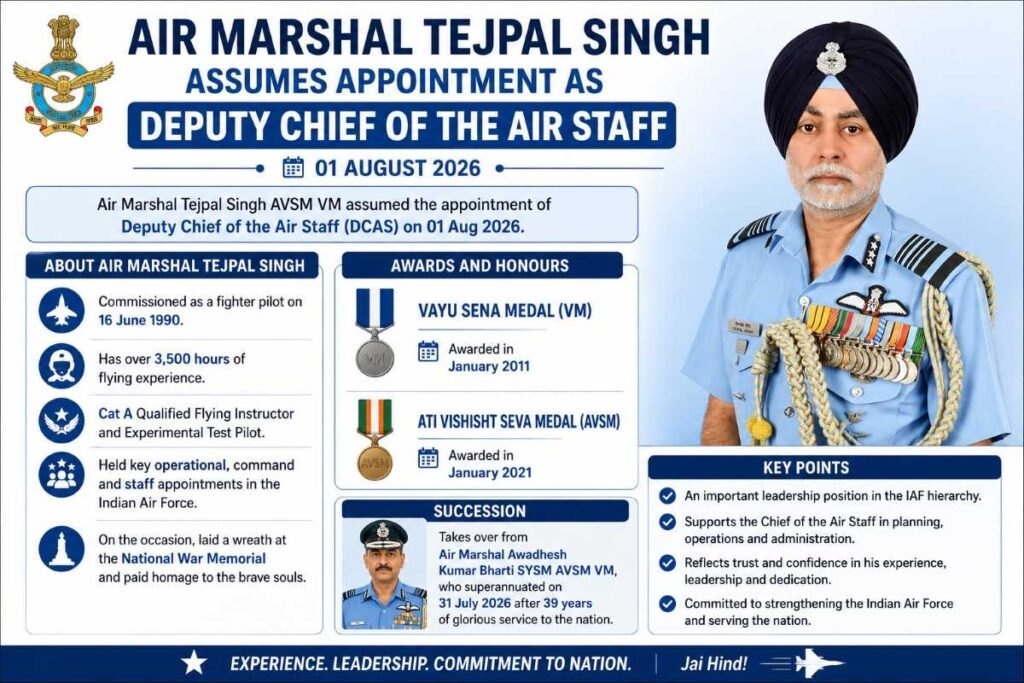
Air Marshal Tejpal Singh AVSM VM assumed the appointment of Deputy Chief of the Air Staff (DCAS) on 1 August 2026.
Key Points
New Deputy Chief of the Air Staff: Air Marshal Tejpal Singh
Assumed office:1 August 2026
He was commissioned into the Indian Air Force as a fighter pilot on 16 June 1990.
He has more than 3,500 hours of flying experience.
He is a Category A Qualified Flying Instructor and an Experimental Test Pilot.
He has held several important operational, command and staff appointments in the Indian Air Force.
He was awarded the Vayu Sena Medal (VM) in 2011.
He received the Ati Vishisht Seva Medal (AVSM) in 2021.
He succeeded Air Marshal Awadhesh Kumar Bharti, who retired on 31 July 2026 after 39 years of service.
Exam Point: Air Marshal Tejpal Singh is the new Deputy Chief of the Air Staff (DCAS) of the Indian Air Force, effective 1 August 2026.
Q. Who assumed the appointment of Deputy Chief of the Air Staff (DCAS) on 1 August 2026?
A) Air Marshal Awadhesh Kumar Bharti B) Air Marshal Tejpal Singh C) Air Marshal A.P. Singh D) Air Marshal Amar Preet Singh
Answer: B) Air Marshal Tejpal Singh Air Marshal Tejpal Singh AVSM VM assumed the appointment of Deputy Chief of the Air Staff (DCAS) on 1 August 2026. He succeeded Air Marshal Awadhesh Kumar Bharti, who retired on 31 July 2026 after 39 years of service.
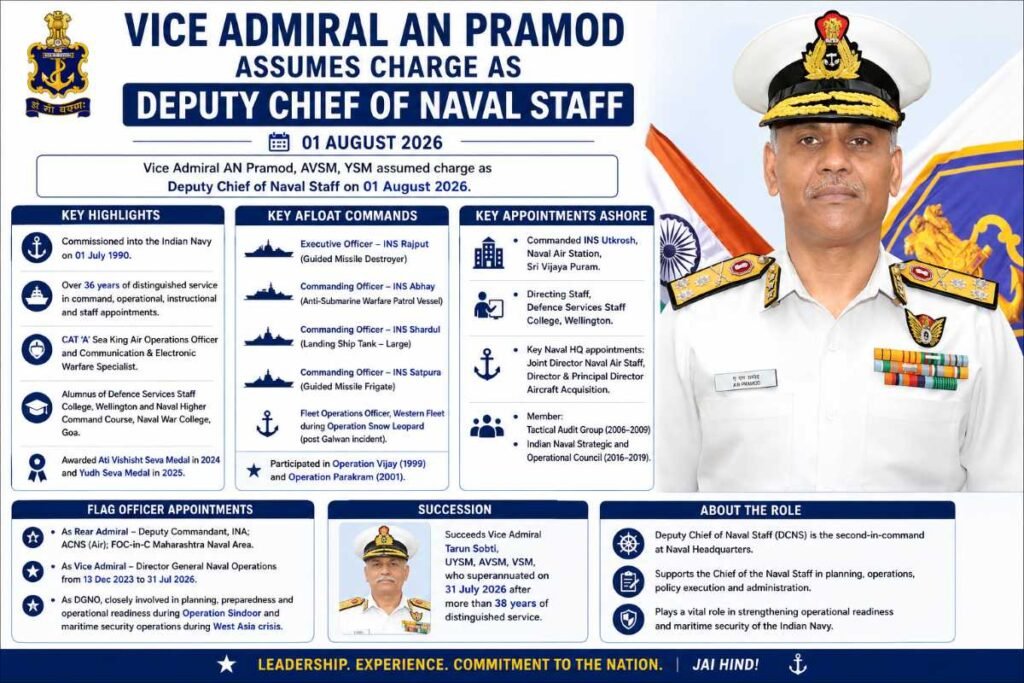
Vice Admiral AN Pramod, AVSM, YSM assumed charge as the Deputy Chief of Naval Staff (DCNS) on 1 August 2026. He succeeds Vice Admiral Tarun Sobti, who retired on 31 July 2026 after more than 38 years of distinguished service.
Vice Admiral Pramod was commissioned into the Indian Navy on 1 July 1990 and has served for more than 36 years in various command, operational, instructional and staff positions.
Key Points
New Deputy Chief of Naval Staff: Vice Admiral AN Pramod
Assumed charge:1 August 2026
Commissioned into Indian Navy:1 July 1990
Experience: More than 36 years of service
He is a CAT ‘A’ Sea King Air Operations Officer and a Communication and Electronic Warfare Specialist.
He is an alumnus of the Defence Services Staff College, Wellington, and Naval Higher Command Course, Naval War College, Goa.
He has commanded several important naval ships, including INS Abhay, INS Shardul and INS Satpura.
He participated in Operation Vijay (1999) and Operation Parakram (2001).
He served as Director General Naval Operations (DGNO) from 13 December 2023 to 31 July 2026.
As DGNO, he was involved in planning and operational readiness during Operation Sindoor and maritime security operations during the West Asia crisis.
He was awarded the Ati Vishisht Seva Medal (AVSM) in 2024 and Yudh Seva Medal (YSM) in 2025.
He succeeds Vice Admiral Tarun Sobti, who superannuated on 31 July 2026.
Exam Point
Vice Admiral AN Pramod is the new Deputy Chief of Naval Staff (DCNS), effective 1 August 2026.
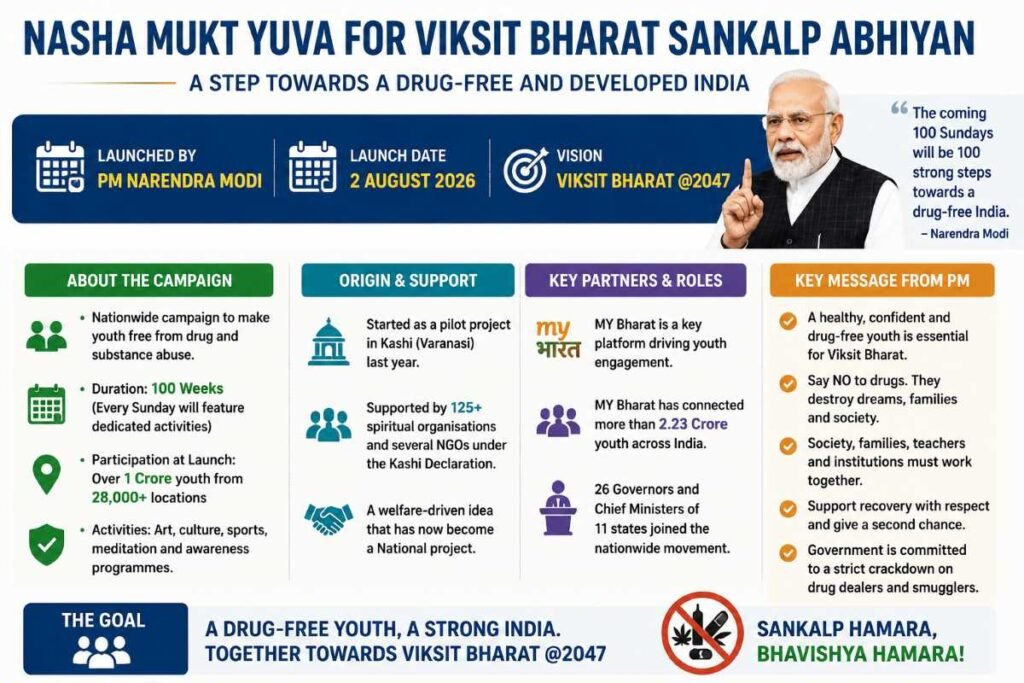
Prime Minister Narendra Modi launched the ‘Nasha Mukt Yuva for Viksit Bharat Sankalp Abhiyan’ on 2 August 2026. The campaign aims to create a drug-free India by encouraging young people to stay away from substance abuse and promoting a healthy, confident and responsible youth population.
More than 1 crore young citizens from over 28,000 locations joined the launch and took an anti-drug pledge. The campaign will run for 100 weeks, with activities organised every Sunday.
Key Points
Launched by: Prime Minister Narendra Modi
Launch date: 2 August 2026
Campaign: Nasha Mukt Yuva for Viksit Bharat Sankalp Abhiyan
Main objective: To make India’s youth free from drug and substance abuse.
100-Week Plan: The campaign will continue for 100 weeks, with activities every Sunday.
Participation: More than 1 crore youth joined the launch from 28,000+ locations.
The campaign grew from a pilot project launched in Kashi (Varanasi) in the previous year.
The initiative is supported by 125+ spiritual organisations and several NGOs under the Kashi Declaration.
MY Bharat is playing an important role in engaging young people in the campaign.
MY Bharat has connected more than 2.23 crore youth across the country.
Activities during the 100 weeks will include art, culture, sports and meditation.
The Prime Minister urged schools, colleges and universities to spread awareness about the harmful effects of drugs.
The campaign also focuses on rehabilitation and social acceptance of people recovering from addiction.
The Prime Minister emphasised that people recovering from addiction should be given respect, support and a second chance.
Dr. Mansukh Mandaviya said the campaign would become a nationwide Jan Bhagidari (people’s participation) movement.
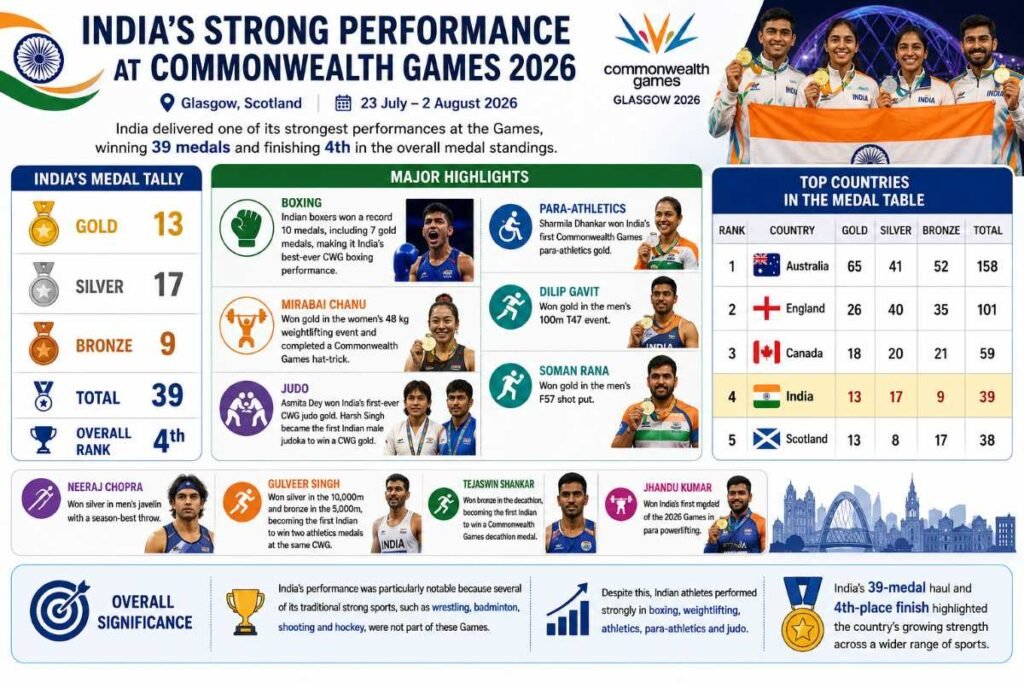
The Commonwealth Games 2026 were held in Glasgow, Scotland, from 23 July to 2 August 2026. India delivered one of its strongest performances at the Games, winning 39 medals and finishing 4th in the overall medal standings.
India won 13 gold, 17 silver and 9 bronze medals. Boxing was the biggest success for India, while weightlifting, athletics, para-athletics and judo also produced several historic achievements.
India’s Medal Tally
🥇 Gold: 13
🥈 Silver: 17
🥉 Bronze: 9
🏅 Total: 39
Overall Rank: 4th
Major Highlights
Boxing: Indian boxers won a record 10 medals, including 7 gold medals, making it India’s best-ever Commonwealth Games boxing performance.
Mirabai Chanu: Won gold in the women’s 48 kg weightlifting event and completed a Commonwealth Games hat-trick.
Judo:Asmita Dey won India’s first-ever Commonwealth Games judo gold. Harsh Singh became the first Indian male judoka to win a CWG gold.
Para-athletics:Sharmila Dhankar won India’s first Commonwealth Games para-athletics gold.
Dilip Gavit: Won gold in the men’s 100m T47 event.
Soman Rana: Won gold in the men’s F57 shot put.
Neeraj Chopra: Won silver in men’s javelin with a season-best throw.
Gulveer Singh: Won silver in the 10,000m and bronze in the 5,000m, becoming the first Indian to win two athletics medals at the same Commonwealth Games.
Tejaswin Shankar: Won bronze in the decathlon, becoming the first Indian to win a Commonwealth Games decathlon medal.
Jhandu Kumar: Won India’s first medal of the 2026 Games in para powerlifting.
Top Countries in the Medal Table
Rank
Country
Gold
Silver
Bronze
Total
1
Australia
65
41
52
158
2
England
26
40
35
101
3
Canada
18
20
21
59
4
India
13
17
9
39
5
Scotland
13
8
17
38
Overall Significance
India’s performance was particularly notable because several of its traditional strong sports, such as wrestling, badminton, shooting and hockey, were not part of these Games. Despite this, Indian athletes performed strongly in boxing, weightlifting, athletics, para-athletics and judo.
India’s 39-medal haul and 4th-place finish highlighted the country’s growing strength across a wider range of sports.
🔔
Stay Updated!
Get latest updates, jobs, results & quizzes directly on your device.