Current Affairs

Current Affairs is the most important part of every competitive exam in India. At gknow.in, we provide accurate, exam-focused, and easy-to-read current affairs to help aspirants prepare confidently for SSC, UPSC, Banking, Railways, Defence, State PCS, and other government exams.

This parent category covers all major current affairs topics, including:

  • National Current Affairs – Government updates, policies, bills, and major developments

  • International Affairs – Global events, agreements, and geopolitical updates

  • Awards & Honours – National and international recognitions

  • Culture & Heritage – Festivals, traditions, and notable cultural events

  • Science & Technology – ISRO, DRDO, space missions, innovations, discoveries

  • Polity & Governance – Constitutional amendments, committees, judicial updates

  • Important Days & Themes – Monthly observances and exam-relevant themes

  • Government Schemes – New initiatives, updates, launches, and budgets

Our content is:
Daily updated
Exam-oriented
Available in simple language

Winter Session of Parliament 2025 Concludes with Passage of Landmark Bills

Both Houses of Parliament were adjourned sine die on 19 December 2025, marking the conclusion of the 19-day Winter Session, which began on 1 December 2025.

In his valedictory address, Lok Sabha Speaker Om Birla said the Lower House held 15 sittings and recorded 111% productivity, thanking members for their cooperation. Rajya Sabha Chairman C.P. Radhakrishnan noted that the Upper House functioned for about 92 hours with 121% productivity, highlighting high-quality debates on issues of democratic and historical importance. Special discussions were held on the 150th anniversary of the national song Vande Mataram and electoral reforms, with wide participation by members.

Key legislations passed included the Viksit Bharat–G RAM G Bill 2025, the SHANTI Bill, and major insurance and health-related bills. The session also witnessed the first-ever dedicated discussion on electoral reforms in Parliament.

SHANTI Bill 2025: Major Reform in India’s Civil Nuclear Energy Sector

The Sustainable Harnessing and Advancement of Nuclear Energy for Transforming India Bill, 2025 (SHANTI Bill) represents a major reform in India’s civil nuclear sector, positioning nuclear power as a key component of the country’s clean energy transition. Passed by both Houses of Parliament in December 2025, the bill replaces outdated laws such as the Atomic Energy Act, 1962 and the Civil Liability for Nuclear Damage Act, 2010.

Despite India’s nuclear power capacity doubling since 2014, it still forms a small share of the overall energy mix. The SHANTI Bill aims to scale up nuclear energy to meet climate commitments and reduce dependence on fossil fuels.

A landmark feature of the bill is the opening of the nuclear sector to private participation, allowing private companies and joint ventures to construct, own, operate, and decommission nuclear power plants. It grants statutory authority to the Atomic Energy Regulatory Board (AERB) to strengthen safety oversight and licensing.

The bill also consolidates safety, liability, and compensation provisions into a single legal framework, reforms liability rules to attract investment while ensuring public safety, and encourages research and innovation by easing licensing for certain R&D activities.

Second WHO Global Summit on Traditional Medicine 2025 Held in New Delhi

The Second WHO Global Summit on Traditional Medicine was held in New Delhi from 17 to 19 December 2025, co-hosted by the World Health Organization (WHO) and India’s Ministry of Ayush. The summit focused on the evidence-based integration of traditional medicine into global health systems under the theme “Restoring balance: The science and practice of health and well-being.”

Held at Bharat Mandapam, New Delhi, the event was supported by the WHO Global Traditional Medicine Centre (GTMC), Jamnagar. Addressing the summit, Prime Minister Narendra Modi stressed the need to mainstream traditional medicine through research, standardisation, and global collaboration. He launched the My Ayush Integrated Services Portal (MAISP), the Ayush Mark for quality assurance, and released WHO’s technical report on Yoga training.

PM Narendra Modi Conferred Order of Oman (First Class)

Prime Minister Narendra Modi was conferred the Order of Oman (First Class) on 18 December 2025 by Sultan Haitham bin Tarik in recognition of his leadership and efforts to strengthen India–Oman relations.

The conferment coincided with the 70th anniversary of diplomatic relations between India and Oman and took place during PM Modi’s official visit to Muscat, highlighting the depth of their strategic partnership.

Instituted in 1970 by the late Sultan Qaboos bin Said, the Order of Oman is one of the Sultanate’s highest civilian honours, awarded to select global leaders for outstanding contributions to public life and bilateral relations.

Indian Army Completes Induction of AH-64E Apache Attack Helicopters

The Indian Army received the final batch of three AH-64E Apache attack helicopters from Boeing on December 16–17, 2025, completing its contracted fleet of six helicopters. The deal, signed with the United States in February 2020 for about $600 million, marks a major milestone for the Army Aviation Corps.

The helicopters arrived at Hindon Air Force Station, Ghaziabad, and will be inducted into the 451 Army Aviation Squadron at Jodhpur, Rajasthan, after assembly and technical checks. This is the first time the Indian Army has its own Apache fleet (the IAF already operates Apaches).

The AH-64E Apache is equipped with advanced sensors, night-fighting capability, Hellfire missiles, rockets, and a 30mm chain gun, making it ideal for precision strikes, reconnaissance, desert warfare, and border operations. The induction significantly enhances India’s strike capability and combat readiness, especially along the western frontiers, and reflects the strengthening India–US defence partnership.

India Launches First Wildlife-Safe Highway on NH-45

India launched its first wildlife-safe highway on National Highway-45 (Bhopal–Jabalpur stretch) in Madhya Pradesh in December 2025, marking a major step toward eco-sensitive infrastructure development. The highway passes through the Veerangana Durgavati Tiger Reserve and near the Nauradehi Wildlife Sanctuary, making wildlife protection a critical concern. A 2 km ghat section of the 11.9 km stretch has been specially redesigned to reduce animal–vehicle collisions.

Key safety features include 5 mm thick thermoplastic red road markings that visually and physically slow vehicles, 25 animal underpasses supported by fencing to guide wildlife toward safe crossings, and speed detection and monitoring systems to enforce limits. The project balances road expansion with conservation needs through an eco-friendly design.

The initiative gained urgency after recent wildlife fatalities on highways, including a cheetah cub death near Kuno National Park. By adopting global best practices, this project sets a first-of-its-kind model in India for highways passing through forest corridors.

Overall, the NH-45 wildlife-safe highway demonstrates how infrastructure growth and biodiversity conservation can coexist, offering a scalable model for future projects across India.

VB-G RAM G Bill 2025: New Law to Replace MGNREGA

The Viksit Bharat–Guarantee for Rozgar and Ajeevika Mission (Gramin) Bill, 2025 (VB-G RAM G Bill) was introduced in the Lok Sabha on 16 December 2025. It proposes to replace the Mahatma Gandhi National Rural Employment Guarantee Act (MGNREGA), marking the biggest reform in India’s rural employment framework in over two decades.

About MGNREGA

MGNREGA, enacted in 2005, guarantees 100 days of wage employment per year to rural households. It has been one of India’s largest social security schemes, providing livelihood support, reducing rural distress, and creating basic rural assets.

What the New Bill Proposes

  • Guaranteed Employment: Increases assured work from 100 days (MGNREGA) to 125 days annually.
  • Infrastructure Focus: Shifts from temporary works to durable rural infrastructure like roads and irrigation.
  • Digital & Transparent System: Real-time wage payments, digital tracking, and stricter audits.
  • Skill Development: Training for rural workers to meet modern economic needs.
  • Funding Change: Revises the Centre–State funding ratio, raising concerns among states.

Indian Film Homebound Shortlisted for Oscars 2026

The Indian film Homebound, directed by Neeraj Ghaywan, has been shortlisted for the 98th Academy Awards (Oscars 2026) in the Best International Feature Film category.

Homebound is among 15 films that have become eligible for final nominations in this category, which highlights outstanding cinema from around the world. Being shortlisted marks a significant achievement for Indian cinema on the global stage.

The final nominations in the shortlisted categories will be announced on 22 January 2026, while the 98th Academy Awards ceremony is scheduled to take place on 15 March 2026.

PM Narendra Modi Conferred Ethiopia’s Highest Civilian Award

Prime Minister Narendra Modi was conferred Ethiopia’s highest civilian award, The Great Honour Nishan of Ethiopia during his visit to Addis Ababa in December 2025. He became the first global Head of State or Government to receive this prestigious honour, marking a historic moment in India–Ethiopia relations.

The award was bestowed by Ethiopian Prime Minister Abiy Ahmed Ali at a special ceremony, recognising PM Modi’s visionary leadership and his role in strengthening Ethiopia’s global partnerships, particularly with India. It reflects Ethiopia’s appreciation of India’s growing influence in Africa and its long-standing cooperation with the country.

Raj Kumar Goyal Appointed as Chief Information Commissioner of India

Raj Kumar Goyal, a retired 1990-batch IAS officer of the AGMUT cadre, was sworn in as India’s new Chief Information Commissioner (CIC) on 15 December 2025 at Rashtrapati Bhavan. The oath of office and secrecy was administered by President Droupadi Murmu in the presence of senior dignitaries.

Before his appointment, Goyal served as Secretary, Department of Justice under the Ministry of Law and Justice and earlier as Secretary (Border Management) in the Ministry of Home Affairs. With over three decades of experience in public administration, he brings extensive expertise in governance, justice, and internal security.

His name was recommended by a high-level selection committee chaired by Prime Minister Narendra Modi, with Home Minister Amit Shah and Leader of Opposition Rahul Gandhi as members.

Goyal’s appointment is significant as it restores the Central Information Commission to full operational strength after nine years. His leadership is expected to strengthen the implementation of the Right to Information Act, 2005, enhancing transparency and accountability in Indian governance.

India Wins Maiden Squash World Cup 2025 – Creates Sporting History

India created history by winning its maiden Squash World Cup title in December 2025, defeating top-seeded Hong Kong 3–0 in the final held at Chennai. With this victory, India became the first Asian nation to lift the prestigious mixed-team Squash World Cup trophy.

The final, played on 14 December 2025 at the Express Avenue Mall, saw a dominant all-round performance by the Indian team. Joshna Chinappa’s experience, Abhay Singh’s composure, Anahat Singh’s fearless play, and Velavan Senthilkumar’s consistency were key to India’s unbeaten run in the tournament. Entering as the second seed, India did not drop a single tie throughout the competition, upgrading its bronze medal from 2023 to gold.

The victory is a major milestone for Indian sports and significantly boosts the country’s profile in squash ahead of the sport’s Olympic debut at the Los Angeles 2028 Games.

Vijay Diwas : India’s Historic Victory in the 1971 War

Vijay Diwas is observed every year on 16 December to mark India’s historic victory in the 1971 Indo-Pak war, which led to the liberation of Bangladesh. The war began on 3 December 1971 and lasted only 13 days, making it one of the shortest and most decisive wars in history.

The conflict arose from a severe humanitarian crisis in East Pakistan, where atrocities forced millions of refugees to flee into India. Responding to this crisis, India intervened. On 16 December 1971, Pakistan’s Eastern Command, led by General A.A.K. Niazi, surrendered unconditionally along with 93,000 troops to the Indian Armed Forces and the Mukti Bahini—one of the largest military surrenders since World War II.

The victory resulted in the creation of Bangladesh and significantly altered South Asian geopolitics. Vijay Diwas symbolizes India’s military strength, strategic leadership, and humanitarian commitment.

Lionel Messi’s GOAT India Tour 2025: A Historic Moment for Indian Football

Lionel Messi’s “GOAT India Tour 2025” was a landmark event for Indian football, held from 13 to 15 December 2025 across Kolkata, Hyderabad, Mumbai, and New Delhi. The three-day visit generated massive fan enthusiasm and placed India firmly on the global football map. Messi was accompanied by fellow football stars Luis Suárez and Rodrigo De Paul, adding to the excitement and international attention.

The tour began in Kolkata, widely regarded as India’s football capital, where thousands of fans gathered to welcome Messi, reflecting the city’s deep football culture. In Hyderabad, the focus shifted to grassroots football, with fan interactions and youth-oriented activities highlighting the sport’s growing popularity among young Indians. Mumbai witnessed one of the most memorable moments of the tour when Messi met Sachin Tendulkar and exchanged jerseys with Sunil Chhetri, symbolizing unity between cricket and football—India’s two major sporting passions. The overwhelming crowd response in Mumbai underlined Messi’s unmatched global appeal.

The tour concluded in New Delhi, where Messi met Prime Minister Narendra Modi, giving the visit a strong diplomatic and cultural dimension. Overall, the GOAT India Tour 2025 was more than a fan event; it promoted football, inspired young athletes, strengthened cultural exchange, and showcased India as an emerging hub for global sports engagement.

Harimau Shakti 2025: India–Malaysia Joint Military Exercise

Harimau Shakti 2025 is the 5th India–Malaysia joint military exercise, held from 5–18 December 2025 at Mahajan Field Firing Range, Rajasthan. It involved the Dogra Regiment (India) and the 25th Battalion, Royal Malaysian Army.

The exercise focused on counter-insurgency, counter-terrorism, and UN peacekeeping operations, aiming to enhance interoperability, operational readiness, and bilateral defence cooperation between the two countries.

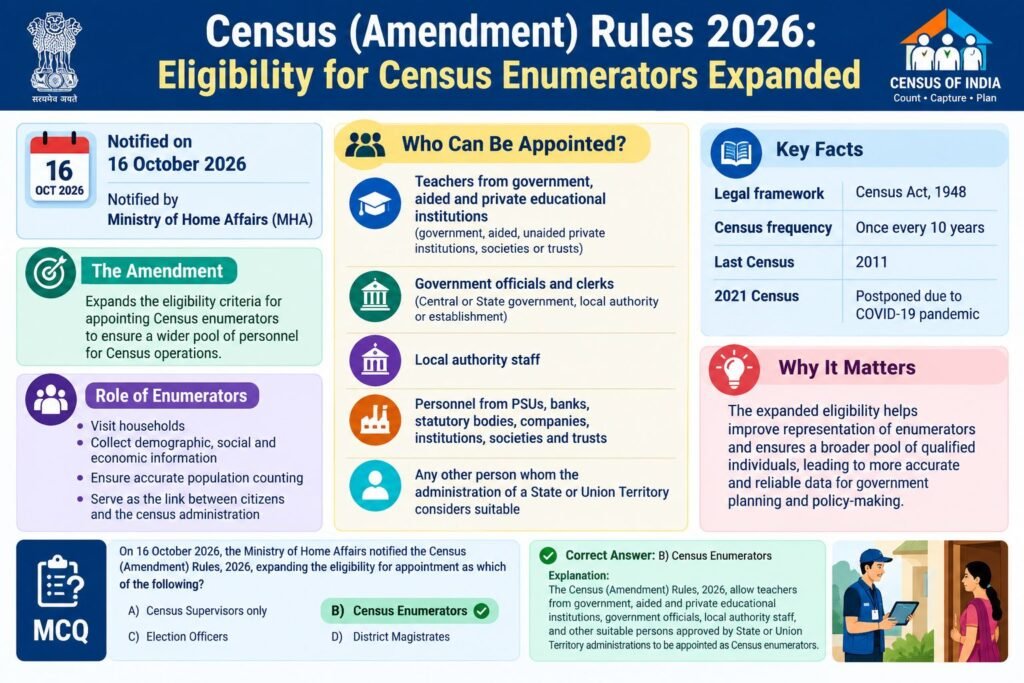
Govt Approves ₹11,718 Crore Budget for India’s First Digital Census 2027

On 12 December 2025, the Union Cabinet approved a budget of ₹11,718 crore for conducting Census 2027.

Census 2027 will be conducted in two phasesPhase I (Houselisting and Housing Census) and Phase II (Population Enumeration). It will be India’s 16th Census overall and the 8th Census since Independence. India’s Census is regarded as the largest administrative and statistical exercise in the world.

A major highlight is that Caste Enumeration will be included in Census 2027. It will also be India’s first-ever digital Census, with data collection carried out through mobile applications available on both Android and iOS platforms.

Around 30 lakh field functionaries will be deployed for the exercise. Census 2027 will cover the entire population of the country, involving door-to-door visits to every household using separate questionnaires for housing and population data.

Government Approves CoalSETU Policy for Transparent Coal Linkage Auctions

On 12 December 2025, the Government of India approved the CoalSETU policy to ensure seamless, efficient, and transparent utilisation of coal resources. The decision was taken by the Cabinet Committee on Economic Affairs (CCEA) chaired by Prime Minister Narendra Modi.

Under this policy, a new auction window called ‘CoalSETU’ has been introduced within the Non-Regulated Sector (NRS) Coal Linkage Auction Policy, 2016. The policy enables long-term auction of coal linkages for any industrial use and exports, ensuring fair access to coal.

Any domestic buyer can participate in the auction irrespective of end use. Coal linkages obtained under CoalSETU can be used for own consumption, exports, or other purposes such as coal washing, but resale within the country is not permitted.

Additionally, linkage holders are allowed to export up to 50% of the allocated coal and can flexibly utilise coal among group companies, improving operational efficiency and optimal resource utilisation.

Supriya Sahu Wins UNEP Champions of the Earth 2025 Award

Supriya Sahu, Additional Chief Secretary, Department of Environment, Climate Change and Forests, Tamil Nadu, has been awarded the UNEP Champions of the Earth 2025 in the Inspiration and Action category. This is the United Nations’ highest environmental honour.


⭐ Why She Received the Award

  • Recognised for sustainable cooling initiatives, ecosystem restoration, and climate resilience projects in Tamil Nadu.
  • Demonstrated how integrated governance and nature-based solutions can protect vulnerable communities.
  • Promoted climate action that created around 2.5 million green jobs.
  • Strengthened campaigns against single-use plastics and improved wildlife conservation efforts.
  • Advocated a model combining low-tech + high-tech solutions to reduce greenhouse gas emissions.

🏛️ Global Stage

  • Award announced during the UN Environment Assembly (UNEA-7) held in Nairobi.
  • Highlights Tamil Nadu as a global leader in climate mitigation, adaptation, and heat-resilience planning.

Modi–Trump Phone Call: India–U.S. Trade Progress and Strategic Cooperation

Prime Minister Narendra Modi and U.S. President Donald Trump held a telephonic conversation on 11 December 2025 to review bilateral ties and ongoing trade negotiations. The discussion focused on strengthening the India–U.S. Comprehensive Global Strategic Partnership, with emphasis on trade, defence, energy, and emerging technologies.

Both leaders assessed progress in resolving tariff disputes and improving market access as negotiations between Indian and U.S. trade officials continue. They also discussed Indo-Pacific security, highlighting the need for maritime cooperation and regional stability.

The call came soon after the India–Russia summit, reflecting India’s balanced and multi-alignment foreign policy.

Germany Wins 2025 FIH Men’s Junior Hockey World Cup; India Secures Bronze

Germany won the FIH Men’s Junior Hockey World Cup 2025 in Chennai on 10 December 2025, defeating Spain 3–2 in a shoot-out after a 1–1 draw in regulation time, securing their eighth title. Justus Warweg scored for Germany, while Nicolas Mustaros equalised for Spain before the match went to penalties.

India claimed their first-ever bronze medal in the Junior World Cup with a brilliant 4–2 comeback win against Argentina, scoring four goals in eleven minutes through Ankit Pal, Manmeet Singh, Shardanand Tiwari, and Anmol Ekka.

Deepavali Inscribed on UNESCO’s Intangible Cultural Heritage List as India’s 16th Element

Deepavali (Diwali), the festival of lights, has been officially inscribed on UNESCO’s List of the Intangible Cultural Heritage of Humanity during the 20th UNESCO Intergovernmental Committee session held at the Red Fort, New Delhi (8–13 December 2025). This makes Deepavali the 16th Indian element on the UNESCO Intangible Heritage list. The announcement was celebrated in Nepal with bhajan gatherings and lamp-lighting at the Pashupati Temple, where community members expressed pride in the global recognition of their tradition.

UNESCO delegates from 194 member states adopted the inscription, acknowledging Deepavali as a living tradition symbolising light over darkness and good over evil. Prime Minister Narendra Modi welcomed the recognition, noting that Deepavali reflects the soul of India’s civilisation.

The festival’s practices—lighting oil lamps, fireworks, community gatherings, and home-cleaning rituals—promote social bonding, cultural continuity, and hygiene. The inscription honours the millions who celebrate the festival, the artisans who preserve its traditions, and the enduring cultural values it represents.

India’s list of intangible heritage elements already includes Garba, Durga Puja, Kumbh Mela, Yoga, Vedic chanting, Ramlila, and several other iconic cultural traditions.

India Installs 7075.78 MW Rooftop Solar Under PM Surya Ghar Muft Bijli Yojana; Gujarat Leads the Nation

India has successfully installed 7,075.78 MW of rooftop solar capacity under the PM Surya Ghar: Muft Bijli Yojana, covering nearly 24 lakh households across the country as of December 2025.


🌞 Overview of the Scheme

  • PM Surya Ghar: Muft Bijli Yojana (PMSG: MBY): A demand-driven program launched to promote residential rooftop solar installations.
  • Target: One crore households by FY 2026–27.
  • Financial Outlay: ₹75,021 crore allocated for implementation.
  • Eligibility: All residential consumers with grid-connected electricity connections can apply via the National Portal.

📊 Current Achievements

  • Installed Capacity: 7,075.78 MW rooftop solar in the residential sector.
  • Households Covered: 23.96 lakh households, which is about 23.96% of the target.
  • Top Performing States:
    • Gujarat: 1,828 MW
    • Maharashtra: 1,322 MW
    • Uttar Pradesh: 1,024 MW
      Together, these three states account for nearly 60% of total capacity.

⚡ Benefits to Citizens

  • Free Electricity: Households can generate up to 300 units per month free of cost, reducing dependence on grid supply.
  • Savings: Lower electricity bills and long-term financial relief.
  • Sustainability: Promotes clean energy adoption, reducing carbon footprint.
  • Community Empowerment: Encourages decentralized energy production and local participation.

Andrej Babiš Reappointed as Prime Minister of Czech Republic

Andrej Babiš was officially appointed Prime Minister of the Czech Republic on 9 December 2025 by President Petr Pavel, marking his return after his earlier tenure from 2017–2021. Leader of the ANO party, Babiš formed a coalition with eurosceptic groups after winning the October 2025 elections.

He pledged to prioritise Czech national interests, adopt a cautious stance on EU integration, and reassess support for Ukraine, signalling a shift in Czech domestic and foreign policy.

India Hosts 20th UNESCO Intangible Cultural Heritage Committee Session at Red Fort

India is hosting the 20th session of UNESCO’s Intergovernmental Committee for the Safeguarding of Intangible Cultural Heritage at the Red Fort, New Delhi, from 8 to 13 December 2025. The session is chaired by Ambassador Vishal V. Sharma, India’s Permanent Delegate to UNESCO, and brings together international delegates, cultural experts, and policymakers to review new nominations and strengthen global cooperation under the 2003 UNESCO Convention.

A key highlight of the session is India’s nomination of Diwali for inclusion in UNESCO’s Intangible Cultural Heritage list. India currently has 15 elements already inscribed, including Yoga, Kumbh Mela, and Ramlila.

India Achieves 50% Non-Fossil Power Capacity Target Five Years Ahead of 2030 Deadline

India has achieved a major clean energy milestone by installing 50% of its total power capacity from non-fossil fuel sources, reaching its Panchamrit target five years ahead of the 2030 deadline. As per data tabled in the Lok Sabha on 8 December 2025, India’s total installed power capacity stood at 485 GW as of 30 June 2025, out of which 243 GW came from non-fossil sources. The Standing Committee on Energy praised the MNRE, Ministry of Power, and stakeholders for this progress.

India has already installed 116 GW of solar capacity and aims to reach 292 GW by 2030 as part of its larger 500 GW non-fossil power target. To achieve this, around 176 GW of new solar capacity must be added in the next five years. Currently, 128 GW is under implementation, while 62 GW is in the tendering stage.

However, the Committee highlighted key challenges such as land acquisition delays, grid connectivity issues, inadequate energy storage, and the need to strengthen domestic manufacturing. Land requirements are particularly critical, as 4–7 acres are needed per MW of solar power, and India may need 1.4–2 million hectares of land for long-term solar expansion. This could lead to conflicts with agriculture and ecologically sensitive areas. The Committee urged strict adherence to the planned energy transition roadmap to sustain progress.

IGNCA Launches Book “Bharat: That Is India – Reclaiming Our Real Identity” in New Delhi

On 7 December 2025, the Indira Gandhi National Centre for the Arts (IGNCA) launched the book “Bharat: That Is India – Reclaiming Our Real Identity” authored by Abhijeet Joag in New Delhi. The event was attended by eminent personalities including Bihar Governor Arif Mohammad Khan and IGNCA Trust President Ram Bahadur Rai.

The programme witnessed active participation from scholars, students, and cultural enthusiasts, reflecting strong interest in India’s history and cultural identity.

FIFA World Cup 2026: First-Ever Tri-Nation Tournament with 48 Teams

The FIFA World Cup 2026 will be the largest edition in history, jointly hosted by the USA, Canada, and Mexico from June 11 to July 19, 2026 across 16 cities. For the first time, the tournament will feature an expanded 48-team format, divided into 12 groups of four teams, with 32 teams advancing to the knockout stage.

The opening match will be played at Estadio Azteca, Mexico City, while the final is scheduled at MetLife Stadium, New York/New Jersey. Argentina, the 2022 champions, will defend their title. The tournament marks the first tri-nation hosting, making it the most inclusive and geographically diverse World Cup ever.

Armed Forces Flag Day Observed on December 7 to Honour India’s Defence Personnel

Armed Forces Flag Day is observed annually on December 7 in India to honour the sacrifice, courage, and service of the Army, Navy, and Air Force. Established in 1949, the day was instituted to create awareness and raise funds for the welfare of ex-servicemen, war widows, and their dependents through the Armed Forces Flag Day Fund (AFFDF).

On this day, citizens contribute voluntarily and receive small flags or stickers as a symbol of solidarity with the armed forces. The observance reflects national gratitude, unity, and responsibility toward those who protect the nation.

India–Malaysia Begin 5th Edition of ‘Harimau Shakti’ Joint Military Exercise in Rajasthan

India and Malaysia commenced the fifth edition of the joint military exercise ‘Harimau Shakti’ on 5 December 2025 at the Mahajan Field Firing Range in Rajasthan, which will continue till 18 December. The exercise focuses on enhancing interoperability in sub-conventional operations under the UN Chapter VII mandate.

The Indian Army is represented mainly by the Dogra Regiment, while Malaysia is represented by the 25th Battalion of the Royal Malaysian Army. Training includes counter-terrorism operations, cordon-and-search drills, search-and-destroy missions, heliborne operations, martial arts, combat reflex shooting, and yoga. Both sides will also rehearse helipad security and casualty evacuation in hostile environments. The exercise aims to improve joint operational readiness, reduce risks, and strengthen defence cooperation and bilateral ties between India and Malaysia.

Putin Concludes Two-Day India Visit, Boosts Trade, Defence and Energy Ties

Russian President Vladimir Putin concluded his two-day visit to India on 5 December 2025, reaffirming the enduring, India–Russia “Special and Privileged Strategic Partnership.”

During the 23rd India–Russia Summit in New Delhi, both sides set an ambitious $100 billion bilateral trade target by 2030, advanced discussions on a free trade agreement with the Eurasian Economic Union, strengthened defence manufacturing cooperation, and expanded energy and nuclear collaboration, including continued Russian oil supplies to India. The visit highlighted India’s balanced foreign policy amid global geopolitics and underscored Russia’s effort to reinforce strategic partnerships despite Western sanctions.

RBI Monetary Policy Committee cut the policy repo rate by 25 basis points to 5.25%

The Reserve Bank of India’s Monetary Policy Committee unanimously cut the policy repo rate by 25 basis points to 5.25% in its December 2025 meeting. This marks the fourth rate reduction in 2025, bringing the cumulative cut for the year to 125 basis points. The move comes amid a backdrop of strong economic growth and subdued inflation, described by RBI Governor Sanjay Malhotra as a “rare Goldilocks period”.

Key details and implications of the announcement:

  • Economic Forecasts: The RBI revised its FY26 GDP growth estimate upward to 7.3% (from 6.8%) and lowered its CPI inflation projection to 2% (from 2.6%).
  • Liquidity Measures: To ensure smoother monetary policy transmission and support liquidity, the central bank announced plans for Open Market Operations (OMO) purchases of government securities worth ₹1 lakh crore and a three-year dollar-rupee buy-sell swap of $5 billion.
  • Impact on Borrowers: The repo rate cut is expected to lead to lower interest rates on loans, benefiting borrowers through reduced Equated Monthly Instalments (EMIs) for home and auto loans.
  • Impact on Investors: Lower interest rates are likely to impact fixed deposit returns, while potentially boosting rate-sensitive sectors of the stock market, such as real estate, auto, and banking.
  • Policy Stance: The MPC has maintained a “neutral” policy stance, leaving room for future adjustments based on evolving economic conditions.
Scroll to Top