Current Affairs is one of the most important sections of competitive examinations in India. At GK Now, we provide daily, accurate, and exam-oriented current affairs covering the latest national and international developments that are important for competitive exam preparation.
This category brings together short, easy-to-read current affairs articles designed to help aspirants quickly understand and revise important events, facts, appointments, government decisions, schemes, sports, science and technology, and other exam-relevant developments.
Topics Covered
National Current Affairs – Important government decisions, policies, bills, major developments, and national events
International Affairs – Global events, international relations, agreements, organisations, and major developments
Appointments – Important appointments, transfers, and new heads of organisations and institutions
Polity & Governance – Constitutional developments, Parliament, Supreme Court and High Court decisions, committees, and governance
Government Schemes & Policies – New schemes, initiatives, Cabinet decisions, programmes, and policy updates
Science & Technology – ISRO, DRDO, space missions, scientific discoveries, technology, and important innovations
Sports Current Affairs – Major tournaments, championships, records, medals, athletes, and sports-related developments
Awards & Honours – Important national and international awards, honours, and recognitions
Defence & Security – Defence exercises, military developments, weapons systems, appointments, and national security
Economy & Banking – Important economic developments, RBI updates, banking, finance, budgets, and major reports
Culture & Heritage – Festivals, traditions, heritage sites, cultural events, and important personalities
Important Days & Themes – National and international days, annual themes, and their significance
Why Follow GK Now Current Affairs?
✅ Daily Updated – 2–3 important current affairs articles are added regularly.
✅ Exam-Oriented – Focused on facts and developments relevant to competitive examinations.
✅ Short & Easy to Read – Important information is presented in a simple and concise format.
✅ Multiple Subjects – Covers national, international, polity, economy, science, sports, defence, awards, and other important areas.
✅ Useful for Revision – Key facts are presented in a format suitable for quick revision and MCQ preparation.
GK Now Current Affairs is useful for aspirants preparing for SSC, UPSC, Banking, Railways, Defence, State PCS, Police, Teaching, and other government and competitive examinations.
Bookmark this page and follow GK Now for daily current affairs updates and exam-relevant news.
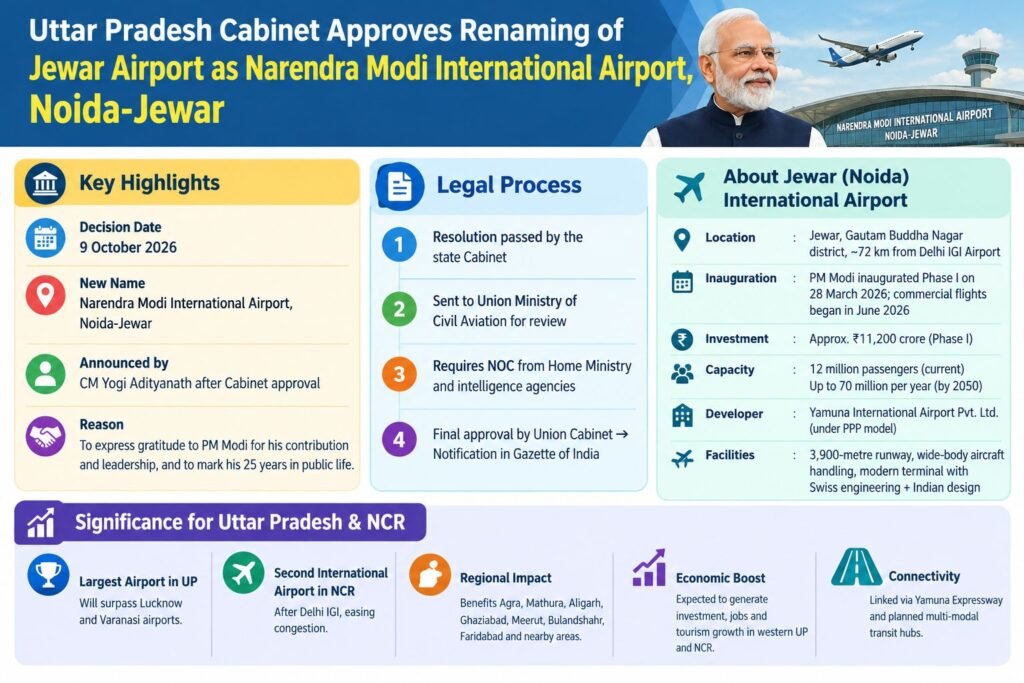
Uttar Pradesh Cabinet has officially approved renaming the Noida International Airport at Jewar asNarendra Modi International Airport, Noida-Jewar. The move, announced on 9 October 2026 by CM Yogi Adityanath.
✈️ Key Highlights of the Renaming
Decision Date: 9 October 2026
New Name:Narendra Modi International Airport, Noida-Jewar
Announced by: CM Yogi Adityanath after Cabinet approval
Legal Process:
Resolution passed by the state Cabinet
Sent to Union Ministry of Civil Aviation for review
Requires NOC from Home Ministry and intelligence agencies
Final approval by Union Cabinet → Notification in Gazette of India
🏗️ About Jewar (Noida) International Airport
Location: Jewar, Gautam Buddha Nagar district, ~72 km from Delhi IGI Airport.
Inauguration: PM Modi inaugurated Phase I on 28 March 2026; commercial flights began in June 2026.
Investment: Approx. ₹11,200 crore for Phase I.
Capacity:
Current: 12 million passengers annually
Future: Up to 70 million passengers per year by 2050 (multi-runway expansion).
Developer: Yamuna International Airport Pvt. Ltd. (subsidiary of Zurich Airport International AG) under PPP model.
Facilities: 3,900-metre runway, wide-body aircraft handling, modern terminal with Swiss engineering + Indian design.
Largest Airport in UP: Will surpass Lucknow and Varanasi airports.
Second International Airport in NCR: After Delhi IGI, easing congestion.
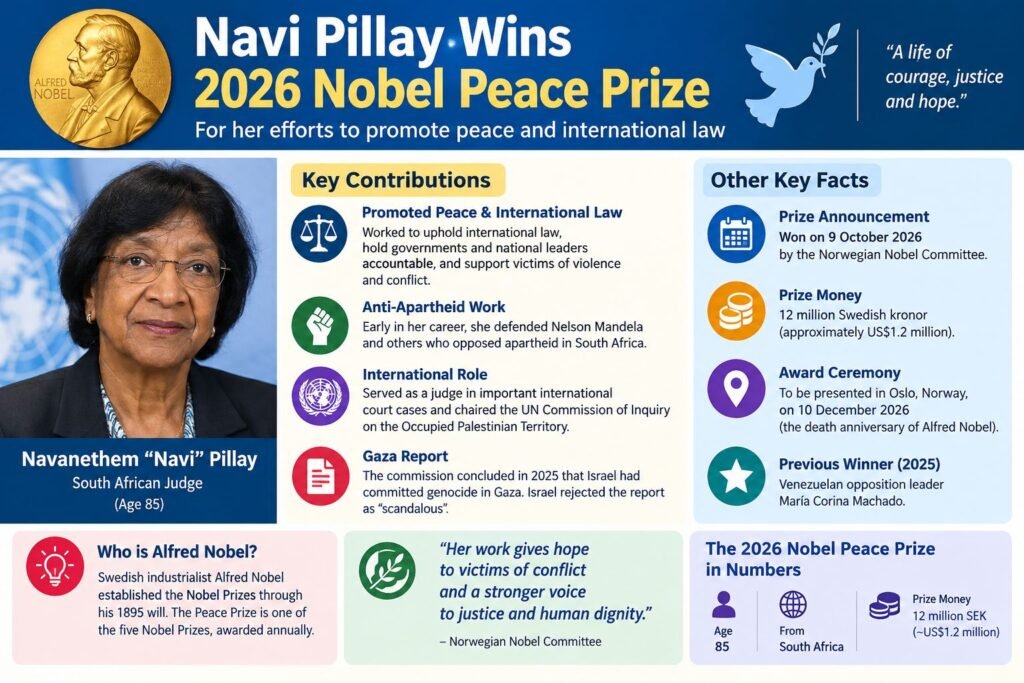
South African judge Navanethem “Navi” Pillay, 85, won the 2026 Nobel Peace Prize on 9 October 2026 for her efforts to promote peace and international law, according to the Norwegian Nobel Committee.
Contribution: She worked to uphold international law, hold governments and national leaders accountable, and support victims of violence and conflict.
Anti-apartheid work: Early in her career, she defended Nelson Mandela and others who opposed apartheid in South Africa.
International role: She served as a judge in important international court cases and chaired the United Nations Commission of Inquiry on the Occupied Palestinian Territory.
Gaza report: The commission concluded in 2025 that Israel had committed genocide in Gaza. Israel rejected the report as “scandalous.”
Prize money: 12 million Swedish kronor (approximately US$1.2 million).
Award ceremony: The prize is scheduled to be presented in Oslo, Norway, on 10 December 2026, the death anniversary of Alfred Nobel, who established the Nobel Prizes through his 1895 will.
Previous winner: Venezuelan opposition leader María Corina Machado won the 2025 Nobel Peace Prize.
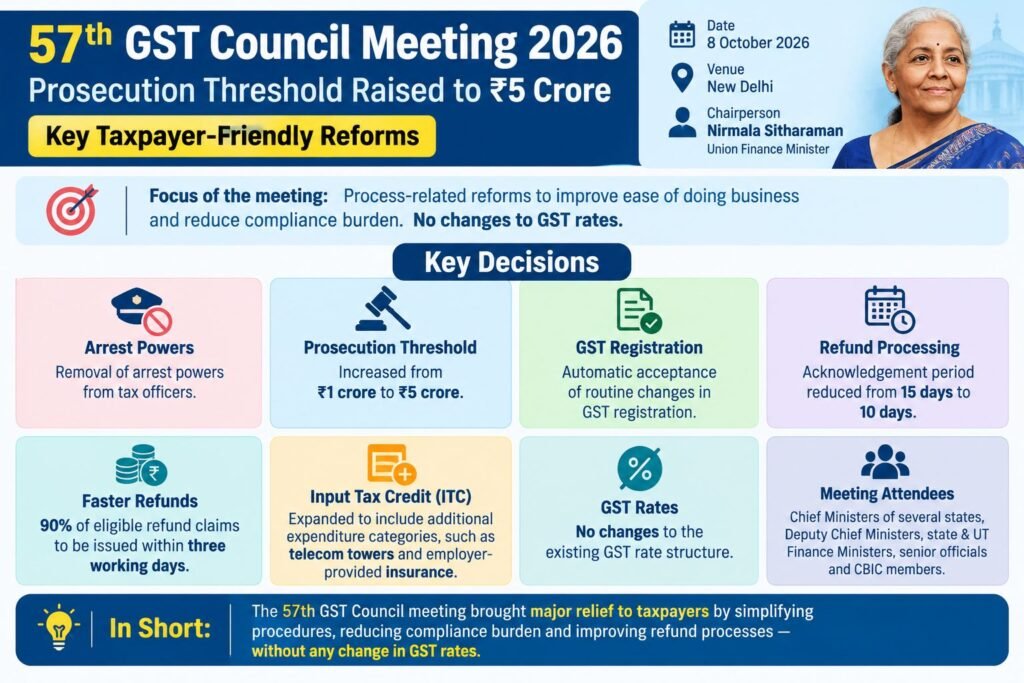
On 8 October 2026, the 57th GST Council meeting, chaired by Union Finance Minister Nirmala Sitharaman in New Delhi, approved several procedural reforms to improve the ease of doing business and reduce the compliance burden on taxpayers. The Council focused on simplifying GST procedures, with no changes to GST rates.
Key Decisions
Arrest Powers: Removal of arrest powers from tax officers, as announced by the Finance Minister.
Prosecution Threshold: Increased from ₹1 crore to ₹5 crore.
GST Registration: Automatic acceptance of routine changes in GST registration.
Refund Processing: Acknowledgement period reduced from 15 days to 10 days.
Faster Refunds: 90% of eligible refund claims to be issued within three working days.
Input Tax Credit (ITC): Expanded eligibility to cover additional expenditure categories, including telecom towers and employer-provided insurance.
GST Rates: No changes were made to the existing GST rate structure.
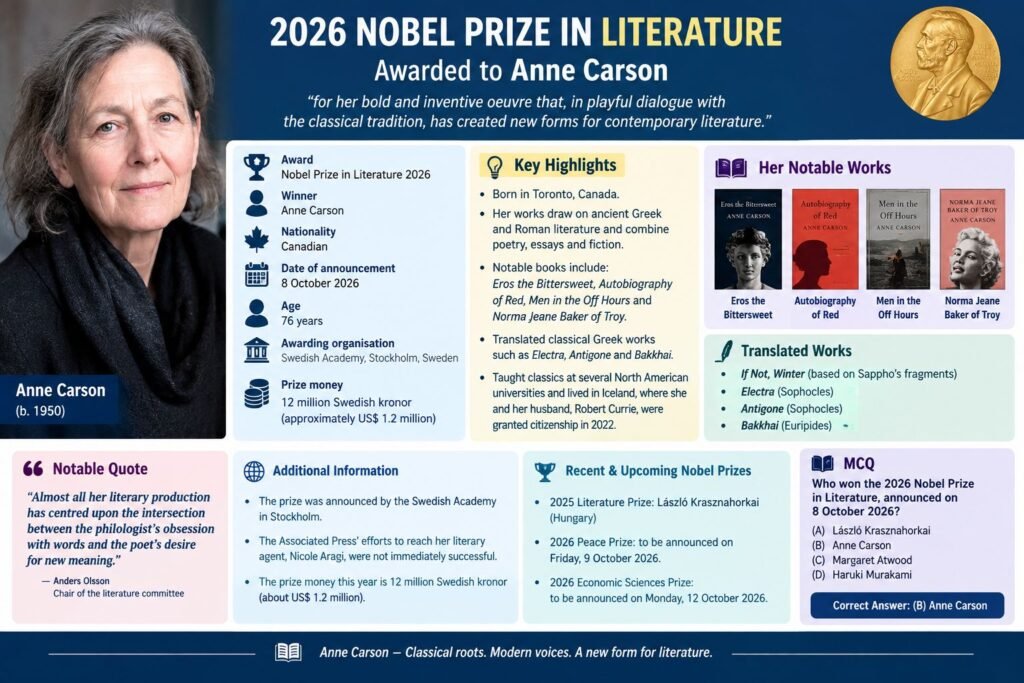
On 8 October 2026, Canadian poet and essayist Anne Carson won the 2026 Nobel Prize in Literature for her innovative literary works combining classical traditions with new forms of contemporary literature.
Anne Carson was born in Toronto, Canada.
Her works draw inspiration from ancient Greek and Roman literature and combine poetry, essays and fiction.
Her notable books include Eros the Bittersweet, Autobiography of Red, Men in the Off Hours and Norma Jeane Baker of Troy.
She has also translated classical Greek works, including Electra, Antigone and Bakkhai.
In 2025, Hungarian writer László Krasznahorkai won the Nobel Prize in Literature.
The 2026 Nobel Peace Prize was scheduled to be announced on Friday, 9 October, while the Nobel Memorial Prize in Economic Sciences was scheduled for Monday, 12 October.
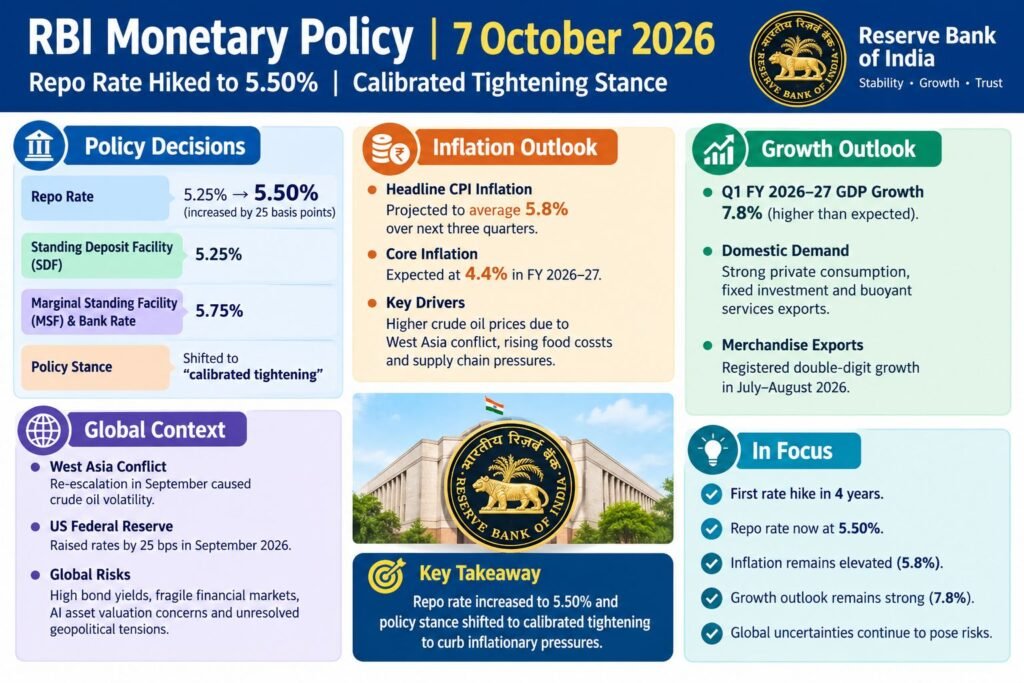
On 7 October 2026, the RBI Monetary Policy Committee (MPC) unanimously raised the repo rate by 25 basis points to 5.50%, marking the first rate hike in four years. The policy stance was changed to “calibrated tightening” to contain rising inflationary pressures.
Key Points:
Repo Rate: 5.25% → 5.50%
SDF:5.25%
MSF & Bank Rate:5.75%
CPI inflation: Projected at 5.8% over the next three quarters.
Core inflation: Expected at 4.4% in FY 2026–27.
Q1 FY 2026–27 GDP growth:7.8%
Inflation risks were linked to higher crude oil prices, food costs and supply-chain pressures.
Strong domestic consumption, investment and services exports supported economic growth.
Global risks included West Asia tensions, high bond yields and financial-market volatility.
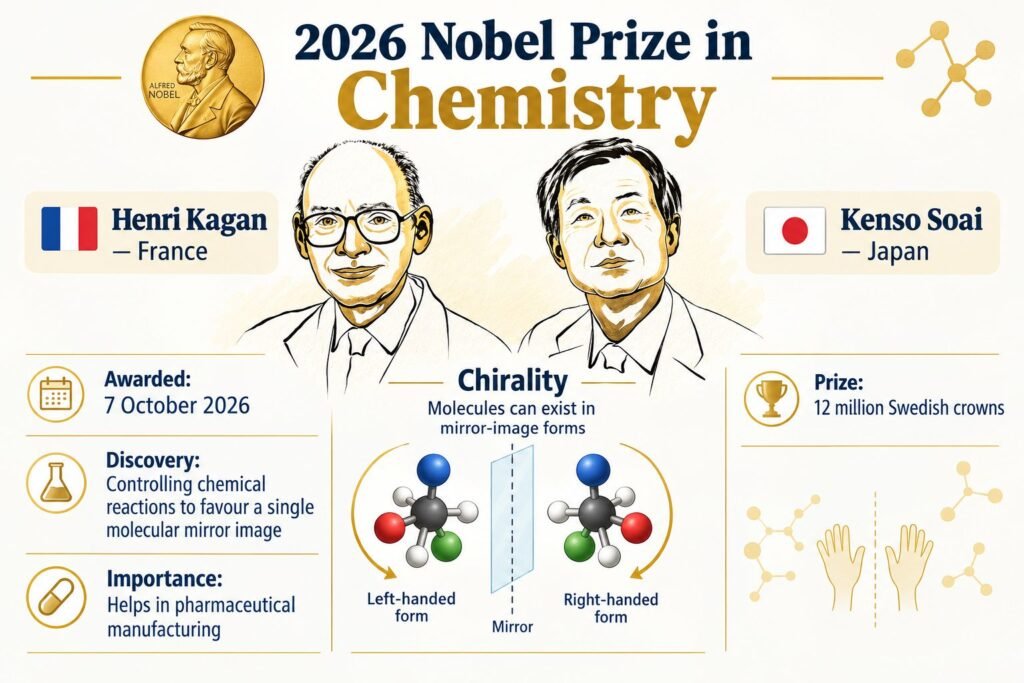
On 7 October 2026, Henri Kagan of France and Kenso Soai of Japan won the 2026 Nobel Prize in Chemistry for discoveries that showed how chemical reactions can be controlled to produce a single molecular mirror image.
Many molecules exist in two mirror-image forms, like left and right hands. This property is called chirality.
Living organisms generally use only one form, a phenomenon known as homochirality.
Their work helped chemists develop reactions that favour one specific mirror-image form of a molecule.
The discovery is especially important in pharmaceutical manufacturing, because one form of a drug may provide the desired therapeutic effect while the other can cause unwanted or harmful side effects.
Kenso Soai is Japanese, while Henri Kagan is French.
The laureates will receive their medals from King Carl XVI Gustaf of Sweden in Stockholm on 10 December 2026.
They will share a prize of 12 million Swedish crowns (about $1.2 million).
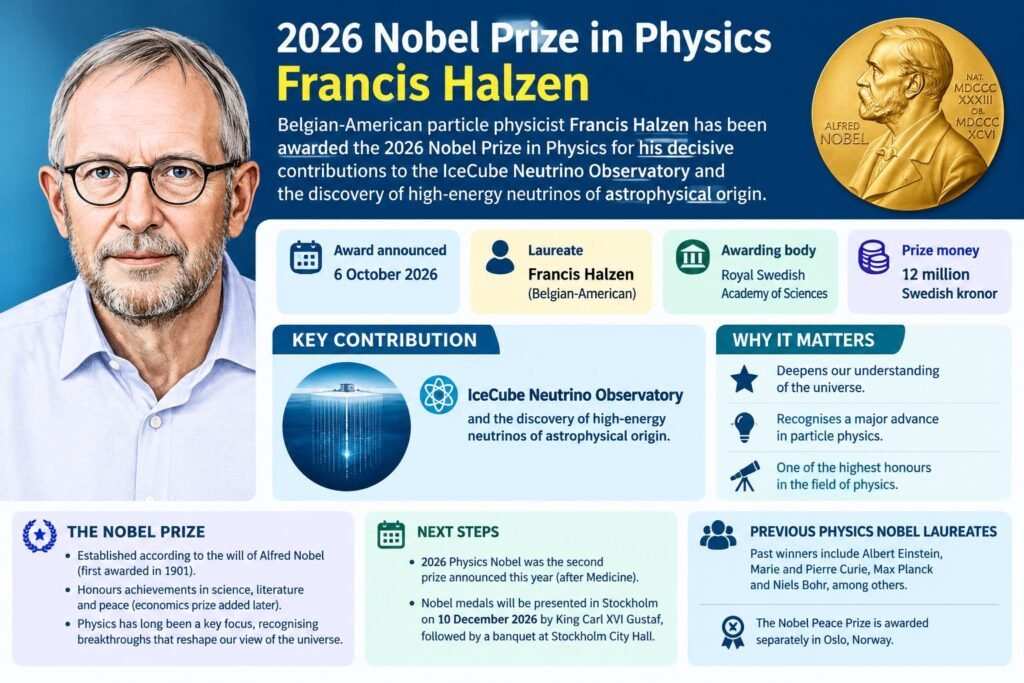
Belgian-American particle physicist Francis Halzen was awarded the 2026 Nobel Prize in Physics on 6 October 2026 for his decisive contributions to the IceCube Neutrino Observatory and the discovery of high-energy neutrinos of astrophysical origin.
The prize is awarded by the Royal Swedish Academy of Sciences and carries a total prize amount of 12 million Swedish kronor.
The Nobel Prize in Physics is one of the highest honours in the field and recognises discoveries that have significantly advanced our understanding of the physical universe.
The 2026 Physics Nobel was the second Nobel Prize announced this year, following the Nobel Prize in Physiology or Medicine. The Nobel medals will be presented in Stockholm on 10 December 2026.
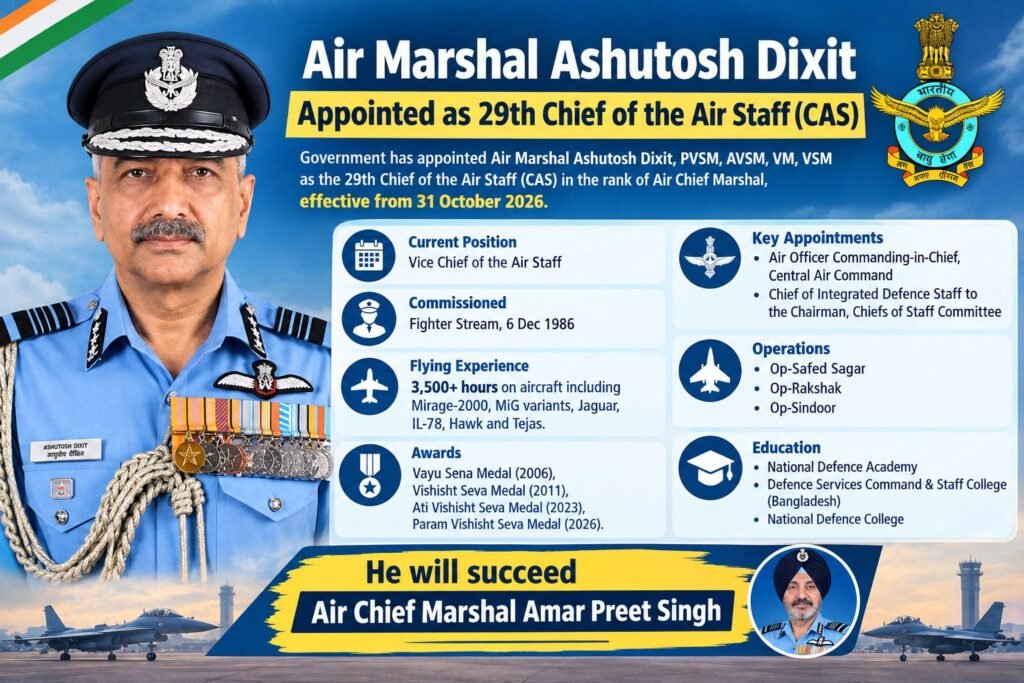
The Government has appointed Air Marshal Ashutosh Dixit as the 29th Chief of the Air Staff (CAS) in the rank of Air Chief Marshal, effective from 31 October 2026. He will succeed Air Chief Marshal Amar Preet Singh, who retires on the same day.
Air Marshal Ashutosh Dixit is currently serving as Vice Chief of the Air Staff.
He was commissioned into the Fighter Stream of the Indian Air Force in 1986.
He has over 3,500 hours of flying experience on aircraft including Mirage-2000, MiG variants, Jaguar, IL-78, Hawk and Tejas.
He has served as Air Officer Commanding-in-Chief, Central Air Command and Chief of Integrated Defence Staff to the Chairman, Chiefs of Staff Committee.
He has participated in operations including Operation Safed Sagar, Operation Rakshak and Operation Sindoor.
He has been awarded Vayu Sena Medal (2006), Vishisht Seva Medal (2011), Ati Vishisht Seva Medal (2023) and Param Vishisht Seva Medal (2026).
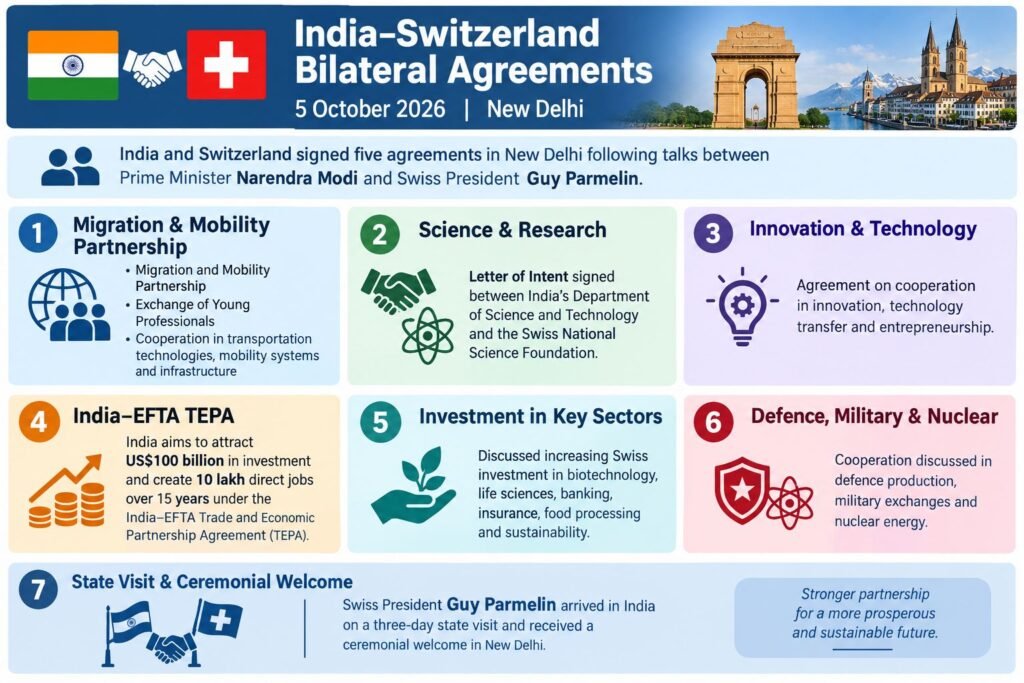
On 5 October 2026, India and Switzerland signed five agreements in New Delhi following talks between Prime Minister Narendra Modi and Swiss President Guy Parmelin.
The agreements cover Migration and Mobility Partnership, Exchange of Young Professionals, and cooperation in transportation technologies, mobility systems and infrastructure.
A Letter of Intent was signed between India’s Department of Science and Technology and the Swiss National Science Foundation.
Another agreement focuses on cooperation in innovation, technology transfer and entrepreneurship.
India highlighted the India–EFTA Trade and Economic Partnership Agreement (TEPA), under which India aims to attract US$100 billion in investment and create 10 lakh direct jobs over 15 years.
The two countries also discussed increasing Swiss investment in sectors including biotechnology, life sciences, banking, insurance, food processing and sustainability.
Cooperation was also discussed in defence production, military exchanges and nuclear energy.
Swiss President Guy Parmelin arrived in India on a three-day state visit and received a ceremonial welcome in New Delhi.
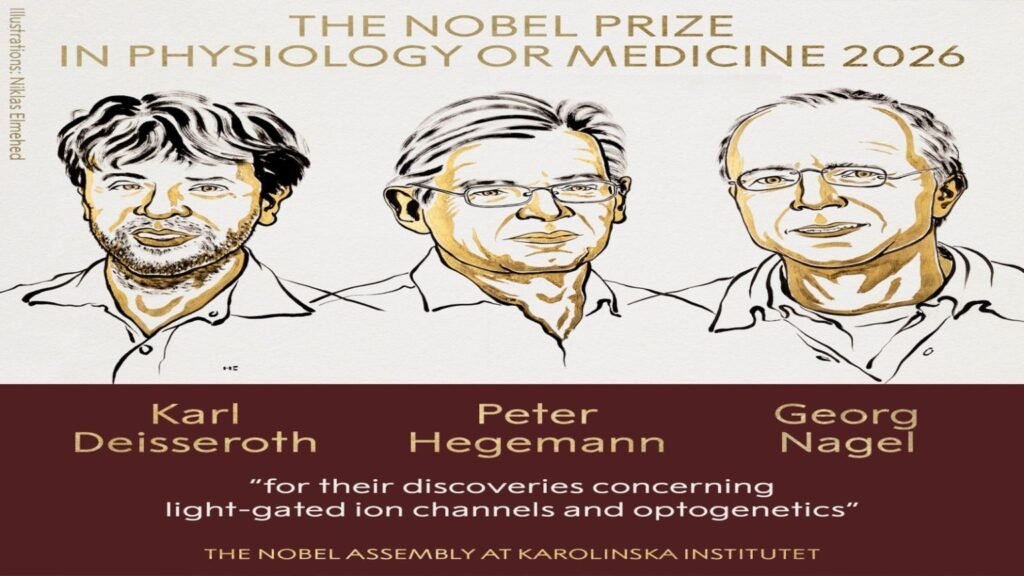
On 5 October 2026, Karl Deisseroth, Peter Hegemann and Georg Nagel were awarded the 2026 Nobel Prize in Physiology or Medicine for their discoveries related to light-gated ion channels and optogenetics.
Karl Deisseroth (USA), Peter Hegemann (Germany) and Georg Nagel (Germany) shared the prize money of 12 million Swedish kronor (about $1.2 million).
Their work led to optogenetics, a technique that uses light to control the activity of individual nerve cells in a living brain.
Optogenetics is now widely used in laboratories to study brain function and neurological processes.
The Medicine Nobel traditionally opens the annual Nobel Prize announcements.
The award is presented by the Nobel Assembly of the Karolinska Institute in Sweden.
The Nobel Prize ceremonies are held on 10 December, the anniversary of Alfred Nobel’s death.
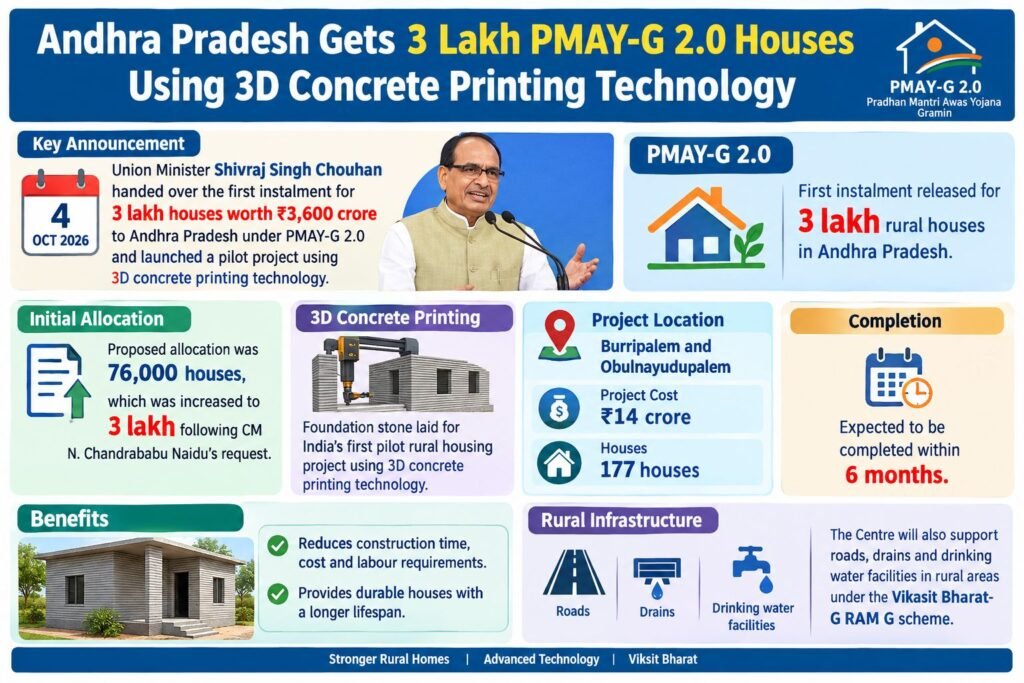
On 4 October 2026, Union Minister Shivraj Singh Chouhan handed over the first instalment for 3 lakh houses worth ₹3,600 crore to Andhra Pradesh under PMAY-G 2.0 and launched a pilot project using 3D concrete printing technology.
PMAY-G 2.0: First instalment released for 3 lakh rural houses in Andhra Pradesh.
Initial allocation: The proposed allocation was 76,000 houses, which was increased to 3 lakh following Chief Minister N. Chandrababu Naidu’s request.
3D Concrete Printing: Foundation stone laid for India’s first pilot rural housing project using 3D concrete printing.
Project Location:Burripalem and Obulnayudupalem.
Project Cost:₹14 crore.
Houses:177 houses to be constructed using advanced 3D printing technology.
Completion: The project is expected to be completed within 6 months.
Benefits: The technology is expected to reduce construction time, cost and labour requirements, while providing durable houses with a longer lifespan.
Rural Infrastructure: The Centre will also support roads, drains and drinking water facilities in rural areas under the Vikasit Bharat-G RAM G scheme.
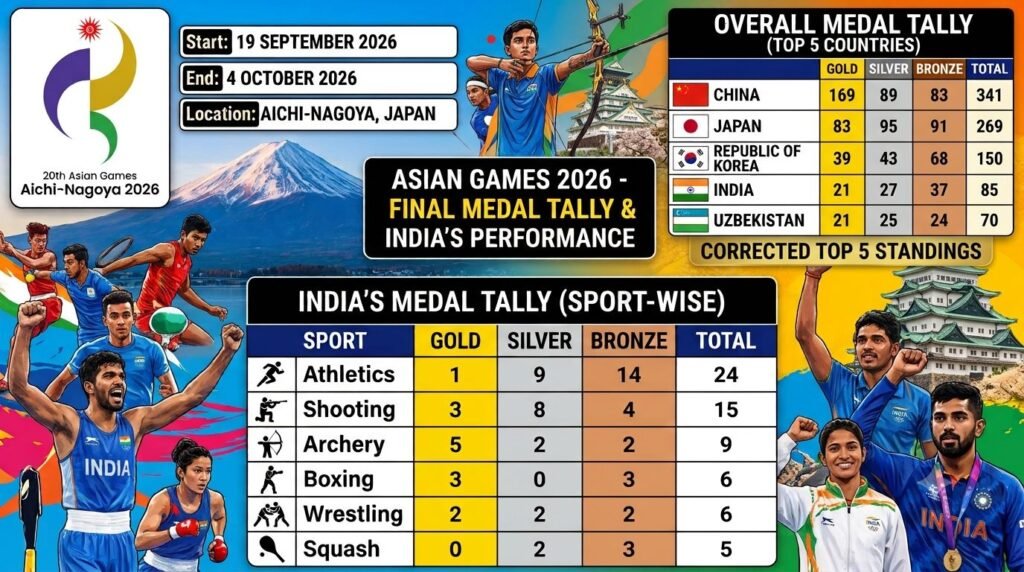
India finished the Asian Games 2026 in Aichi–Nagoya with a strong tally of 85 medals (21 Gold, 27 Silver, 37 Bronze), securing4th place overall. Top performers included historic wins in archery, golf, shooting, boxing, and team sports like cricket and hockey.
🏅 India’s Performance – Asian Games 2026
Total Medals: 85 (21 Gold, 27 Silver, 37 Bronze)
Rank: 4th place overall (behind China, Japan, South Korea; ahead of Uzbekistan & Iran)
Best-ever campaigns: Second only to Hangzhou 2023 (106 medals).
Sports with maximum impact: Athletics (24 medals), Archery (9 medals, 5 Gold), Shooting, Boxing, Hockey, Cricket.
🌟 Top Performer Players & Teams
Archery
Kumkum Mohod – First Indian woman to win individual recurve gold; also secured LA 2028 Olympic quota.
Indian Archery Teams – Swept compound team titles (men, women, mixed).
Golf
Pranavi Urs – First-ever Indian woman to win golf gold; also silver in team event with Aditi Ashok & Diksha Dagar.
Shooting
Neeru Dhanda – Historic women’s trap gold (first in 48 years) + mixed trap gold with Kynan Chenai.
Suruchi Singh & Kamaljeet – Gold in 10m air pistol mixed team with Asian record.
Boxing
Lovlina Borgohain – Won her maiden Asian Games gold in 75kg category.
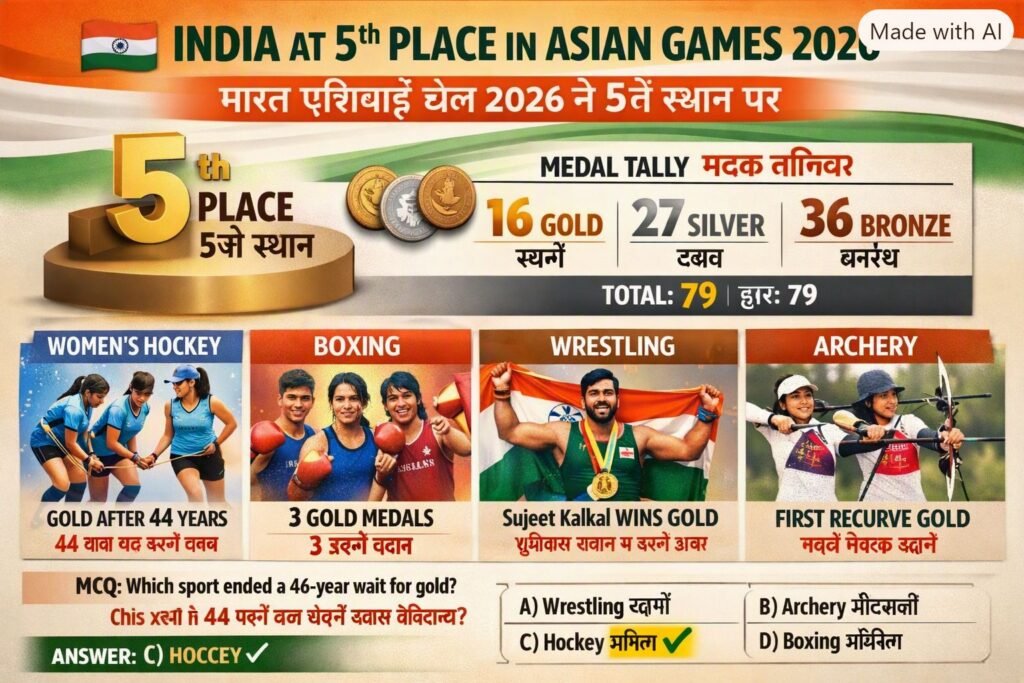
India delivered a strong performance at the Asian Games 2026, reaching 5th place with 16 gold medals and more than 75 medals overall as of 2 October 2026.
Key Highlights
Women’s Hockey: India defeated China 1–0 to win its first Asian Games gold since 1982, ending a 44-year wait and securing direct qualification for the Los Angeles 2028 Olympics.
Boxing: India won three gold medals through Lovlina Borgohain (75kg), Parveen Hooda (65kg), and Ankush Panghal (80kg), along with three bronze medals.
Wrestling:Sujeet Kalkal won gold in the men’s 65kg freestyle category after a comeback victory.
Recurve Archery: India’s women’s team of Ankita Bhakat, Kumkum Mohod and Kirti Sharma defeated South Korea to win India’s first-ever Asian Games gold in recurve archery.
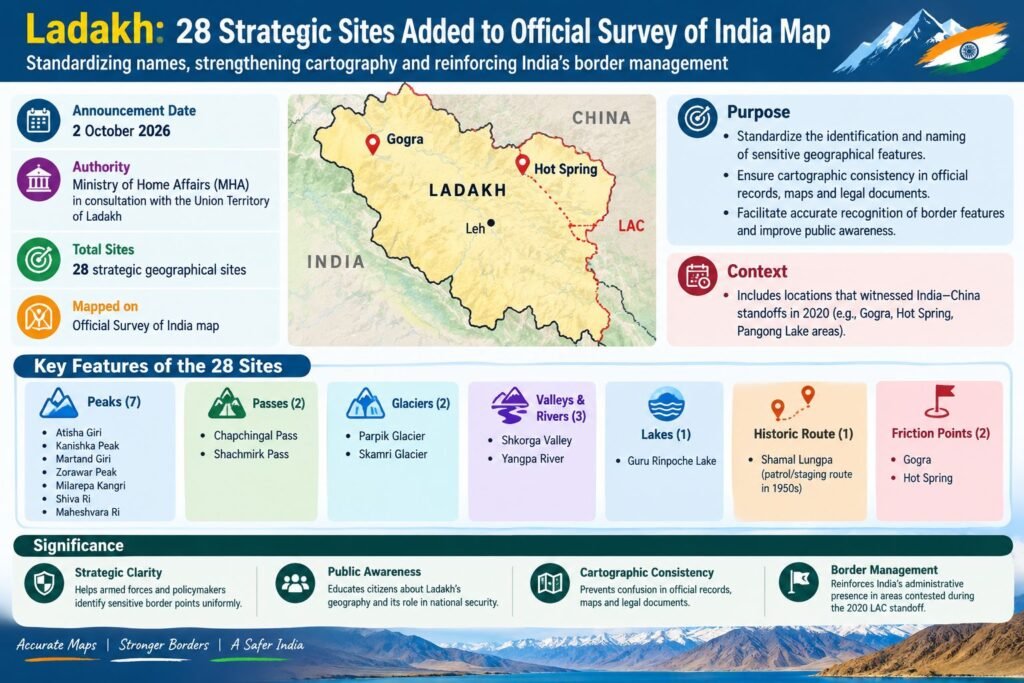
The Government of India has formally identified 28 strategic geographical sites in Ladakh on the official Survey of India map, including the LAC friction points Gogra and Hot Spring. The move aims to standardize the names of important border features and improve consistency in official mapping and border management.
Date: 2 October 2026
Authority: Ministry of Home Affairs (MHA), in consultation with the UT of Ladakh
Other features: Chapchingal Pass, Parpik Glacier, Skamri Glacier, Shkorga Valley, Yangpa River and Guru Rinpoche Lake
Historical route: Shamal Lungpa, associated with patrol/staging activities in the 1950s
The initiative is intended to promote cartographic consistency, public awareness and uniform identification of sensitive geographical locations, particularly those associated with the India–China border and the 2020 LAC tensions.
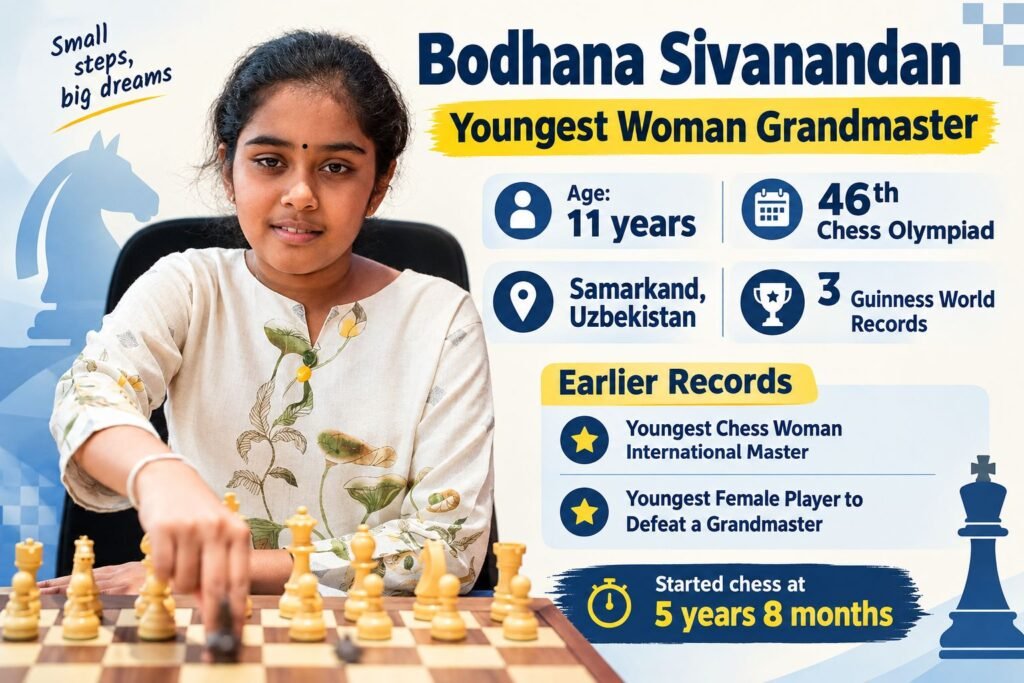
British-Indian chess prodigy Bodhana Sivanandan, an 11-year-old schoolgirl from London, has been recognised by Guinness World Records as the youngest chess player to achieve the Woman Grandmaster (WGM) title.
Achievement: Youngest player ever to earn the Woman Grandmaster (WGM) title.
Event: 46th Chess Olympiad in Samarkand, Uzbekistan.
Age: 11 years.
Guinness World Records: This is Bodhana’s third world record.
Earlier records: Youngest chess Woman International Master and youngest female player to defeat a Grandmaster in a chess tournament.
Chess journey: She began playing chess at 5 years and 8 months, inspired by her fascination with the knight chess piece.
Early success: She started winning competitions by the age of six.
Bodhana’s response: She called the recognition a great honour and a motivation to continue improving.
Guinness World Records: Editor-in-Chief Craig Glenday praised her journey as an inspiring example of childhood curiosity and passion leading to extraordinary achievements.
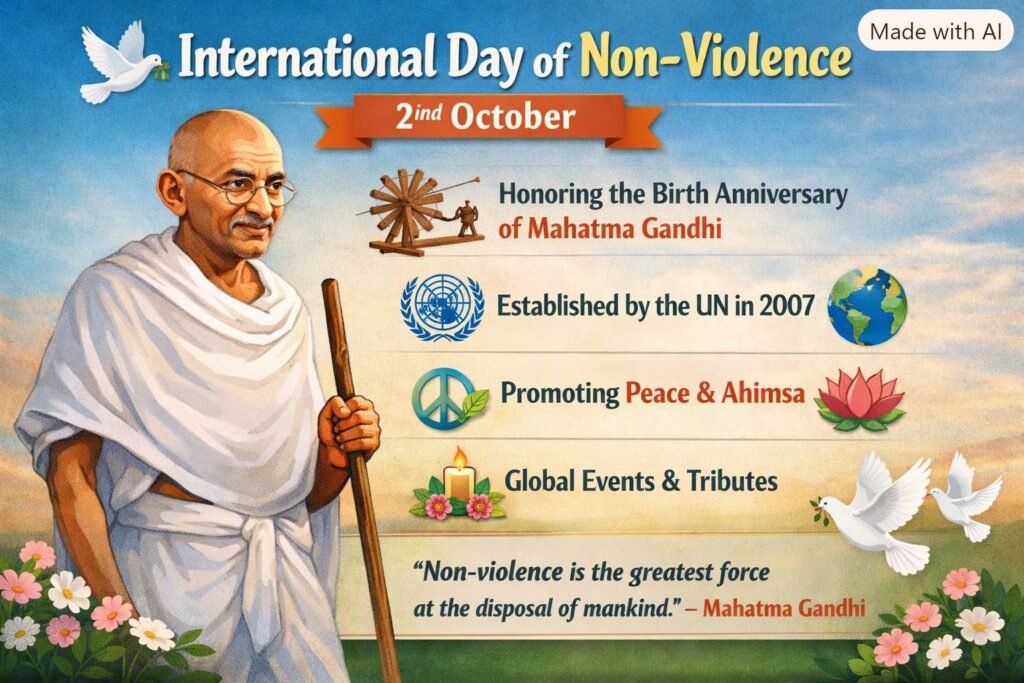
International Day of Non-Violence Observed on 2 October every year.
The United Nations General Assembly (UNGA) declared 2 October—the birth anniversary of Mahatma Gandhi—as the International Day of Non-Violence in 2007.
Aim: To spread the message of peace, tolerance, and non-violent resistance across the world.
🌍 Significance
Promotes non-violence as a universal value in resolving conflicts.
Honors Mahatma Gandhi’s philosophy of Ahimsa (non-violence) and Satyagraha (truth-force).
Encourages education and awareness about human rights, harmony, and peaceful coexistence.
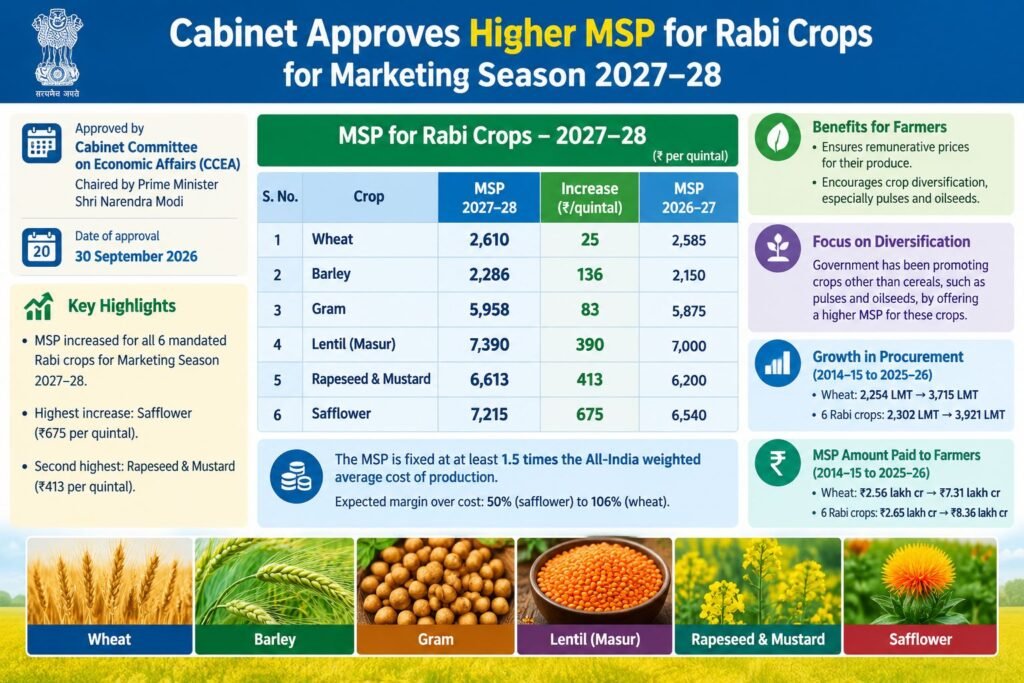
The Cabinet Committee on Economic Affairs (CCEA) approved higher Minimum Support Prices (MSP) for all six mandated Rabi crops for Marketing Season 2027–28 on 30 September 2026. The largest increase is for safflower, followed by rapeseed & mustard.
Key Points
Safflower: MSP increased by ₹675/quintal to ₹7,215.
Rapeseed & Mustard: increased by ₹413/quintal to ₹6,613.
Lentil (Masur): increased by ₹390/quintal to ₹7,390.
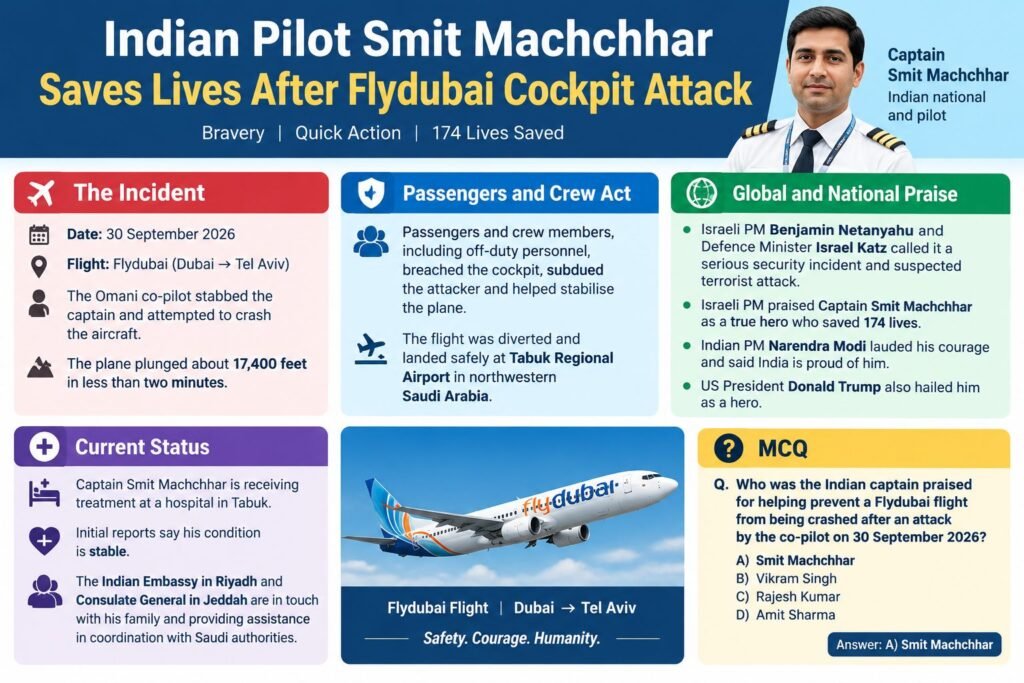
An Omani co-pilot was arrested in Saudi Arabia after allegedly stabbing the captain and attempting to crash a Flydubai flight from Dubai to Tel Aviv on 30 September 2026. The aircraft plunged about 17,400 feet in less than two minutes before passengers and crew members intervened and subdued the attacker.
The flight was diverted and landed safely at Tabuk Regional Airport, Saudi Arabia.
The incident was described by Israeli officials as a serious security incident and suspected terrorist attack.
Captain Smit Machchhar, an Indian national, was seriously injured while fighting back against the attacker and helping prevent the aircraft from crashing.
Israeli Prime Minister Benjamin Netanyahu, Indian Prime Minister Narendra Modi, and US President Donald Trump praised Captain Machchhar for his courage and credited him with helping save the lives of those on board.
Captain Machchhar is receiving treatment at a hospital in Tabuk, and initial reports said his condition was stable.
The Indian Embassy in Riyadh and Consulate General in Jeddah are in contact with his family and Saudi authorities and are providing assistance.
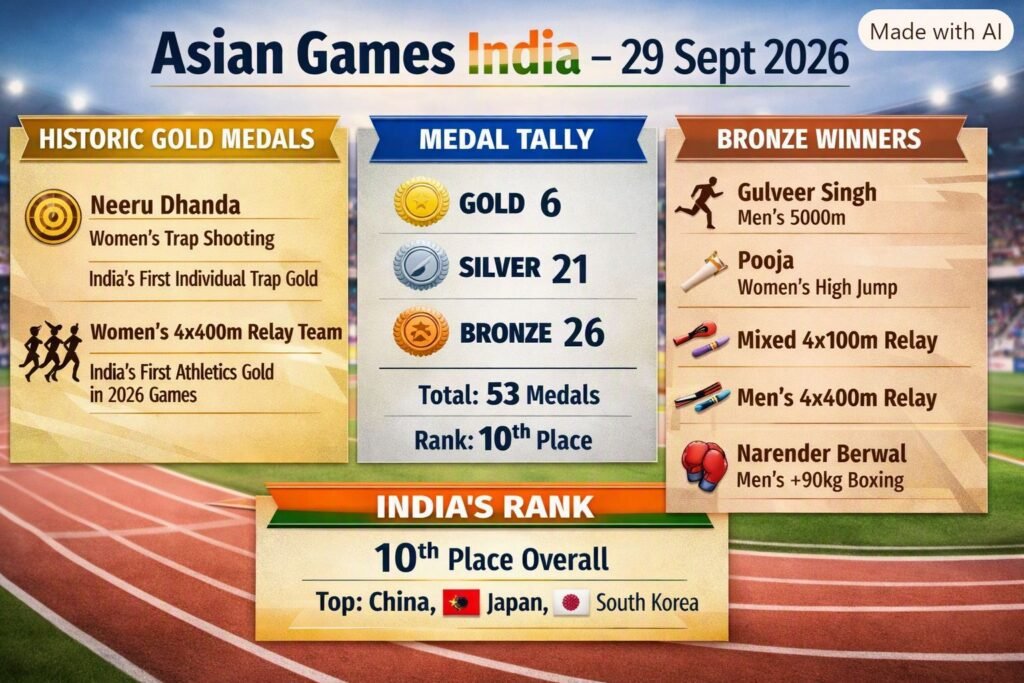
On 29 September 2026, India had a landmark day at the Asian Games in Aichi–Nagoya, winning its first athletics gold (women’s 4x400m relay) and its first individual gold in shooting (Neeru Dhanda in women’s trap). India’s overall tally rose to 53 medals (6 Gold, 21 Silver, 26 Bronze), placing the country 10th in the standings.
🥇 Key Gold Medal Wins
Neeru Dhanda (Shooting – Women’s Trap Individual)
First Indian woman to win an individual Asian Games gold in trap shooting.
Scored 28/30 hits, beating China’s Sun Yunong.
Women’s 4x400m Relay Team (Athletics)
India’s first athletics gold at the 2026 Games.
Team members: Names not fully reported yet, but performance marked a breakthrough.
🥈 Silver Medal
Women’s Trap Team (Shooting)
Neeru Dhanda, Aashima Ahlawat, Manisha Keer.
Scored 328 points, finishing behind China (346).
🥉 Bronze Medals
Athletics
Gulveer Singh – Men’s 5000m (his third medal of the Games).
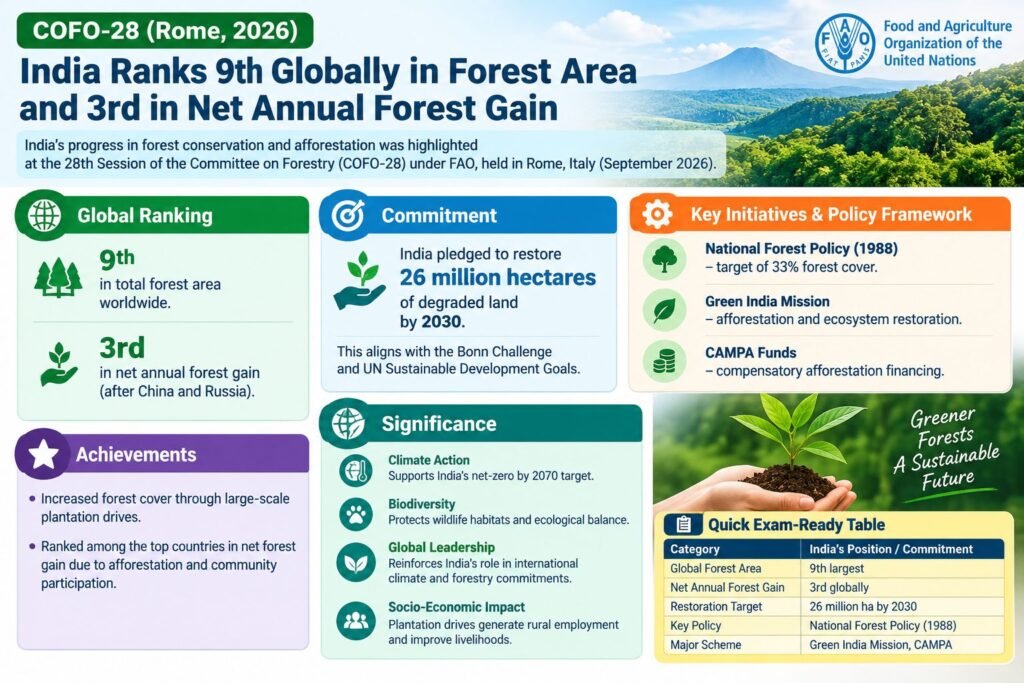
At the 28th Session of the Committee on Forestry (COFO-28) held in Rome in September 2026, India’s progress in forest conservation and afforestation was highlighted on the global platform.
India ranks 9th globally in total forest area.
India ranks 3rd globally in net annual forest gain, after China and Russia.
India has committed to restoring 26 million hectares of degraded land by 2030.
Major initiatives supporting forest restoration include the National Forest Policy 1988, Green India Mission, and CAMPA.
India’s forestry efforts contribute to climate action, biodiversity conservation, ecological restoration, and rural livelihoods.
The country’s forest and land-restoration efforts are also linked to its broader climate and sustainable-development commitments.
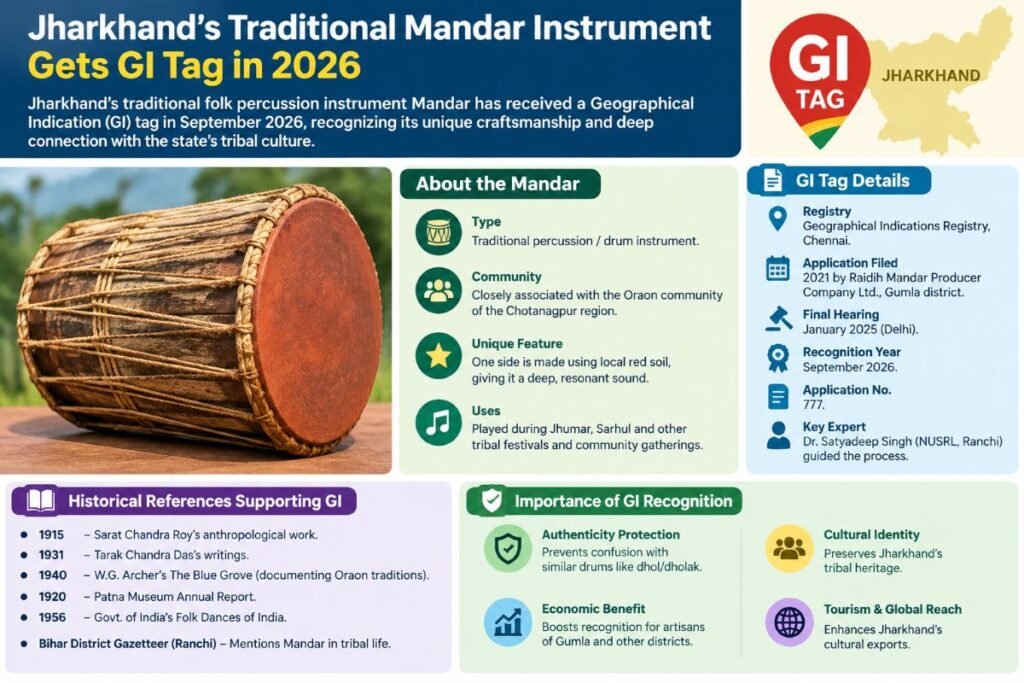
Jharkhand’s traditional folk percussion instrument Mandar received a Geographical Indication (GI) tag in September 2026, recognizing its distinctive craftsmanship and deep connection with the state’s tribal culture.
Key Points
Instrument: Traditional percussion/drum instrument of Jharkhand.
Community: Closely associated with the Oraon community of the Chotanagpur region.
Unique feature: One side is made using local red soil, giving it a distinctive deep, resonant sound.
Uses: Played during Jhumar, Sarhul and other tribal festivals and community gatherings.
GI Registry: Geographical Indications Registry, Chennai.
Application: Filed in 2021 by Raidih Mandar Producer Company Ltd., Gumla.
Application No.:777.
Importance: Protects the instrument’s authenticity, supports local artisans, preserves tribal heritage, and promotes Jharkhand’s cultural identity.
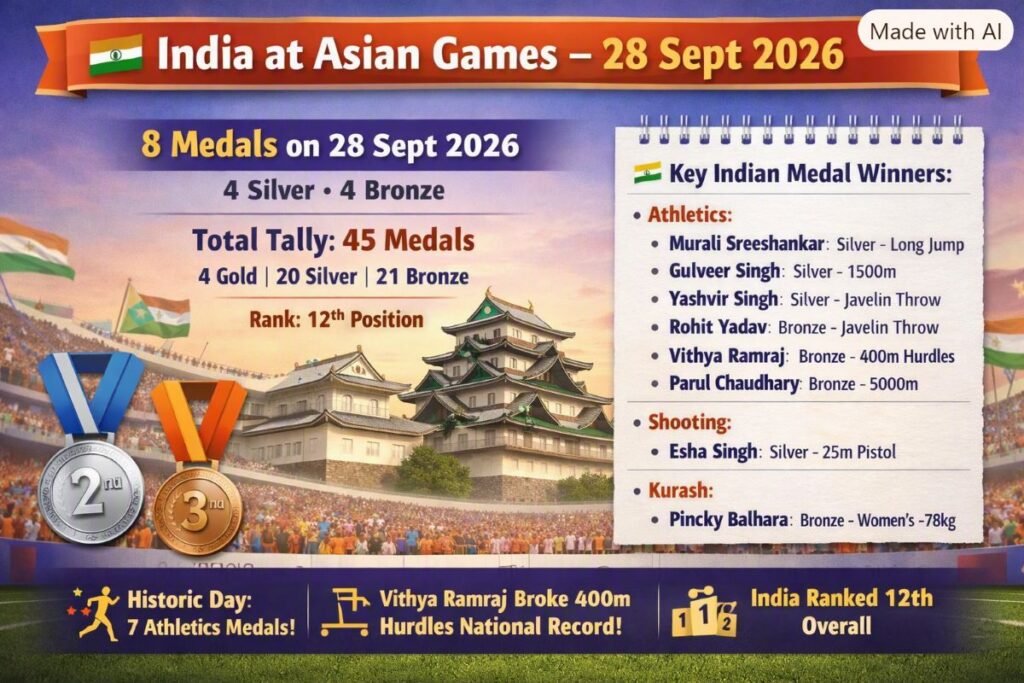
On 28 September 2026, India delivered its strongest day yet at the Asian Games in Nagoya, winning8 medals (4 Silver, 4 Bronze), with athletics contributing 7 podium finishes. The overall tally rose to 45 medals (4 Gold, 20 Silver, 21 Bronze), placing India at 12th position in the standings.
🏅 India’s Medal Wins on 28 Sept 2026
Athletics (Track & Field)
Murali Sreeshankar – Silver in Men’s Long Jump (8.07m).
Gulveer Singh – Silver in Men’s 1500m (3:36.72, his 2nd medal after 10,000m silver).
Yashvir Singh – Silver in Men’s Javelin Throw (85.72m, personal best).
Rohit Yadav – Bronze in Men’s Javelin Throw (84.35m).
Vithya Ramraj – Bronze in Women’s 400m Hurdles (54.75s, broke PT Usha’s 42-year-old national record).
Parul Chaudhary – Bronze in Women’s 5000m (15:14.61, her 2nd medal after steeplechase bronze).
Athletics contributed 7 medals in one day, a record surge for India.
Shooting
Esha Singh – Silver in Women’s 25m Pistol (equalled Games record with 38 hits, lost gold in shoot-off).
Martial Arts (Kurash)
Pincky Balhara – Bronze in Women’s -78kg Kurash (her 2nd Asian Games medal after 2018 silver).
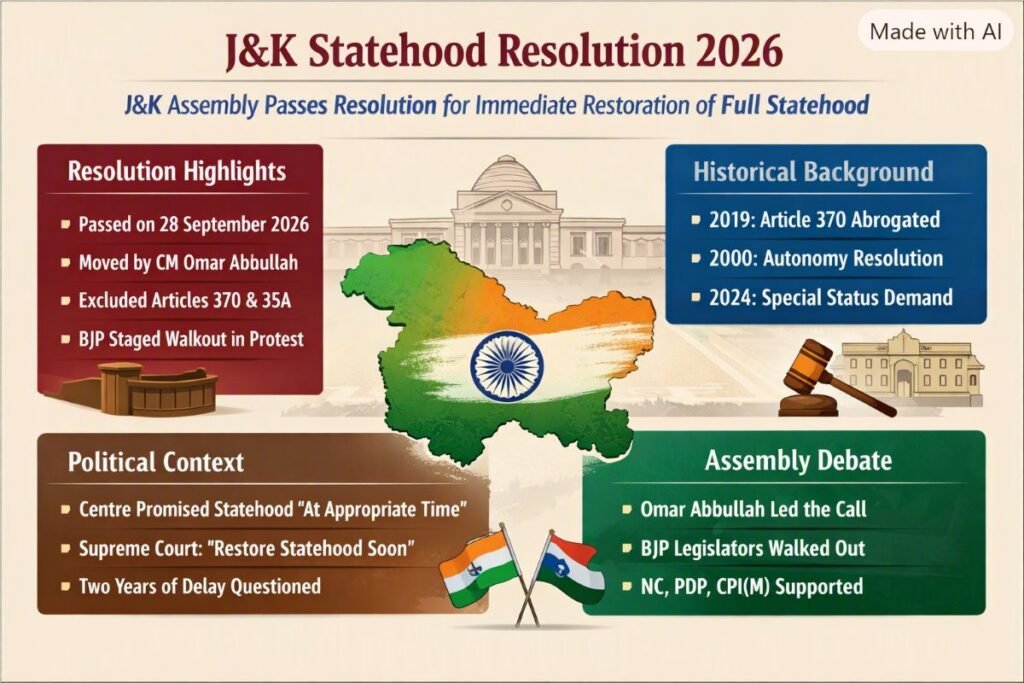
On 28 September 2026, the Jammu & Kashmir Legislative Assembly adopted a resolution demanding the urgent restoration of full statehood. The resolution, moved by Chief Minister Omar Abdullah, was passed by voice vote amid protests and a walkout by BJP legislators.
🔑 Key Points
Mover: CM Omar Abdullah
Adoption: Voice vote, despite BJP opposition
Scope: Calls for full statehood restoration only
Exclusions: No mention of Articles 370 & 35A (to avoid derailment)
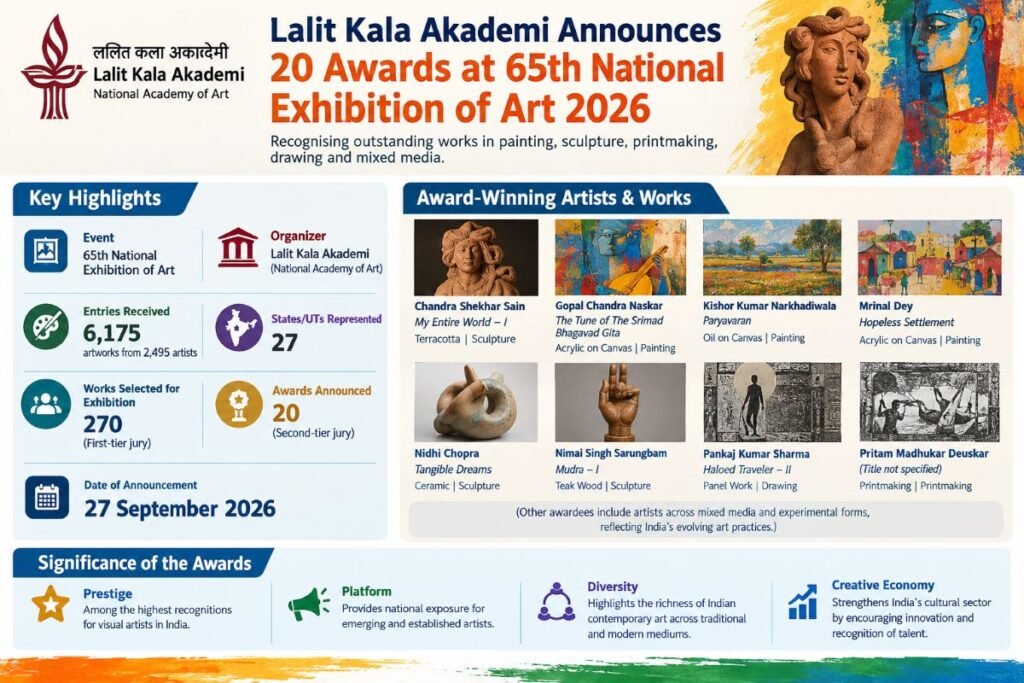
The Lalit Kala Akademi has announced 20 awards at the65th National Exhibition of Art (2026), selecting winners from over 6,175 entries by 2,495 artists across 27 states and UTs. The awards span painting, sculpture, printmaking, drawing, and mixed media, showcasing the diversity of contemporary Indian art.
🎨 Key Highlights of the 65th National Exhibition of Art
Event: 65th National Exhibition of Art
Organizer: Lalit Kala Akademi (National Academy of Art)
Entries Received: 6,175 artworks from 2,495 artists
States/UTs Represented: 27
Works Selected for Exhibition: 270 (First-tier jury)
Awards Announced: 20 (Second-tier jury)
Date of Announcement: 27 September 2026
🏆 Award-Winning Artists & Works
The Lalit Kala Akademi Awards are among the highest recognitions for visual artists in India.
Artist
Artwork
Medium
Category
Chandra Shekhar Sain
My Entire World – I
Terracotta
Sculpture
Gopal Chandra Naskar
The Tune of The Srimad Bhagavad Gita
Acrylic on Canvas
Painting
Kishor Kumar Narkhadiwala
Paryavaran
Oil on Canvas
Painting
Mrinal Dey
Hopeless Settlement
Acrylic on Canvas
Painting
Nidhi Chopra
Tangible Dreams
Ceramic
Sculpture
Nimai Singh Sarungbam
Mudra – I
Teak Wood
Sculpture
Pankaj Kumar Sharma
Haloed Traveler – II
Panel Work
Drawing
Pritam Madhukar Deuskar
(Title not specified)
Printmaking
Printmaking
(Other awardees include artists across mixed media and experimental forms, reflecting India’s evolving art practices.)
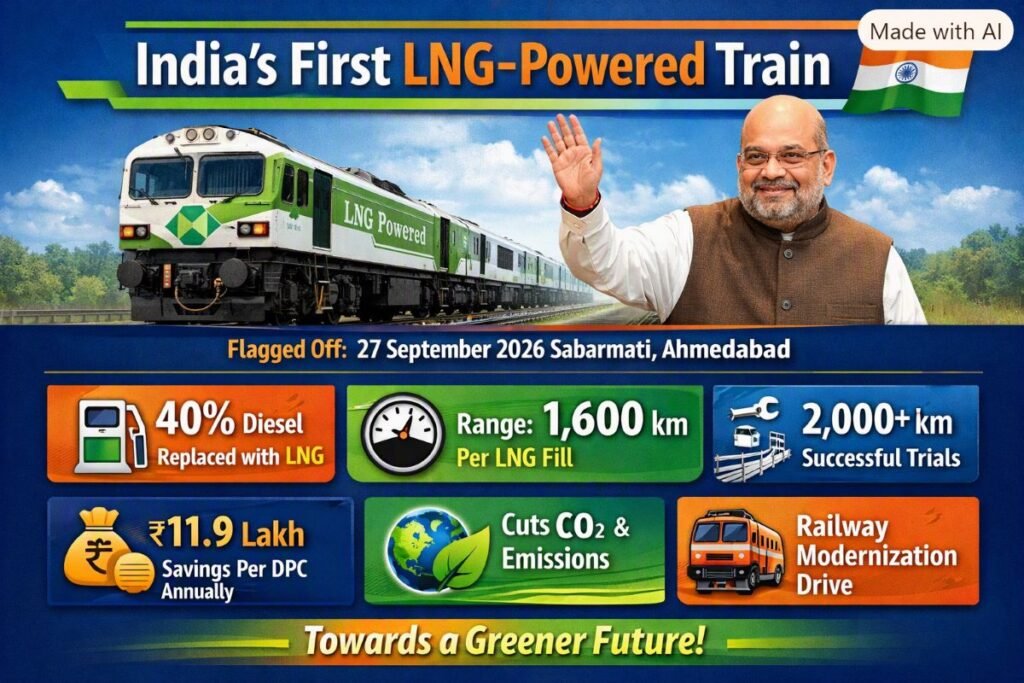
India’s first LNG-powered train was flagged off on 27 September 2026 from Sabarmati Railway Station, Ahmedabad, by Union Home Minister Amit Shah. It uses a diesel–LNG dual-fuel system, replacing up to 40% of diesel consumption, cutting costs and emissions while marking a major step in India’s green railway transition.
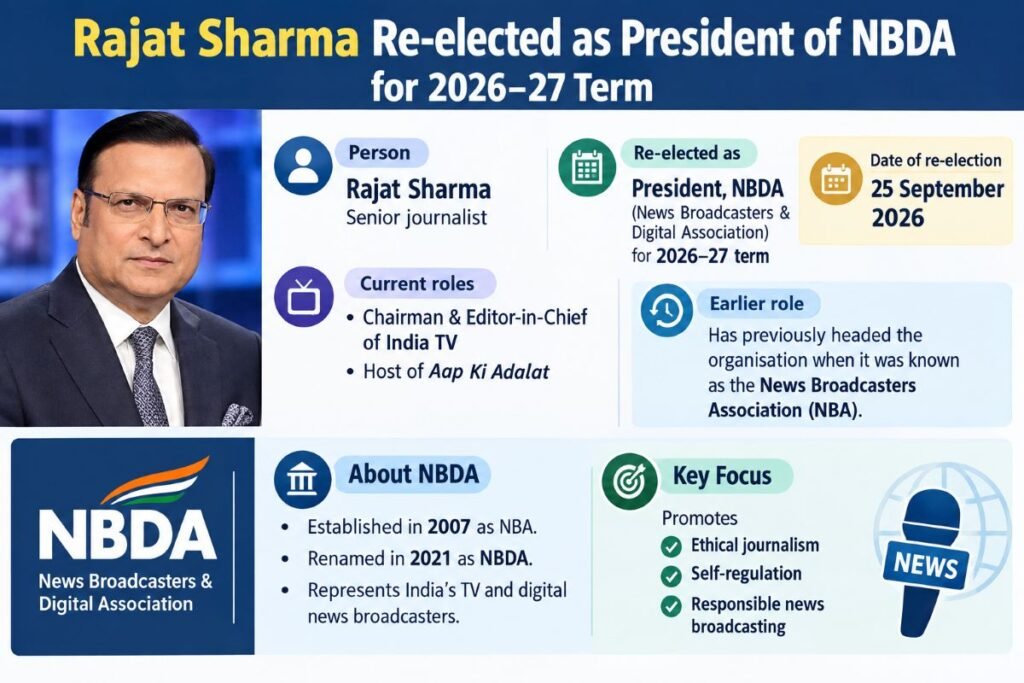
Senior journalist Rajat Sharma has been unanimously re-elected as the President of the News Broadcasters & Digital Association (NBDA) for the 2026–27 term on 25 September 2026. Sharma, Chairman and Editor-in-Chief of India TV and host of Aap Ki Adalat, has previously headed the organisation when it was known as the News Broadcasters Association (NBA).
The NBDA, established in 2007 as NBA and renamed in 2021, represents India’s TV and digital news broadcasters and promotes ethical journalism, self-regulation and responsible news broadcasting.
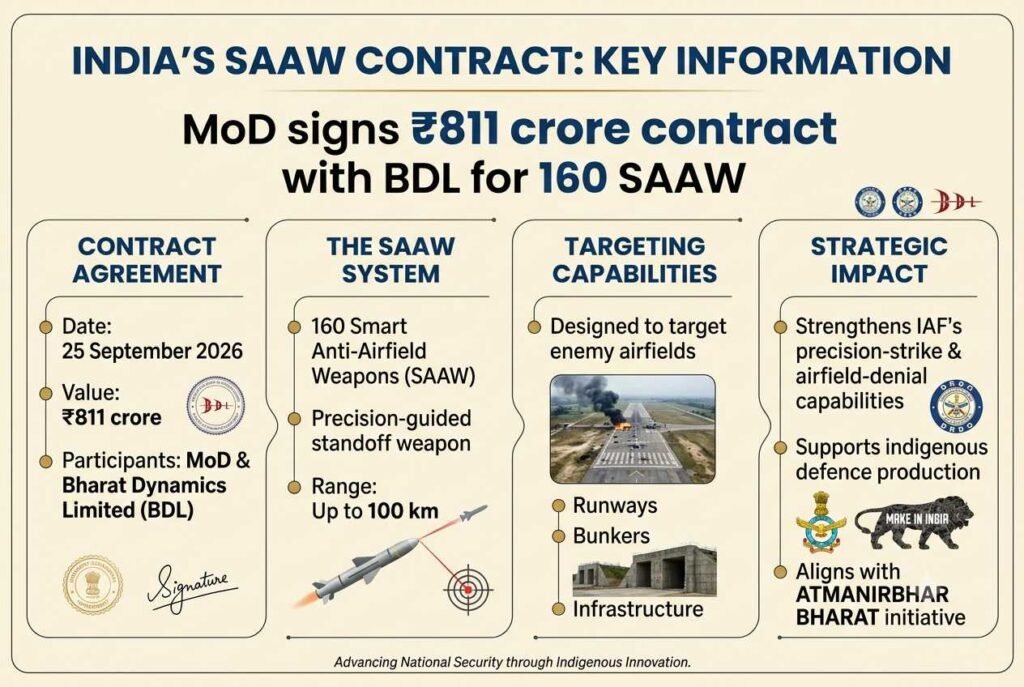
The Ministry of Defence (MoD) signed a ₹811 crore contract with Bharat Dynamics Limited (BDL) on 25 September 2026 for the supply of 160 Smart Anti-Airfield Weapons (SAAW) to the Indian Air Force (IAF).
The SAAW, developed by DRDO and manufactured by BDL, is a precision-guided standoff weapon with a range of up to 100 km, designed to target enemy airfield runways, bunkers and other infrastructure. The procurement will strengthen the IAF’s precision-strike and airfield-denial capabilities while supporting indigenous defence production under Atmanirbhar Bharat.
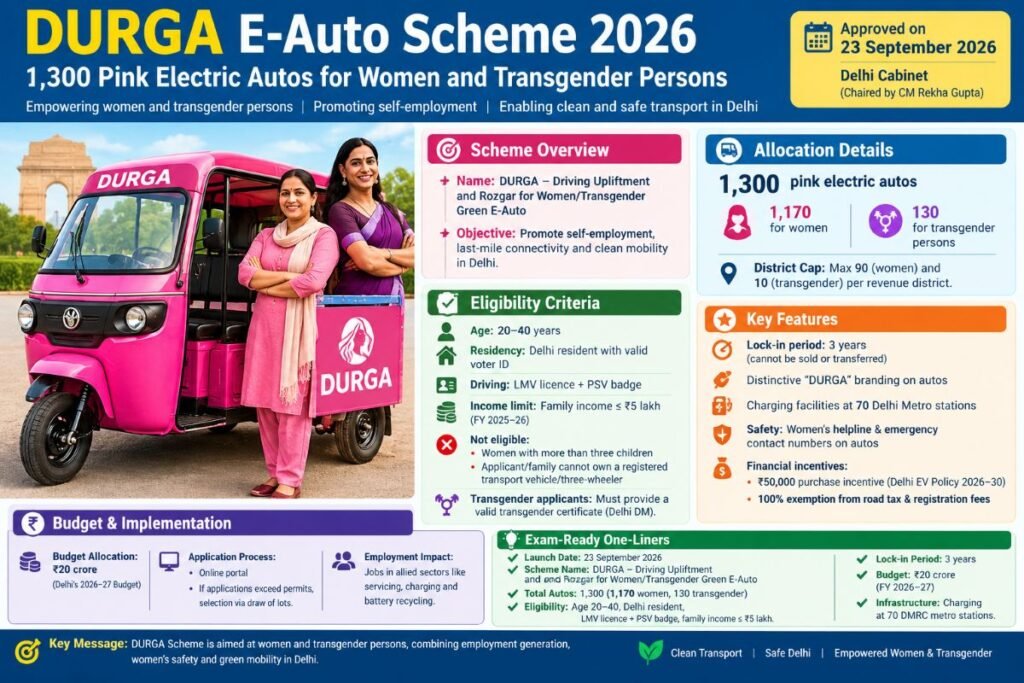
The Delhi Cabinet approved the DURGA (Driving Upliftment and Rozgar for Women/Transgender Green E-Auto) Scheme on 23 September 2026 to promote self-employment among women and transgender persons while encouraging clean and safe urban transport.
Total e-autos: 1,300 pink electric autos
1,170 for women
130 for transgender persons
Eligibility: Delhi residents aged 20–40 years, with LMV licence and PSV badge.
Income limit: Family income up to ₹5 lakh in FY 2025–26.
Budget:₹20 crore for 2026–27.
Lock-in period:3 years.
EV benefits: ₹50,000 purchase incentive and 100% exemption from road tax and registration fees.
Charging infrastructure: Facilities at 70 Delhi Metro stations.
Selection: Applications will be submitted online; if applications exceed available permits, selection will be through a draw of lots.
India has chosen the Marathi filmGondhal as its official entry for the Academy Awards (Oscars) 2027 in the Best International Feature Film category. This marks a proud moment for Marathi cinema, highlighting its growing global recognition.
📌 Key Highlights
Film:Gondhal (Marathi)
Category: Best International Feature Film (Oscars 2027)
Significance: Represents India on the world stage at the Academy Awards.
Impact: Strengthens regional cinema’s presence in global film circuits.
🏆 About the Selection
The Film Federation of India (FFI) annually selects one film to represent India at the Oscars.
Gondhal was chosen for its unique storytelling, cultural depth, and cinematic excellence.
The film showcases the richness of Marathi traditions while addressing universal themes, making it relatable to international audiences.
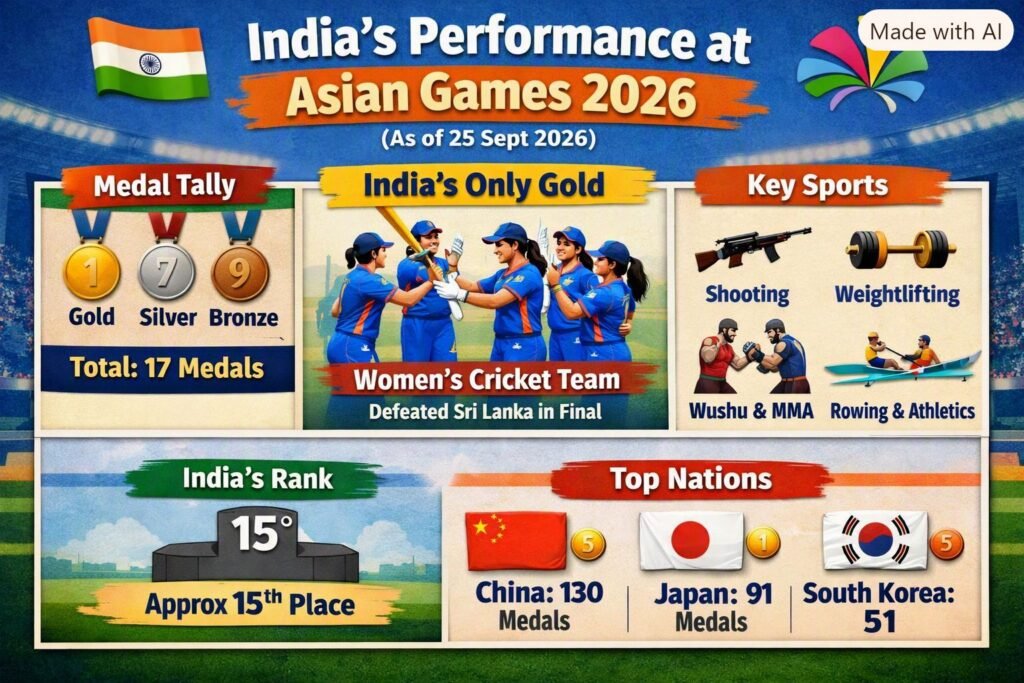
India has won 17 medals so far at the Asian Games 2026 (Aichi–Nagoya, Japan), including 1 Gold, 7 Silver, and 9 Bronze, placing the country around 15th in the medal standings. The women’s cricket team secured India’s only gold, while shooting, athletics, wushu, and rowing have contributed heavily to the tally.
🇮🇳 India’s Medal Tally (as of 25 Sept 2026)
Medal Type
Count
Key Events
🥇 Gold
1
Women’s Cricket (defeated Sri Lanka in final)
🥈 Silver
7
Shooting (Elavenil Valarivan – individual & team 10m air rifle; Himanshu Dhillon – 10m air rifle; Men’s team 10m air rifle), Weightlifting (Mirabai Chanu – 49kg), Wushu (Roshibina Devi – 60kg sanda), Athletics (Mixed 4x400m relay)